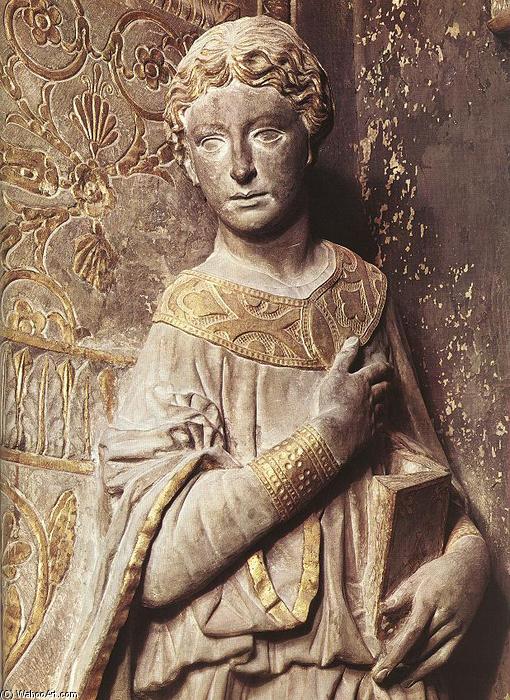
The Genesis of a Vision: Donatello’s Annunciation
Donatello's "Annunciation," specifically this exquisite detail from the relief adorning the Cavalcanti Chapel in Santa Croce, Florence, stands as a pivotal moment in the burgeoning Renaissance. Crafted around 1435, it represents more than just a biblical narrative; it’s a profound exploration of human emotion and a masterful synthesis of classical ideals with emerging humanist sensibilities. Donatello, already a rising star after his time in Rome, was pushing boundaries, moving beyond the stylized formality of the International Gothic style towards a greater emphasis on naturalism, dynamism, and psychological depth – qualities that would define the Florentine Renaissance itself. This particular panel captures a crucial juncture: the moment of revelation, the silent exchange between the Archangel Gabriel and the Virgin Mary, pregnant with the promise of divine intervention.

Sculpting Emotion: Technique and Material
Donatello’s genius lies not just in his subject matter but also in the remarkably expressive execution. Carved from *pietra serena*, a durable, fine-grained marble prized for its ability to hold detail, the relief is imbued with an astonishing sense of immediacy. The artist employed a technique known as “bassorilievo,” creating figures that recede slightly from the background plane, lending them a tangible presence and inviting the viewer into the scene. Note the subtle shifts in posture – Mary’s slight inclination towards Gabriel, her hand raised in a gesture of receptive humility; Gabriel's alert stance, conveying urgency and divine authority. The use of gold highlights, particularly noticeable upon restoration, adds to the work’s opulence and emphasizes the sacred nature of the event. The meticulous detailing of their garments—the flowing robes, the delicate folds—demonstrates Donatello’s mastery of form and his ability to capture the texture and weight of fabric with remarkable precision.
- Pietra Serena Marble: Chosen for its durability and capacity for fine detail.
- Bassorilievo Technique: Creates a sense of depth and immediacy, drawing the viewer into the scene.
- Gold Highlights: Accentuate the sacredness of the event and add to the work’s visual richness.
Symbolism and Narrative Resonance
Beyond its literal depiction of the Annunciation, the panel is rich in symbolic meaning. The setting within a *ædicula*, or small shrine-like enclosure, immediately elevates the scene to a realm of sacred contemplation. The figures themselves are imbued with classical references – Mary’s head echoes the idealized forms of Greek sculpture, suggesting her purity and divine grace. The putti (cherubic angels) flanking the central figures represent innocence and joy, symbolizing the hope associated with the birth of Christ. The overall composition is carefully balanced, reflecting a harmonious order that reflects Renaissance ideals of beauty and proportion. The inclusion of the Cavalcanti family’s name on the base underscores the work's commission by a prominent Florentine family, highlighting its significance within the city’s cultural landscape.
A Legacy of Innovation
Donatello’s “Annunciation” is more than just a beautiful artwork; it’s a landmark achievement in Renaissance sculpture. It represents a decisive break from the conventions of previous generations and established new standards for naturalism, emotional expression, and technical virtuosity. His willingness to experiment with form, texture, and composition paved the way for subsequent artists like Michelangelo and Raphael, shaping the course of Western art history. Reproductions of this masterpiece offer a tangible connection to one of the most transformative periods in artistic innovation – a chance to experience the profound beauty and intellectual depth of Donatello’s vision.