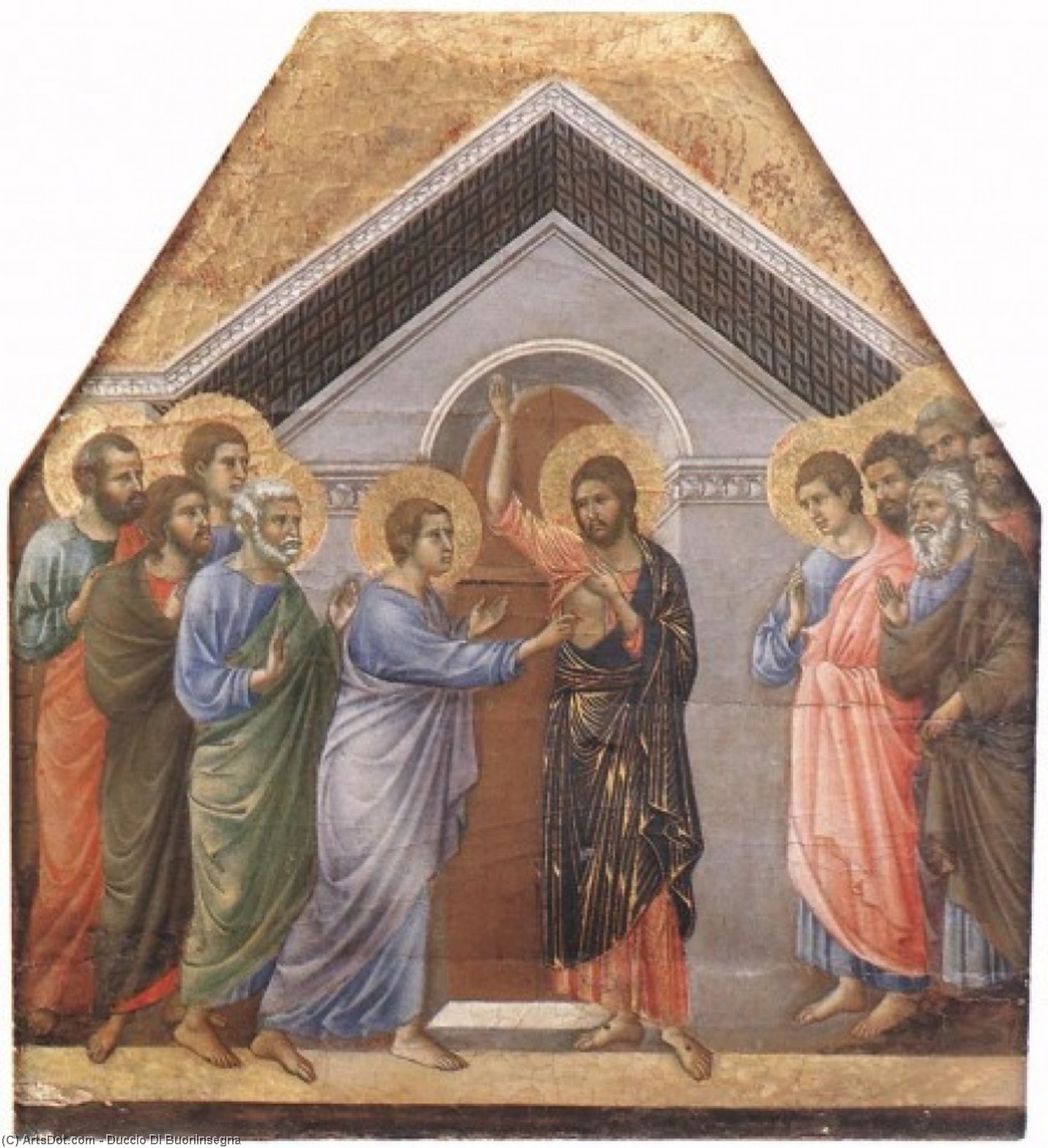
Doubting Thomas: A Meditation on Faith and Doubt in Early Renaissance Siena
Duccio di Buoninsegna’s “Doubting Thomas,” painted in 1308, transcends mere visual representation; it embodies the profound intellectual and spiritual currents of its time—the dawn of a new Italian artistic vision. Located within the Museo dell'Opera del Duomo in Siena, Italy, this tempera panel stands as an emblem of Sienese art’s ambition to grapple with complex theological questions alongside masterful craftsmanship.
- Subject Matter: The painting depicts the iconic biblical episode wherein Jesus appears to Thomas Aquinas, one of his apostles, after his resurrection. Thomas, skeptical and unconvinced by the testimony of his fellow disciples, demands tangible proof of Christ’s divinity—a touch upon his wounds—challenging the very foundations of Christian belief.
- Style: Buoninsegna's work firmly establishes itself within the Gothic International style, a transitional phase between Byzantine grandeur and the burgeoning naturalism of Florentine art. While retaining Byzantine influences in its compositional structure and flattened perspective, “Doubting Thomas” demonstrates an unprecedented sensitivity to human emotion and psychological nuance.
- Technique: Executed in tempera—a medium favored by Buoninsegna for its luminosity and ability to achieve subtle gradations of color—the painting showcases remarkable attention to detail. The artist skillfully employs layering techniques, creating a textured surface that enhances the visual impact of the scene.
- Historical Context: Siena during the early fourteenth century was a bastion of papal authority and religious fervor. Buoninsegna’s artistic endeavors were deeply intertwined with the theological debates surrounding papal infallibility and the interpretation of scripture. The painting reflects this intellectual climate, prompting viewers to contemplate questions of faith and doubt.
The composition itself is deliberately balanced, mirroring the harmonious ideals of medieval art. Jesus and Thomas occupy opposing positions within the frame, their gaze locked in a silent exchange that speaks volumes about the struggle between skepticism and conviction. Surrounding them are figures representing Mary Magdalene and Nicodemus—witnesses to Christ’s resurrection—further enriching the narrative tapestry.
Beyond its technical prowess, “Doubting Thomas” resonates with viewers on an emotional level. The artist's masterful portrayal of Thomas’s furrowed brow and questioning eyes captures the vulnerability inherent in confronting existential uncertainties. It is a poignant reminder that faith isn’t merely acceptance of dogma but rather a courageous embrace of doubt—a willingness to grapple with unanswered questions and to seek truth beyond mere sensory experience.
- Symbolism: The wounds on Jesus's body serve as potent symbols of sacrifice and redemption, representing Christ’s suffering for humanity’s salvation. Thomas’s touch signifies the triumph of faith over doubt—the affirmation that divine revelation can penetrate even the most hardened skepticism.
Duccio di Buoninsegna's legacy extends far beyond his individual paintings; he fundamentally reshaped Sienese artistic sensibilities and paved the way for subsequent generations of artists. “Doubting Thomas” remains a testament to his genius—a masterpiece that continues to inspire contemplation and provoke dialogue about the enduring questions of faith, doubt, and human experience.