A Vision of Royal Authority: Solomon in the Siena School
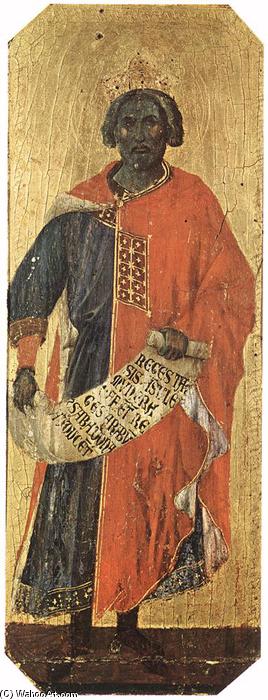
Duccio’s “Solomon,” painted around 1308, is more than a portrait; it's a carefully constructed meditation on power, wisdom, and divine authority. Executed during a pivotal moment in Italian art – the transition from Byzantine formality to burgeoning naturalism – this work exemplifies the Sienese school’s innovative approach to religious iconography. The painting immediately commands attention with its bold composition: Solomon stands as a figure of imposing dignity, his red robe shimmering with gold trim, a potent symbol of wealth and royal status. The carefully rendered scepter and scroll aren't merely props; they represent the tools of his wisdom and governance, reinforcing his role as a divinely appointed king.

The background, a deliberate wash of yellow, isn’t merely decorative; it serves to dramatically elevate Solomon, creating a halo-like effect that emphasizes his importance and links him directly to the divine. The platform upon which he stands further reinforces this sense of elevated status, echoing the architectural grandeur often found in Byzantine art – a subtle nod to the artistic traditions Duccio was both building upon and transforming.
The Dawn of Naturalism: A Shift in Artistic Vision
Duccio di Buoninsegna’s “Solomon” represents a crucial step in the evolution of Italian painting. While deeply rooted in Byzantine conventions – evident in the stylized rendering of Solomon's features and the use of gold leaf – Duccio subtly introduces elements that foreshadow the naturalism championed by artists like Giotto. Notice how the folds of his robe are rendered with a newfound sense of volume, suggesting three-dimensionality rather than simply flat surface decoration. This is not yet fully realized naturalism, but it’s a significant departure from the rigid formality of earlier works, signaling a growing interest in representing human form and emotion with greater accuracy.
The painting's creation coincided with a period of intense religious fervor within Siena. Duccio was commissioned to create this piece for the high altar of Siena Cathedral, reflecting the city’s deep devotion to its patron saint, Catherine. This context informs our understanding of the work – it is not simply a depiction of a biblical king, but a powerful expression of faith and civic pride.
Craftsmanship & Technique: The Legacy of Sienese Painting
Duccio’s mastery of tempera paint is immediately apparent. The vibrant colors, achieved through meticulous layering of pigments, retain their brilliance even today. The use of gold leaf, a hallmark of Sienese art, adds an ethereal quality to the scene, further enhancing Solomon's regal presence. Duccio was renowned for his ability to create incredibly detailed and luminous surfaces – a testament to his technical skill and artistic vision.
The painting’s construction involved painstaking detail: the intricate folds of fabric, the delicate rendering of the scepter and scroll, and the subtle modeling of Solomon's face all demonstrate Duccio’s dedication to achieving realism. This level of craftsmanship was highly valued in Siena, where art played a central role in civic life.
Symbolism & Spiritual Resonance
Beyond its aesthetic qualities, “Solomon” is rich in symbolic meaning. Solomon is traditionally associated with wisdom and justice – qualities that were highly prized by the medieval Church. The book or scroll he holds represents his knowledge and divine guidance, while the scepter symbolizes his authority as a ruler. The overall composition evokes a sense of solemnity and reverence, inviting contemplation on themes of leadership, faith, and the relationship between humanity and the divine.
This reproduction offers a unique opportunity to own a piece of art history – a window into the artistic innovations of the Sienese school and a testament to Duccio di Buoninsegna’s genius. Its enduring appeal lies not only in its beauty but also in its profound spiritual resonance.