A Moment Frozen in Time: Edmund Blair Leighton’s “Off”
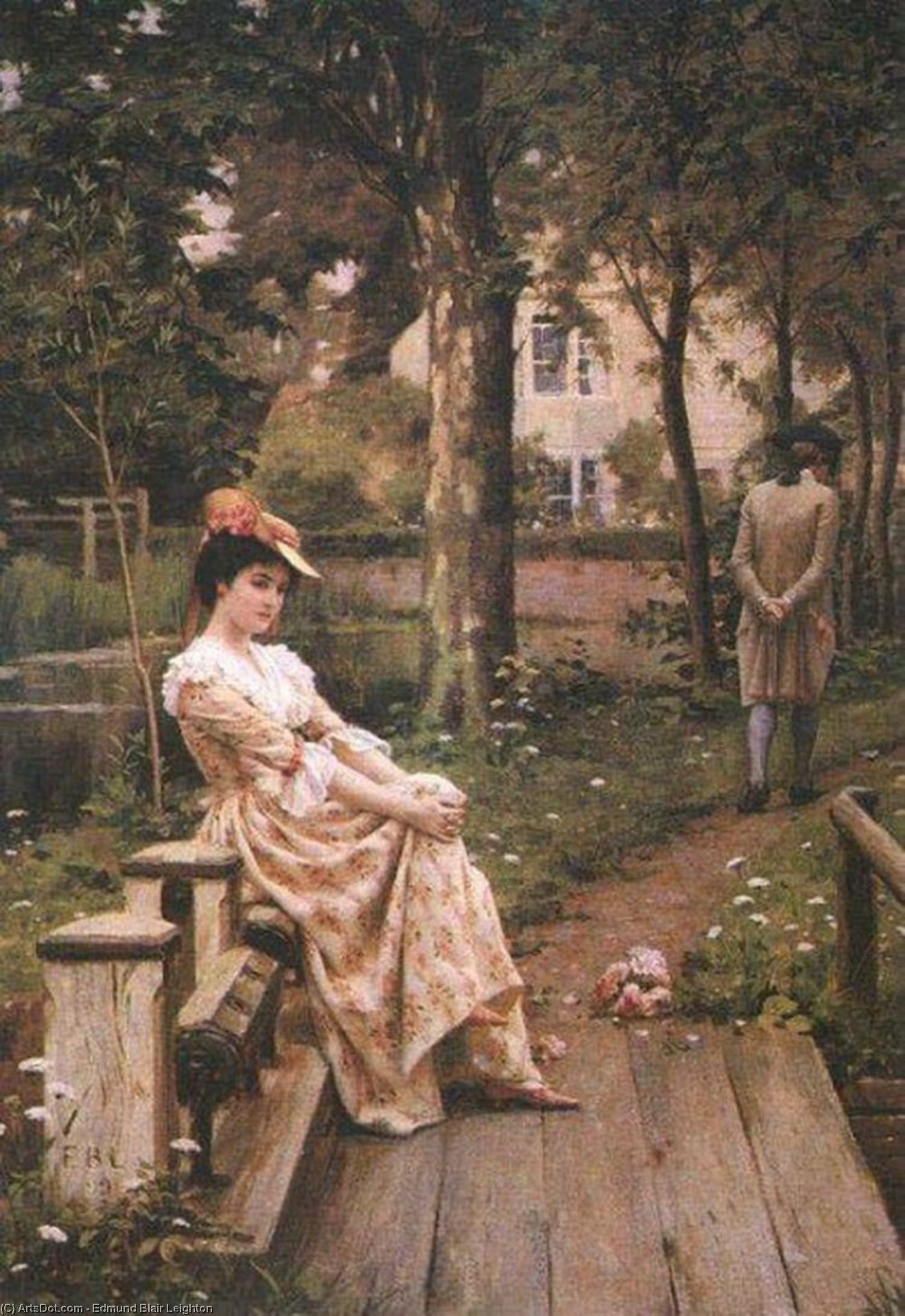
Edmund Blair Leighton's "Off," painted in 1899, isn't merely a depiction of a pastoral scene; it’s a meticulously crafted tableau vivant—a staged moment plucked from the realm of romantic legend and Victorian sensibilities. The painting immediately draws the eye with its muted palette of greens, browns, creams, and subtle pinks, evoking an overcast afternoon bathed in diffused light. This deliberate restraint allows the figures to emerge from the landscape, their forms rendered with a delicate realism that speaks volumes about Leighton’s painstaking attention to detail. The composition is remarkably balanced, guiding the viewer's gaze across the wooden bridge towards the approaching man, creating a palpable sense of anticipation and unspoken narrative.
A Pre-Raphaelite Vision: Style and Technique
Leighton’s style firmly aligns with the late 19th-century academic painting tradition, yet he possesses a uniquely evocative quality. He masterfully employs oil paint in visible brushstrokes—a technique that lends texture and depth to the canvas, suggesting the roughness of wood, the softness of fabric, and the varied surfaces of foliage and grass. The perspective is subtly elevated, offering a broader view of the scene while maintaining an intimate connection with the figures. The use of atmospheric perspective – the softening of distant elements – creates a convincing sense of depth, anchoring the composition within a believable landscape. Notice particularly how Leighton utilizes light to sculpt form; it’s not merely illumination but a tool for storytelling, highlighting key features and subtly hinting at the emotions beneath the surface.
Echoes of Chivalry and Lost Romance
“Off” is steeped in themes of chivalry, courtly love, and the poignant beauty of lost romance—a hallmark of Leighton’s oeuvre. The scene depicts a woman seated on a bridge, her posture suggesting quiet contemplation as she awaits an arrival. The approaching figure, partially obscured by distance, embodies potential connection or perhaps even a lingering regret. The bridge itself is a potent symbol – a transition point, a threshold between states, and a representation of the journey of love and relationships. Considering the historical context—the late Victorian era was fascinated with idealized notions of romance and the past—Leighton taps into this cultural yearning for a bygone era of elegance and emotional intensity. The painting whispers of unrequited affections, missed opportunities, and the bittersweet beauty of memory.
Beyond the Canvas: Research and Context
Born in London in 1852, Edmund Blair Leighton was a master storyteller through paint, an artist who breathed life into the romanticized visions of medieval and Regency-era England. His work frequently draws inspiration from Arthurian legends and historical narratives, imbuing his paintings with a sense of timelessness and emotional resonance. Further research reveals that Leighton’s father, Charles Blair Leighton, was also a painter, adding to the family's artistic legacy. The painting “Off” is part of a larger body of work characterized by its meticulous detail, dramatic lighting, and evocative storytelling—a testament to Leighton’s skill as a visual poet. The artwork’s presence in institutions like the Manchester Art Gallery underscores its significance within British art history. You can explore related works on sites like Wikipedia and Manchester Galleries, where you can delve deeper into the artist’s life and artistic vision.
ArtsDot offers high-quality reproductions of “Off,” allowing art lovers to experience this captivating masterpiece in their own homes. Each reproduction is meticulously crafted to capture the original's nuances and textures, ensuring a faithful representation of Leighton’s extraordinary talent.