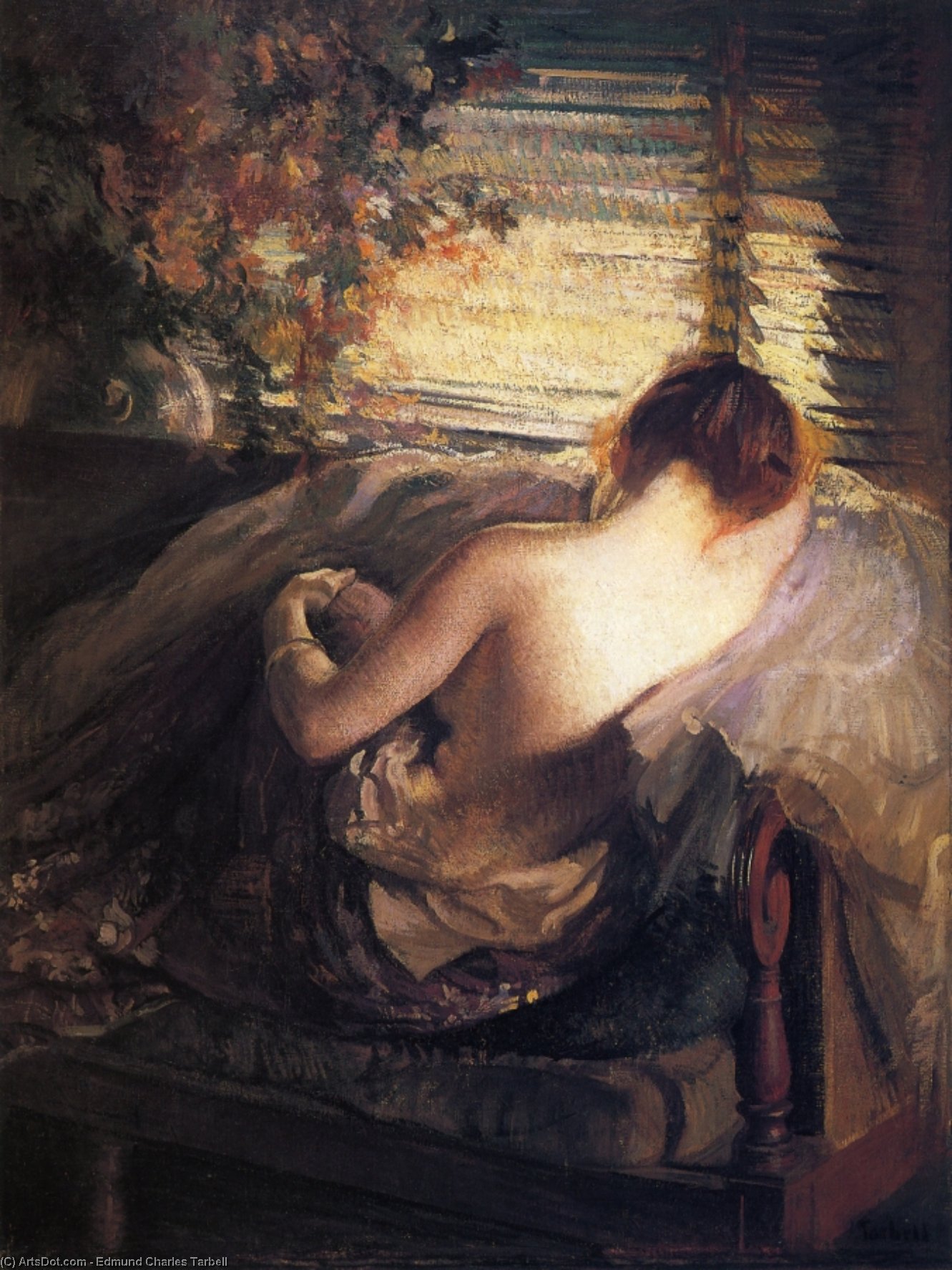
Edmund Charles Tarbell’s ‘The Venetian Blind,’ painted in 1898, exemplifies American Impressionism with its focus on capturing fleeting moments of atmosphere and natural light within a domestic setting. Featuring a woman resting peacefully in bed alongside vases and clocks, the artwork showcases Tarbell's masterful technique and contemplative style.
Discover Edmund Charles Tarbell (1862-1938), a leading American Impressionist & 'Ten American Painters' member. Explore luminous portraits & domestic scenes!
Explore art & history at the Worcester Art Museum! Discover Roman mosaics, Japanese prints, and an impressive arms collection – a vibrant cultural hub in Massachusetts.
A Window Into Tranquility: Edmund Charles Tarbell’s “The Venetian Blind”
Edmund Charles Tarbell (1862-1938), a pivotal figure in American Impressionism, gifted us with "The Venetian Blind," an oil painting completed in 1898 that transcends mere depiction—it embodies the very essence of contemplative repose. More than just capturing a scene, Tarbell sought to distill the feeling of stillness and serenity within domestic interiors, reflecting a broader artistic movement concerned with portraying fleeting moments of beauty and emotion. This piece resides proudly at the Worcester Art Museum, where it continues to inspire viewers with its luminous palette and masterful execution.
The Artist’s Vision: American Impressionism Defined
Tarbell's artistic journey began amidst the burgeoning landscape of Boston’s art scene, nurtured by formative influences from Otto Grundmann at the School of the Museum of Fine Arts. He honed his skills through an apprenticeship with Forbes Lithographic Company, absorbing techniques that would become hallmarks of his distinctive style—American Impressionism. Unlike its European counterparts, American Impressionism prioritized capturing atmospheric conditions and subjective experience above precise topographical accuracy. Tarbell’s canvases shimmer with diffused light, conveying a palpable sense of warmth and intimacy. He skillfully blended brushstrokes to create textures that mimic the subtle nuances of fabric and illumination, mirroring the quiet elegance of his subject matter.
A Study in Light and Texture: Technique and Composition
“The Venetian Blind” exemplifies Tarbell’s meticulous approach to technique. Observe how he utilizes layering—thin washes of color gradually built upon thicker impasto—to sculpt the surface of the canvas. This textural richness isn't merely decorative; it contributes significantly to conveying the feeling of warmth emanating from the room and highlighting the soft glow of natural light filtering through the window. The composition itself is deceptively simple: a woman reclining gracefully on a bed, bathed in gentle illumination. However, Tarbell’s careful placement of objects—a vase and two clocks—creates visual anchors that guide the eye and reinforce the mood of peaceful contemplation. These elements aren't merely props; they serve as symbols of domestic comfort and timelessness.
Symbolism Within Stillness: Interpreting the Image
Beyond its aesthetic qualities, “The Venetian Blind” resonates with deeper symbolic meanings. The Venetian blind itself represents privacy and seclusion—a deliberate choice by Tarbell to encapsulate a state of inner peace. The woman’s posture conveys relaxation and surrender, suggesting acceptance of life's rhythms without striving for excessive activity. Furthermore, the clocks subtly underscore the passage of time while simultaneously emphasizing the importance of savoring each moment. These elements invite viewers to contemplate themes of tranquility, domestic harmony, and the beauty found in quiet contemplation—values central to the American Impressionist ethos.
Legacy and Inspiration: An Enduring Masterpiece
Edmund Charles Tarbell’s “The Venetian Blind” stands as a testament to his artistic prowess and his ability to capture the intangible essence of human experience. Its luminous colors, textured surface, and thoughtful composition continue to captivate audiences today, securing its place among the most celebrated works of American Impressionism. It serves as an enduring inspiration for artists seeking to convey emotion through visual language—a reminder that beauty can be found in simplicity and that capturing fleeting moments of serenity remains a profoundly rewarding endeavor. Its presence at the Worcester Art Museum ensures that this masterpiece will continue to illuminate the artistic landscape for generations to come.