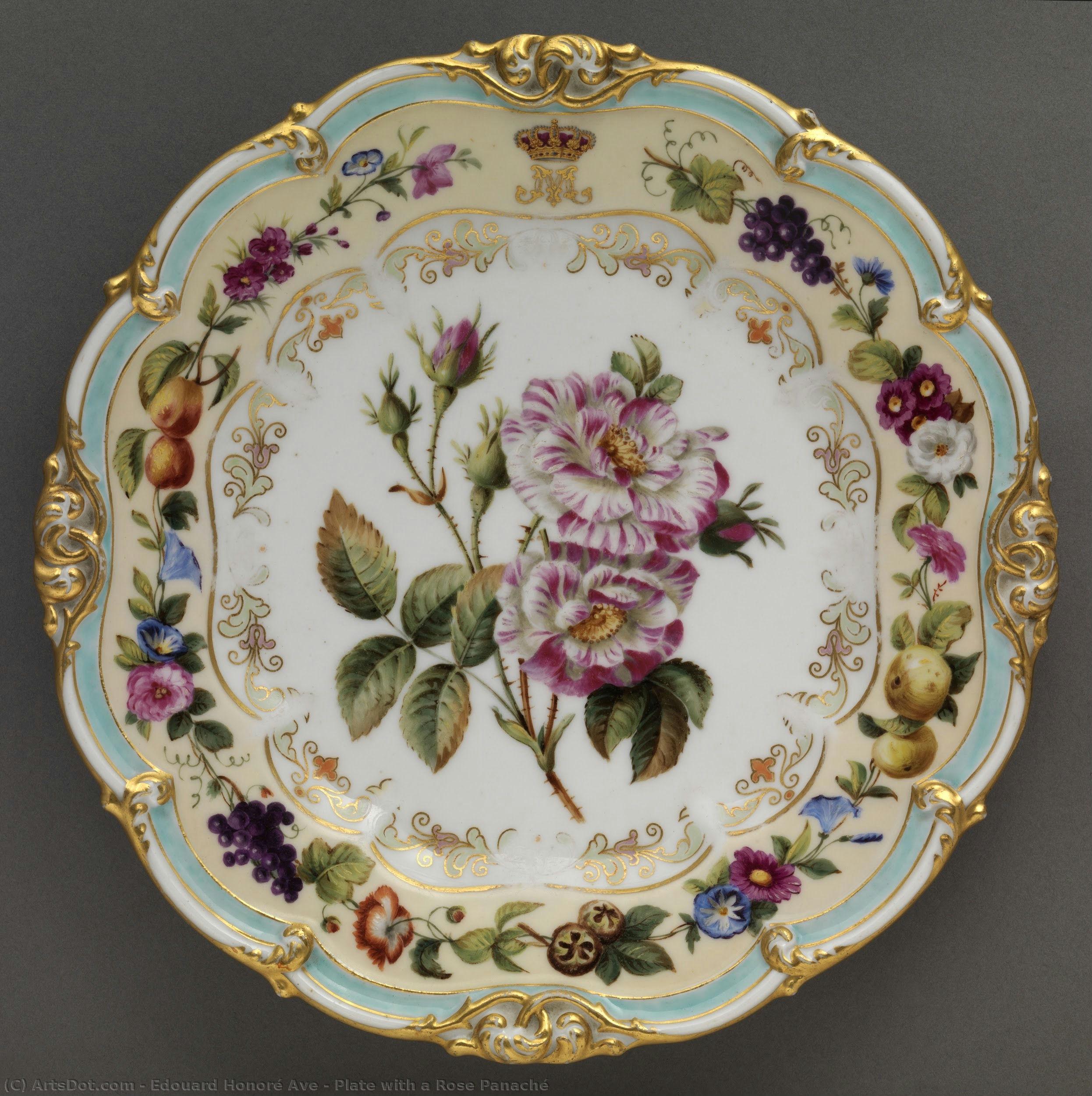
A Symphony in Blue and Bloom: Exploring Édouard Honoré Ave’s “Plate with a Rose Panaché”
Édouard Honoré Ave's "Plate with a Rose Panaché," painted circa 1840, is more than simply a decorative object; it’s a meticulously rendered window into the opulent aesthetic sensibilities of mid-19th century France. This exquisite porcelain plate, a testament to Ave’s mastery as a “Master of Floral Porcelain,” embodies the Rococo revival that swept through European art and design during this period. The piece speaks volumes about the era's fascination with natural beauty, particularly the delicate allure of floral arrangements, and its desire to evoke a sense of aristocratic elegance.
- Subject Matter & Composition: The central focus is undeniably the profusion of pink flowers – roses dominating the palette – arranged with an almost obsessive attention to detail. Scattered amongst these blooms are ripe apples, strategically placed to add both visual interest and a subtle layer of symbolic meaning. The inclusion of a complementary bowl in the upper left corner further enhances the composition, creating a harmonious tableau that invites prolonged contemplation.
- Technique & Style: Ave’s technique is characterized by its remarkable precision and delicate brushwork. The application of enamel colors onto the porcelain surface demonstrates a mastery of glazing techniques, resulting in a luminous quality that captures the subtle nuances of light and shadow. The plate's design adheres closely to Rococo principles – asymmetrical arrangements, flowing lines, and an emphasis on ornamentation—reflecting the artistic trends of the time.
The Historical Context: Rococo Revival and the Rise of Decorative Arts
"Plate with a Rose Panaché" emerged during a period of intense artistic revival. The late 18th and early 19th centuries witnessed a renewed interest in the art and design of the French Rococo era (roughly 1730-1780). This revival, fueled by a desire to escape the perceived austerity of Neoclassicism, embraced ornamentation, asymmetry, and a celebration of natural forms. Porcelain decoration played a crucial role in this movement, becoming a favored medium for capturing the beauty of the botanical world – a trend exemplified by Ave’s work.
The rise of porcelain as a decorative art form itself is significant. Advances in manufacturing techniques during the early 19th century made it possible to produce increasingly complex and elaborate designs, catering to the tastes of the wealthy elite who sought to furnish their homes with luxurious objects. Ave’s work reflects this burgeoning industry and its commitment to producing pieces that were both beautiful and technically impressive.
Symbolism & Emotional Impact
Beyond its aesthetic qualities, "Plate with a Rose Panaché" is rich in symbolic meaning. Roses, traditionally associated with love, beauty, and passion, are the dominant motif, suggesting an appreciation for romantic ideals. The inclusion of apples, often linked to knowledge, temptation, and immortality, adds another layer of complexity to the composition.
The overall effect is one of serene elegance and refined pleasure. The plate’s delicate colors and intricate details evoke a sense of nostalgia and timeless beauty. It's an object designed not just for practical use but also for visual delight – a miniature world of floral splendor intended to inspire contemplation and foster a feeling of luxurious comfort.
Collecting & Reproduction
Édouard Honoré Ave’s “Plate with a Rose Panaché” represents a pinnacle of 19th-century decorative arts. ArtsDot.com offers meticulously crafted hand-painted reproductions that faithfully capture the original's beauty and detail. These reproductions provide an accessible way to own a piece of art history, bringing the elegance and sophistication of Ave’s work into your home or office. The reproduction process utilizes archival quality materials ensuring longevity and preserving the artwork's vibrant colors for generations to come.