Explore Édouard Manet (1832-1883), a pivotal figure bridging Realism & Impressionism. Discover iconic works like 'Le Déjeuner sur l'herbe' and 'Olympia,' and his lasting impact on modern art.
Explore The Metropolitan Museum of Art: 5,000 years of art from around the world! Discover masterpieces, ancient artifacts & immersive exhibitions – a global art destination awaits.
A Matador: Capturing Modernity’s Tension
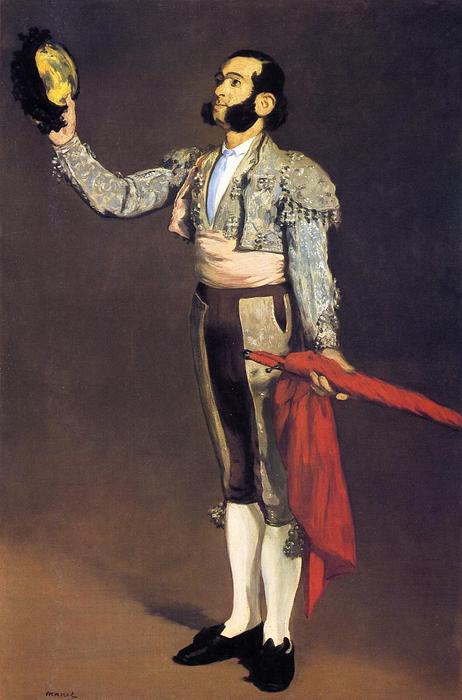
Édouard Manet's “A Matador,” completed in 1866-67, stands as a cornerstone of Impressionism and Realism alike—a testament to the artist’s refusal to simply replicate artistic conventions of his time. More than just a depiction of a bullfight spectacle, it embodies a profound exploration of psychological complexity and societal anxieties simmering beneath the surface of Parisian life during the Second Empire. The painting portrays Cayetano Sanz y Pozas, a celebrated matador, posed before a mirror—a deliberate compositional choice that immediately draws attention to themes of self-representation and performance.
The Style & Technique: Impressionistic Realism Converges
Manet skillfully blends elements of Impressionist technique with the meticulous observation characteristic of Realism. The muted palette – dominated by browns, ochres, and reds – eschews the vibrant hues favored by many Impressionists, prioritizing tonal gradations that convey a sense of immediacy and atmospheric depth. Brushstrokes are loose and visible, capturing the fleeting movement of Sanz’s pose and reflecting the diffused light of the studio where the painting was executed. However, Manet's attention to anatomical detail—particularly in Sanz’s musculature—demonstrates his commitment to portraying subjects with accuracy, mirroring the approach championed by artists like Velázquez. This duality underscores Manet’s ambition: to capture not just what he *saw*, but also how it *felt*.
Historical Context & Societal Commentary
Painted during a period of significant social and intellectual ferment in Paris, “A Matador” reflects anxieties about the changing role of masculinity and the pressures of bourgeois society. The matador’s gaze is directed towards his reflection—a gesture that speaks to questions of identity and performance – mirroring the broader preoccupation with portraying inner life alongside external appearances. Furthermore, Manet's inclusion of a mirror subtly critiques the obsession with idealized representations of beauty prevalent in academic art circles. It suggests that true artistry lies not in flawless imitation but in confronting uncomfortable truths about human experience. The painting’s placement within the Louvre’s collection—a deliberate provocation against established artistic tastes—solidified Manet’s reputation as a rebel and cemented his legacy as one of the fathers of modern art.
Symbolism & Psychological Depth
Beyond its formal innovations, “A Matador” is laden with symbolic significance. The mirror serves as a visual metaphor for introspection and self-awareness, prompting viewers to consider Sanz's inner state alongside his outward bravado. The cape—a symbol of honor and tradition—represents the enduring influence of Spanish culture on Parisian society. Yet, Manet’s portrayal of Sanz is not heroic; he presents him with a quiet dignity that conveys vulnerability beneath the surface. This nuanced depiction challenges viewers to confront the complexities of human psychology and to question conventional notions of heroism.
Emotional Impact & Legacy
“A Matador” continues to resonate powerfully with audiences today, eliciting contemplation on themes of performance, identity, and societal pressures. Its unsettling stillness—contrasting sharply with the dynamism of a bullfight—forces us to confront uncomfortable truths about human behavior and artistic ambition. Manet’s groundbreaking approach paved the way for subsequent generations of artists who sought to explore psychological realism and challenge artistic dogma. Today, reproductions of this iconic artwork offer an opportunity to experience firsthand the brilliance of Impressionistic Realism and to appreciate Manet's enduring contribution to the history of art.