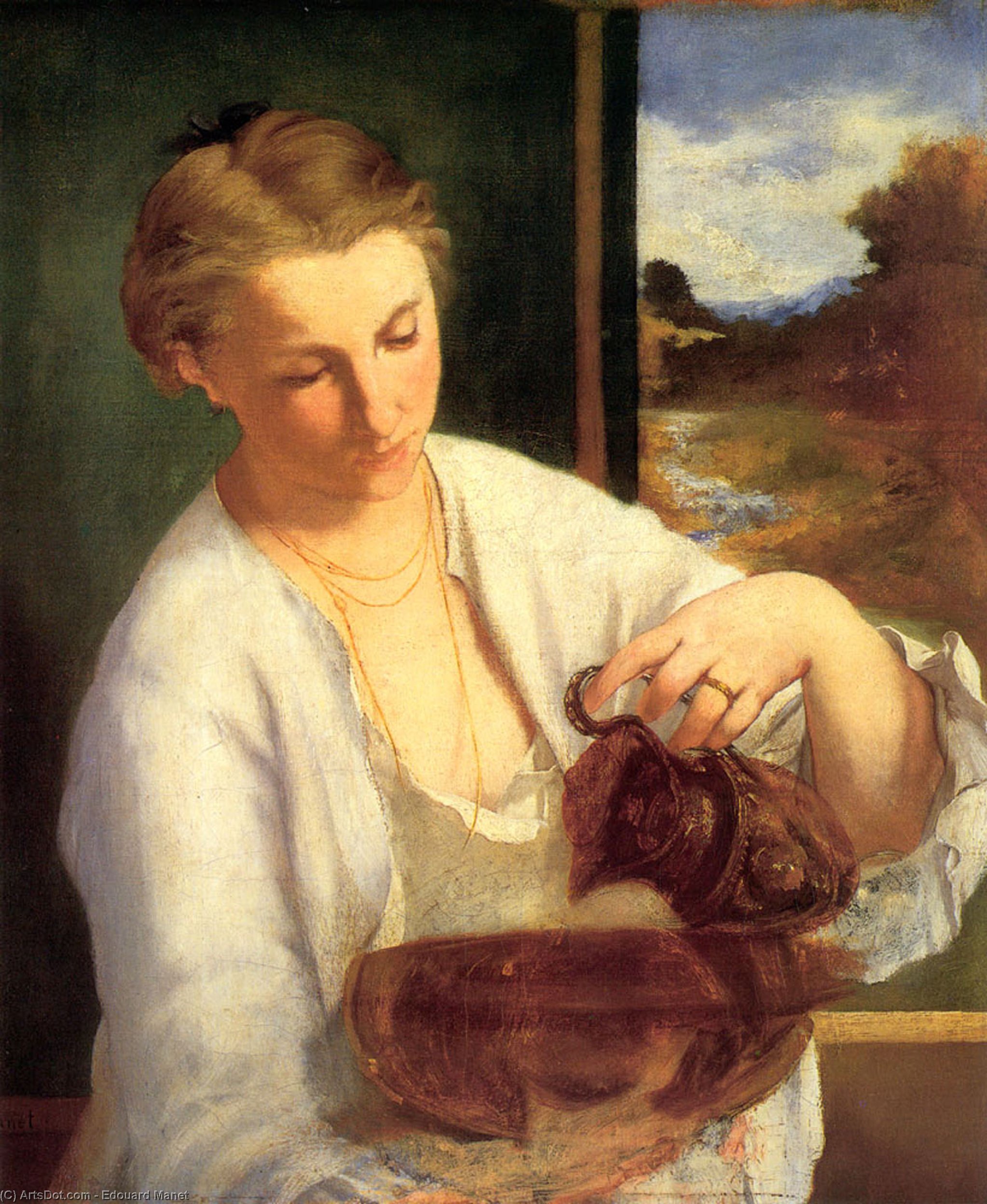
A Glimpse of Domesticity: Manet’s “A Woman Pouring Water”
Édouard Manet's "A Woman Pouring Water (Study of Suzanne Leenhoff)," painted in 1858, is more than a simple depiction of a mundane task; it’s a pivotal moment in the evolution of modern art. Created during a period of intense artistic ferment, this work represents a deliberate departure from the rigid conventions of academic painting and a bold embrace of contemporary life – a characteristic that would ultimately define Impressionism. Manet, already a controversial figure for his earlier works like “Le Déjeuner sur l’herbe,” here offers a quiet study in light, color, and the subtle beauty of everyday moments. The painting captures Suzanne Leenhoff, Manet's future wife, as she gracefully pours water from a pitcher into a basin – an action rendered with remarkable detail and imbued with a sense of serene contemplation. It’s a scene stripped bare of grand narratives or dramatic gestures, yet profoundly resonant in its simplicity and the way it invites the viewer to observe the world around them.
Artistic Context: Bridging Realism and Impressionism
Manet's artistic trajectory was shaped by the currents of his time. He initially trained within the traditional framework of academic painting, diligently studying the works of masters like Caravaggio and Velázquez at the Louvre. However, he quickly became disillusioned with the idealized representations and historical subjects favored by the Salon – the official art exhibition of the day. Inspired by Gustave Courbet’s Realist movement, which championed the depiction of ordinary people and contemporary life without romantic embellishment, Manet began to paint scenes from Parisian streets, cafes, and domestic interiors. Yet, unlike Courbet's often stark realism, Manet sought to capture the fleeting effects of light and color – a hallmark of Impressionism. “A Woman Pouring Water” exemplifies this synthesis; it’s not merely a portrait but an exploration of how light dances across surfaces, transforming a simple act into a visually captivating experience. The painting's loose brushstrokes and subtle tonal variations demonstrate Manet’s willingness to experiment with new techniques, paving the way for future generations of Impressionist painters.
Subject and Composition: A Study in Light and Space
The composition is remarkably restrained, focusing entirely on the subject – Suzanne Leenhoff – within a limited spatial framework. The scene unfolds near a window, providing a diffused natural light that illuminates her form and the surrounding environment. The placement of the woman centrally draws our attention to her gesture, while the minimal furniture – a chair positioned to the right – creates a sense of spaciousness and tranquility. Notice how Manet uses color to define the space; the warm tones of the room contrast with the cool blues and greens of the light filtering through the window. The absence of strong diagonals or elaborate details contributes to the painting’s quiet elegance, emphasizing the subject's presence within her environment. It is a deliberate choice that invites us to linger and observe the subtle nuances of the scene.
Technique and Style: Impressionistic Brushwork
Manet’s masterful use of oil paint creates a rich tapestry of textures and colors. The brushstrokes are bold and expressive, particularly evident in the folds of Suzanne Leenhoff's dress and the play of light on the surrounding surfaces. Unlike the smooth, polished finish favored by academic painters, Manet’s technique is characterized by visible brushwork – a deliberate choice that adds to the painting’s sense of immediacy and spontaneity. The Impressionist influence is palpable in his treatment of light; he captures not just the appearance of objects but their fleeting reflections and shadows. This focus on capturing the ephemeral qualities of light and color was revolutionary at the time, challenging traditional notions of representation and opening up new possibilities for artistic expression.
Historical Significance and Enduring Relevance
“A Woman Pouring Water” is a crucial work in Manet’s oeuvre, representing an early step towards Impressionism and a significant departure from academic conventions. It reflects his interest in portraying modern life with honesty and capturing the beauty of everyday moments – a theme that continues to resonate with viewers today. The painting's quiet intimacy and subtle observations offer a poignant glimpse into the lives of women during the 19th century, prompting us to consider the significance of seemingly ordinary activities. Furthermore, it stands as a testament to Manet’s artistic courage—his willingness to challenge established norms and explore new ways of seeing and representing the world. For those seeking to appreciate the evolution of modern art or simply find beauty in the commonplace, “A Woman Pouring Water” remains a captivating and thought-provoking masterpiece.
For high-quality reproductions and further exploration of Manet’s work, please visit ArtsDot.