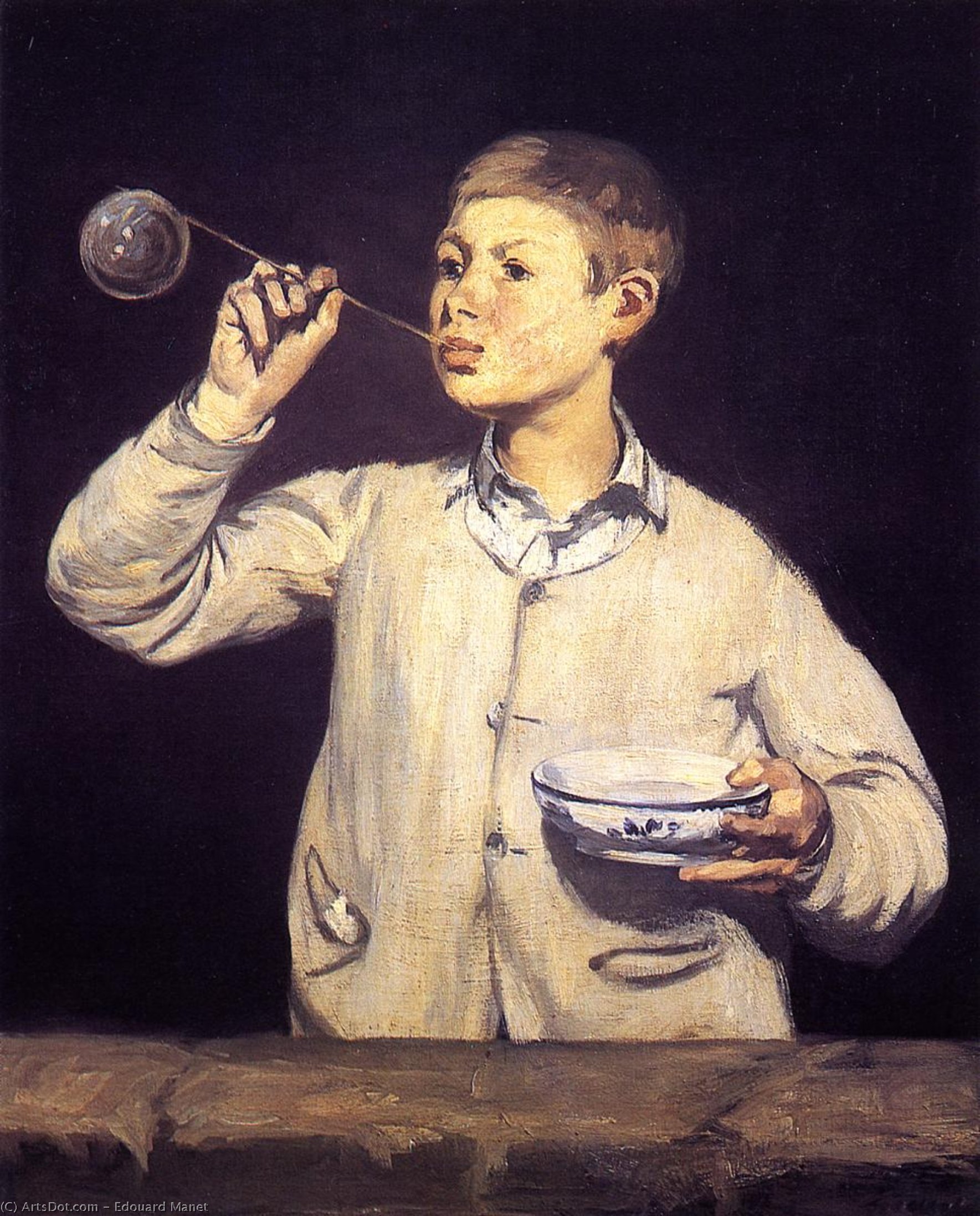
Boy Blowing Bubbles: A Snapshot of Innocence by Édouard Manet
Édouard Manet’s
Boy Blowing Bubbles (1867) stands as a deceptively simple yet profoundly significant work within Manet’s oeuvre—a testament to his unwavering commitment to portraying the everyday realities of modern life with remarkable precision and emotional resonance. More than just a depiction of childhood play, it encapsulates a broader exploration of themes concerning mortality, beauty, and the fleeting nature of existence, skillfully rendered in Manet's signature realist style.
Composition and Technique: Embracing Impressionistic Roots
Measuring 100 x 81 cm, the painting utilizes oil on canvas—a medium favored by Manet to achieve luminous textures and vibrant colors—reflecting influences from artists like Gustave Courbet who championed a rejection of academic conventions. The composition is carefully balanced, placing the young boy prominently in the foreground against a muted backdrop that emphasizes his presence. Notice how Manet employs loose brushstrokes and subtle tonal variations to capture the ephemeral quality of the bubbles themselves, hinting at their imminent burst—a visual metaphor for life’s transient beauty. This technique aligns closely with Impressionistic principles, despite Manet's insistence on maintaining a grounding in realism. The inclusion of a bowl positioned slightly off-center contributes to the overall dynamism and directs the viewer’s gaze toward the central subject.
Historical Context: Reflecting Victorian Sensibilities
Painted during a period marked by considerable social upheaval—the burgeoning industrial revolution and shifting artistic sensibilities—
Boy Blowing Bubbles speaks to the anxieties of its time concerning mortality and the passage of time. The boy’s gaze upward—towards the bubbles—is interpreted as a contemplation on life's brevity, mirroring the philosophical currents prevalent in Victorian England. Manet deliberately eschewed idealized representations, opting instead for an honest portrayal of childhood experience—a bold departure from prevailing artistic trends.
Symbolism: Beyond Mere Observation
The painting’s symbolism extends far beyond its surface appearance. The bubbles themselves serve as a powerful emblem of fragility and impermanence—a visual reminder that beauty is fleeting and destined to vanish. Simultaneously, the bowl symbolizes containment and preservation—representing an attempt to hold onto moments of joy and innocence. Furthermore, the inclusion of school books subtly underscores the importance of education and knowledge within Victorian society. The muted color palette reinforces this contemplative mood, creating a harmonious blend of observation and symbolic interpretation.
Legacy: An Icon of Modern Art
https://ArtsDot.com offers exquisite handmade oil painting reproductions of
Boy Blowing Bubbles—allowing art enthusiasts to experience the brilliance of Manet’s vision firsthand. Explore more masterpieces by Édouard Manet and discover how this iconic painting continues to inspire admiration for its artistic merit and profound contemplation on human existence. The Staatliche Museen zu Berlin houses one of Europe's foremost collections of paintings from the 13th to the 18th centuries—a treasure trove for anyone interested in delving deeper into the artistic heritage of Western civilization. Visit
https://ArtsDot.com to embark on a journey through art history!