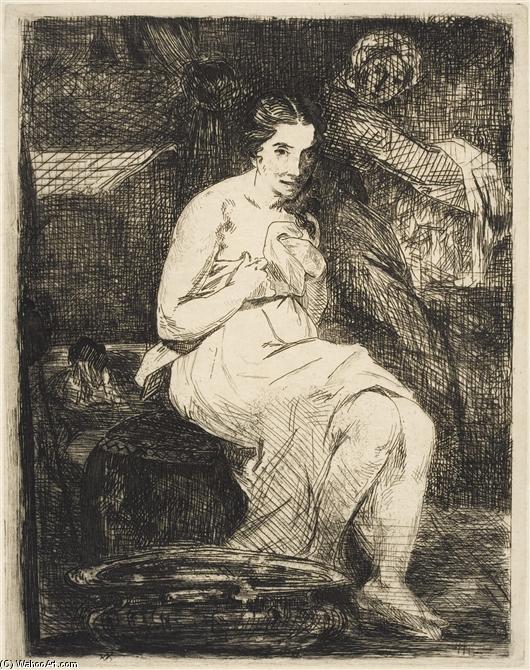
La Toilette: A Revolutionary Glance into Parisian Life
Édouard Manet’s “La Toilette,” completed in 1860, stands as a cornerstone of Impressionism and a defiant challenge to the academic conventions that dominated French art at the time. More than just a depiction of a woman preparing for bathing—though meticulously observed—the drawing embodies Manet's ambition to capture fleeting moments of modern life with unprecedented honesty and psychological depth.
- Subject Matter: The artwork portrays a nude woman seated on a chair, accompanied by her infant son. This subject matter was considered scandalous for its time due to the departure from idealized representations prevalent in academic painting.
- Style & Technique: Manet employed a bold technique characterized by loose brushstrokes and a muted palette—a deliberate rejection of the polished surfaces favored by his predecessors. He utilized red chalk, an unconventional medium for portraiture, layering it onto toned paper to create subtle gradations of light and shadow that imbue the figure with palpable presence.
The drawing’s historical context is crucial to understanding its significance. Painted during a period of social upheaval in Paris—marked by industrialization, urbanization, and burgeoning bourgeois culture—Manet sought to portray the everyday realities of Parisian life without resorting to sentimental embellishment. He meticulously studied Caravaggio and Velázquez, absorbing their mastery of chiaroscuro – dramatic contrasts between light and dark – to achieve this goal.
- Symbolism: Beyond its realistic portrayal, “La Toilette” carries symbolic weight. The woman’s gaze directs towards the viewer, establishing a confrontational dialogue that disrupts traditional artistic hierarchies. Her posture exudes serenity despite the vulnerability inherent in motherhood, reflecting Manet's fascination with capturing psychological nuance.
- Influence: "La Toilette" profoundly impacted subsequent artists and cemented Manet’s reputation as a pioneer of modernism. It paved the way for Impressionists like Monet and Renoir to explore subjective experience and capture atmospheric effects—a radical departure from artistic dogma.
Emotionally, “La Toilette” resonates with viewers through its understated beauty and profound observation. The drawing invites contemplation on themes of femininity, motherhood, and the complexities of human emotion. It remains a testament to Manet’s unwavering commitment to portraying the world as he saw it—a world brimming with both dignity and unease.
Source Material: Courtauld Institute of Art; National Gallery of Art; Metropolitan Museum of Art