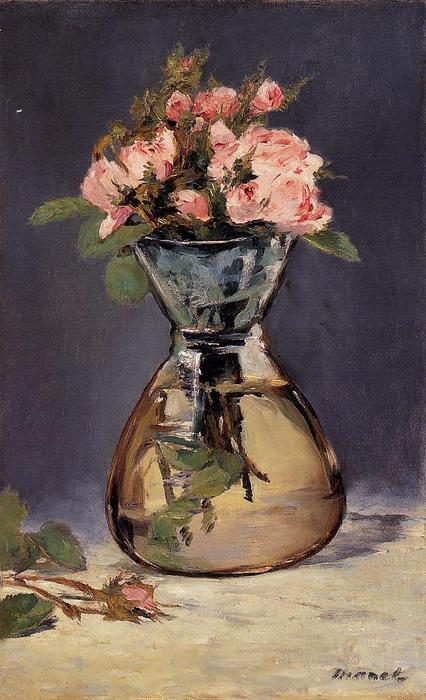
Édouard Manet’s Serene Still Life: “Mosee Roses in a Vase”
Édouard Manet's "Mosee Roses in a Vase," painted in 1882, is more than just a depiction of flowers; it’s a carefully constructed meditation on beauty, light, and the quiet dignity of everyday life. Housed within the Sterling and Francine Clark Art Institute in Williamstown, Massachusetts, this oil-on-canvas work offers a glimpse into Manet's evolving style – a bridge between his earlier academic training and the burgeoning Impressionist movement that would soon redefine modern art. The painting immediately draws the eye to its central subject: a vibrant arrangement of pink roses nestled within a clear glass vase, presented against a remarkably simple, almost neutral backdrop. This deliberate restraint is key to Manet’s technique; he eschews elaborate detail or dramatic composition in favor of capturing the essence of the scene with remarkable precision and sensitivity.
Manet's approach to still life was revolutionary for its time. Rather than striving for idealized beauty, as was common in academic painting, he focused on observing and rendering the subtle nuances of light and color. The roses themselves are not depicted in a state of perfect bloom; instead, they possess a slightly wilted quality, suggesting a fleeting moment captured in time. This realism, combined with Manet’s loose brushstrokes – visible yet controlled – creates an immediate sense of immediacy and intimacy. He masterfully employs the technique of *plein air* painting, though working indoors, to achieve this effect, capturing the way light interacts with the textures of the flowers and glass.
The Language of Light and Color
A critical element of “Mosee Roses in a Vase” is Manet’s exploration of color. He utilizes a limited palette – primarily pinks, greens, and browns – to create a harmonious yet dynamic composition. The varying shades of pink within the roses themselves are particularly noteworthy, demonstrating his keen eye for detail and his ability to capture subtle tonal shifts. The clear glass vase acts as a prism, refracting light and casting delicate shadows that add depth and dimension to the scene. Notice how Manet doesn’t attempt to create a photographic representation; instead, he uses color to evoke an emotional response – a feeling of serenity, perhaps, or a quiet contemplation.
The choice of roses themselves carries symbolic weight. Roses have long been associated with love, beauty, and passion, but in this painting, they seem less overtly romantic and more imbued with a sense of melancholy. The slightly drooping petals suggest a transient beauty, a reminder that all things are subject to decay. This subtle shift in symbolism reflects Manet’s broader interest in exploring the complexities of human experience – not just idealized notions of love or happiness.
Contextualizing Manet's Innovation
To fully appreciate “Mosee Roses in a Vase,” it’s important to consider Manet’s place within the artistic landscape of 19th-century France. He was a controversial figure, often at odds with the established art establishment and its rigid conventions. His early works, such as "Le Déjeuner sur l'herbe" (The Luncheon on the Grass) and “Olympia,” caused considerable scandal due to their unconventional subject matter and realistic portrayal of modern life. Manet’s willingness to challenge artistic norms paved the way for Impressionism and subsequent movements in modern art.
Works like "A Path in the Garden at Rueil" and “Flowers in a Crystal Vase” from the same year further demonstrate Manet's exploration of still life, showcasing his growing confidence in capturing fleeting moments and experimenting with light and color. These paintings reveal a shift towards a more personal and expressive style, moving away from purely academic representation.
A Timeless Masterpiece
"Mosee Roses in a Vase" remains a powerful testament to Manet’s artistic vision and his enduring influence on the course of art history. Its quiet beauty, subtle symbolism, and masterful technique continue to captivate viewers today. Whether admired for its technical brilliance or its poignant portrayal of everyday life, this painting stands as a significant milestone in the transition from Realism to Impressionism – a timeless example of Manet’s unique artistic voice.