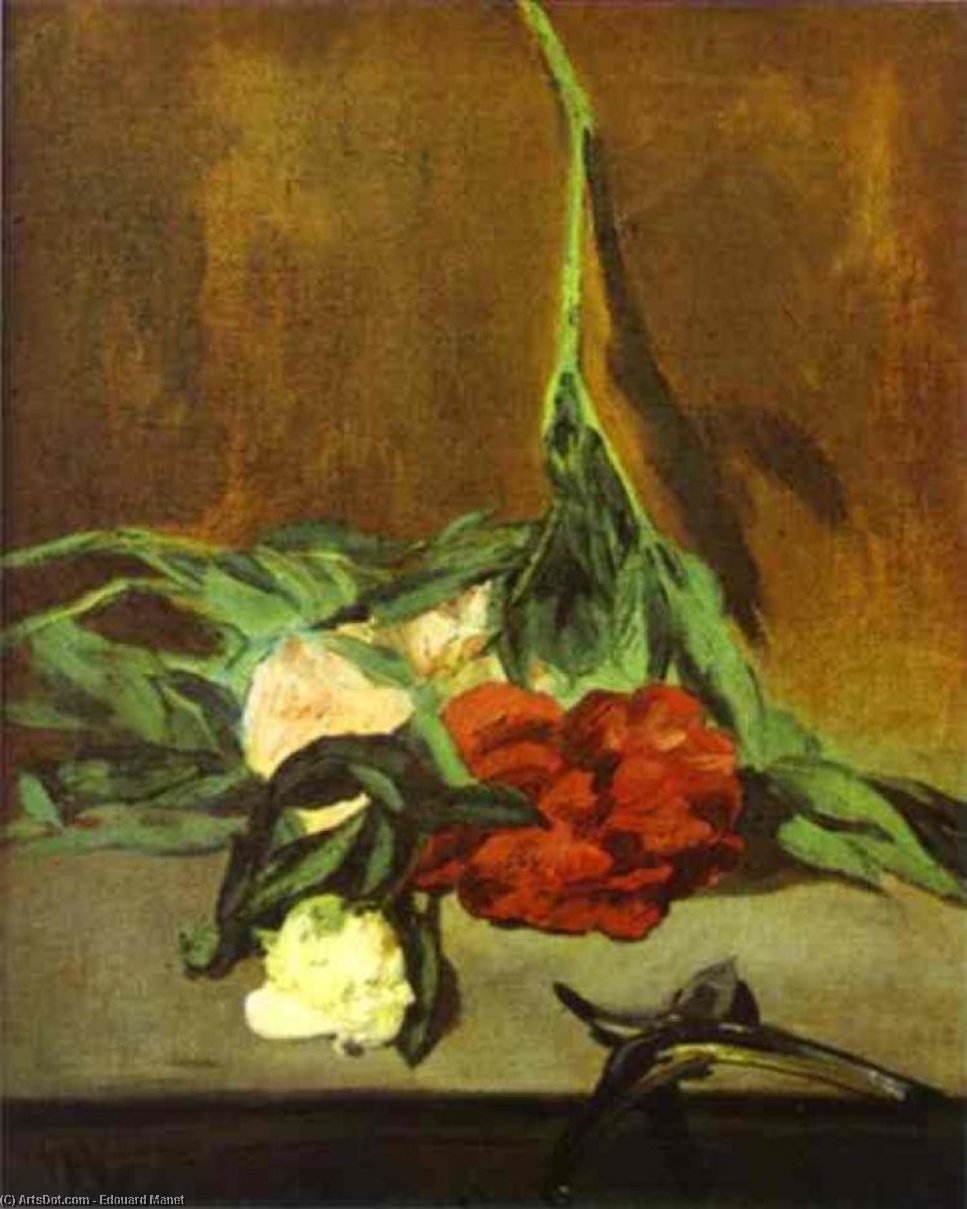
A Moment Frozen in Time: Exploring Édouard Manet’s ‘Peony Stem and Shears’
Édouard Manet's “Peony Stem and Shears,” painted in 1864, isn’t merely a depiction of flowers; it’s a deliberate challenge to artistic conventions—a testament to Manet’s unwavering commitment to portraying the world as he saw it. Created during a period of significant upheaval in Parisian art, this seemingly simple still life embodies the spirit of Realism and speaks volumes about Manet's intellectual engagement with the burgeoning Impressionist movement. Unlike his predecessors who meticulously idealized nature or adhered to academic standards, Manet sought to capture fleeting moments of everyday life with unflinching honesty.
- Subject Matter: The painting centers around a vase containing peonies—fragile blossoms symbolizing beauty and prosperity—alongside shears used for pruning. These elements aren’t presented in an idealized manner; instead, they are rendered with palpable realism, reflecting Manet's fascination with observing the natural world directly.
- Style: “Peony Stem and Shears” firmly establishes Manet within the Realist tradition. Rejecting Romantic sentimentality and historical grandeur, Realists aimed to depict subjects accurately without embellishment, focusing on observable details rather than emotional interpretation. This stylistic choice distinguishes it from the opulent canvases favored by artists like Eugène Delacroix.
- Technique: Manet employed a technique characterized by loose brushstrokes and subtle tonal variations—a departure from the smooth surfaces achieved by academic painters. He utilized glazing, layering thin washes of color over underpaintings to build up depth and luminosity, mirroring the influence of Caravaggio’s dramatic chiaroscuro.
Historical Context: Challenging Artistic Boundaries
Painted against the backdrop of a rapidly changing Parisian society—marked by industrialization and urbanization—Manet's work represents a crucial juncture in art history. The Salon, Paris’s official art exhibition, was dominated by academic painters who championed idealized representations of classical mythology and historical narratives. Manet deliberately defied these expectations, presenting his paintings as they appeared to the eye, sparking controversy and debate among critics and fellow artists alike. His refusal to conform to established norms signaled a decisive break from artistic tradition and paved the way for Impressionism’s emergence.
Symbolism Beyond Aesthetics
While visually striking, “Peony Stem and Shears” carries deeper symbolic significance. Peonies themselves are associated with nobility, purity, and rebirth—themes prevalent in Victorian culture. However, Manet doesn't glorify these concepts; rather, he juxtaposes them with the shears – instruments of action and decay – suggesting a meditation on mortality and the transient nature of beauty. The muted palette contributes to this contemplative mood, emphasizing texture and form over vibrant color.
Emotional Resonance: Capturing Perception
Ultimately, “Peony Stem and Shears” succeeds in conveying an emotional resonance that transcends mere visual representation. It invites viewers to contemplate the passage of time and the inevitability of change—themes explored by philosophers like Nietzsche at the time. Manet’s masterful handling of light and shadow captures not just what is seen but also how it feels, mirroring the Impressionists' ambition to depict subjective experience. This artwork remains a powerful reminder that true artistic achievement lies in capturing the essence of reality with honesty and sensitivity.