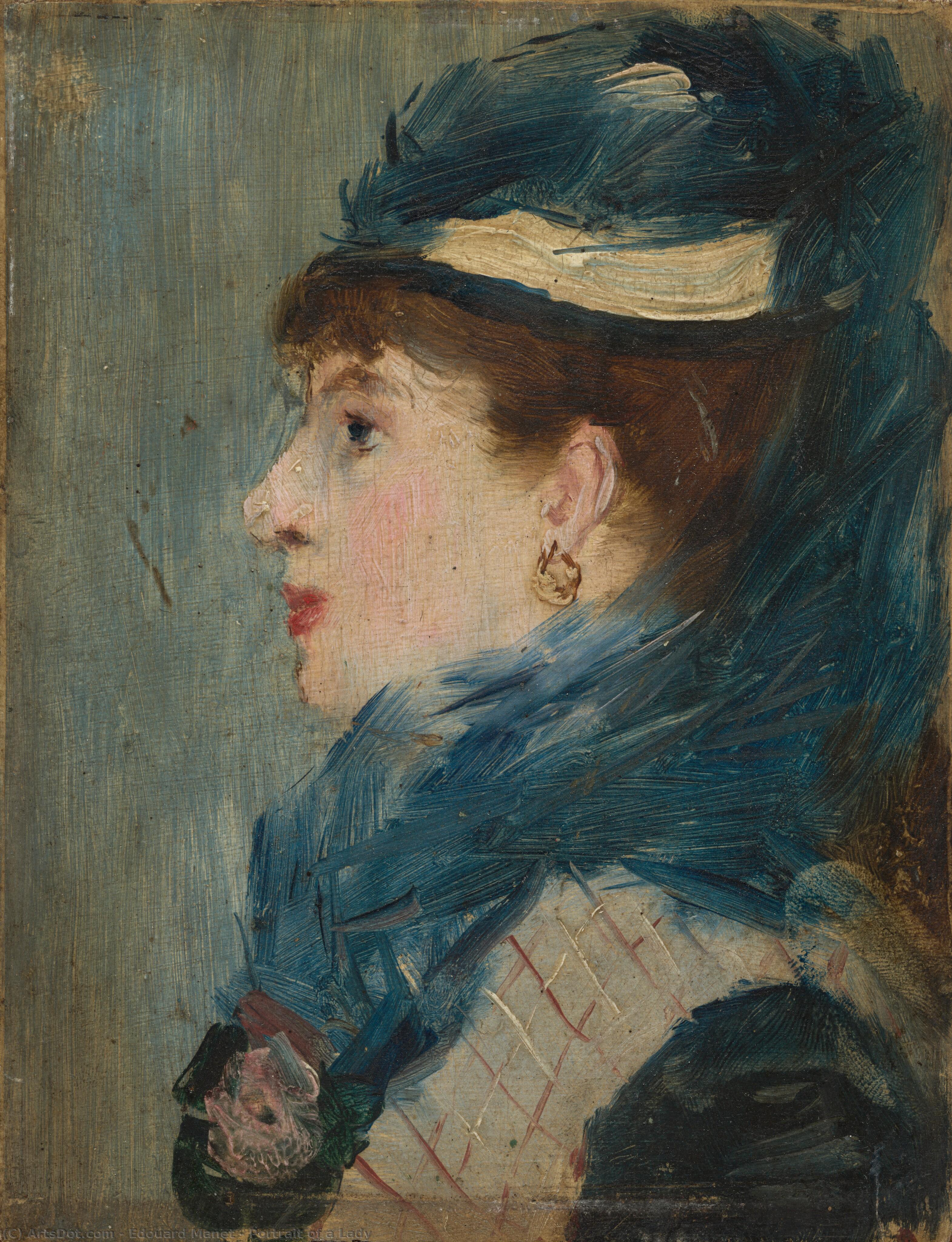
A Glimpse of Parisian Grace: Édouard Manet’s “Portrait of a Lady”
Édouard Manet's "Portrait of a Lady," painted in 1879, offers more than just a likeness; it’s a carefully constructed tableau of late 19th-century Parisian life and a subtle challenge to the established artistic conventions of the time. This intimate portrait, measuring a modest 31 x 28 cm, immediately draws the viewer in with its restrained palette dominated by shades of blue and white – colors often associated with quiet contemplation and understated elegance. The subject, a woman adorned with a striking blue scarf and a delicate hat, possesses an air of both vulnerability and dignified composure. Her slightly parted lips suggest either a moment of silent reflection or perhaps the anticipation of speech, inviting us to imagine her story.
Manet’s Revolutionary Approach: Bridging Realism and Modernity
Born into a comfortable Parisian family, Édouard Manet was an unlikely revolutionary. Initially destined for naval service by his father, he quickly gravitated towards the world of art, rejecting the rigid academic training favored by his social circle. Manet’s artistic journey wasn't about slavishly copying the Old Masters; instead, he sought to capture the immediacy and dynamism of modern life – a radical departure from the prevailing artistic trends. He studied the techniques of artists like Caravaggio and Velázquez, meticulously analyzing how they used light and shadow to sculpt form and create depth, but ultimately forged his own path, depicting scenes and individuals with unprecedented honesty and a keen awareness of contemporary society. “Portrait of a Lady” exemplifies this approach; it’s not a formal, idealized representation, but rather a snapshot of a woman in her environment, imbued with a sense of lived experience.
Details of Technique and Symbolism
The painting's execution reveals Manet’s deliberate choices. The use of loose brushstrokes, characteristic of Impressionism, creates a shimmering effect on the fabric of the scarf and dress, suggesting movement and light. Notice the subtle modeling of the face – Manet avoids sharp outlines, opting instead for soft transitions that convey volume and form. The black dress with its lace collar adds an element of formality and elegance, while the blue scarf introduces a touch of color and visual interest. Beyond the purely aesthetic, consider the symbolism inherent in the composition. The hat, fashionable at the time, speaks to social status and contemporary trends. The woman’s posture – upright yet relaxed – conveys self-assurance and grace.
A Window into 1879 Paris
“Portrait of a Lady” offers a valuable glimpse into Parisian society in 1879. The painting reflects the growing interest in depicting everyday life, moving away from mythological or historical subjects that dominated earlier art. Manet’s focus on a single individual within a domestic setting – though we don't see the room itself – speaks to the changing role of women and the increasing emphasis on personal identity. Further research reveals this portrait was part of a larger body of work exploring modern life, mirroring the social shifts occurring in France during that era. The provenance of the painting, tracing back through prominent collections like Knoedler & Co., highlights its significance within the art world’s history.
At ArtsDot.com, we are proud to offer a meticulously crafted hand-painted reproduction of “Portrait of a Lady,” allowing you to bring this captivating work into your home or office. Our reproductions capture the essence of Manet's artistic vision with exceptional detail and fidelity, ensuring that you experience the beauty and emotional resonance of this iconic painting.