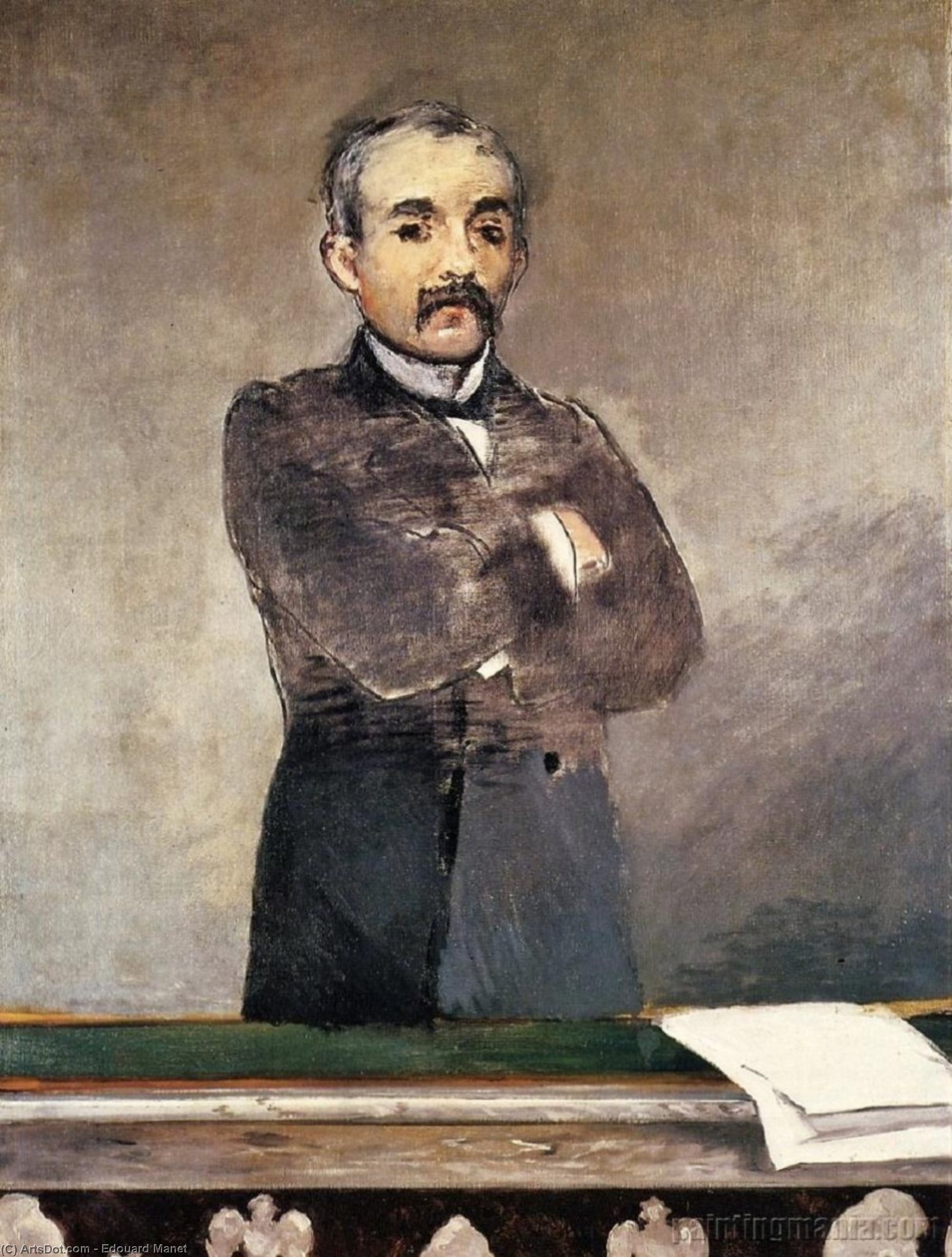
A Portrait of Power and Precision: Edouard Manet’s Clemenceau at the Tribune
Edouard Manet's 1880 painting, “Portrait of Clemenceau at the Tribune,” is more than a simple likeness; it’s a carefully constructed statement about power, politics, and the evolving role of the artist in modern France. This oil on canvas, currently residing within the esteemed Kimbell Art Museum in Fort Worth, offers a captivating glimpse into the world of Georges Clemenceau, a pivotal figure in late 19th-century French history, as rendered through Manet’s distinctive and revolutionary style. The painting immediately commands attention with its stark realism – a deliberate departure from the romanticized depictions prevalent at the time – and its subtly imbued sense of authority emanating from the subject himself.
Clemenceau, then Prime Minister of France, is presented not as a heroic figure idealized for posterity, but as a man of considerable presence and unwavering resolve. He stands rigidly at a podium, his arms crossed in a gesture that speaks volumes about control and determination. Manet’s masterful use of light and shadow sculpts Clemenceau's face, emphasizing the lines etched by years of political maneuvering and reflecting an intense gaze directed towards an unseen audience. The muted palette – dominated by browns, grays, and ochres – contributes to a sense of gravitas, reinforcing the solemnity of the scene.
The Realist Approach: A Revolutionary Shift
Manet’s decision to portray Clemenceau with such unflinching realism was a bold move for the time. He rejected the elaborate embellishments and idealized forms favored by academic painters, instead opting for a direct and unvarnished representation of his subject. This commitment to depicting contemporary life – as seen in works like “Olympia” – marked a crucial step towards what would become known as Impressionism. The background wall, rendered with careful attention to texture and detail, provides context without distracting from the central figure; it’s a subtle reminder of Clemenceau's position within the French political landscape.
The technique itself is notable for its precision and control. Manet employed short, broken brushstrokes – a hallmark of his style – to build up layers of color and create a sense of immediacy. He skillfully captured the nuances of Clemenceau’s attire, from the folds of his suit to the texture of his tie, demonstrating an acute awareness of form and detail. This meticulous approach belies the painting's overall feeling of understated power; it is in these small details that Manet truly reveals his artistic mastery.
Historical Context: Politics and Artistic Influence
The creation of “Portrait of Clemenceau at the Tribune” occurred during a period of immense political upheaval in France. Clemenceau’s role as Prime Minister was particularly significant, especially considering the aftermath of the Franco-Prussian War and the subsequent rise of German power. Manet's friendship with Clemenceau extended beyond mere artistic patronage; it involved a complex interplay of mutual respect and influence. Notably, Manet played a key role in relocating “Olympia” from the Musée du Luxembourg to the Louvre, effectively granting it ‘old master’ status – an act that further cemented his reputation as a revolutionary artist challenging established norms.
The painting's historical significance is further underscored by its connection to Gustave Courbet, whose Realist movement profoundly influenced Manet. Courbet’s emphasis on depicting everyday life and rejecting idealized representations paved the way for Manet’s own approach, demonstrating a clear lineage of artistic innovation. Manet’s decision to portray Clemenceau in such a direct manner reflects this influence – a conscious rejection of traditional portraiture conventions in favor of a more honest and contemporary representation.
Symbolism and Emotional Resonance
Beyond its technical merits, “Portrait of Clemenceau at the Tribune” is rich in symbolic meaning. The podium itself represents Clemenceau’s authority and his role as a leader addressing the nation. His crossed arms convey confidence and determination, while his gaze suggests an unwavering focus on the task at hand. Even the muted color palette contributes to the painting's emotional impact – it evokes a sense of seriousness and gravitas, reflecting the weighty responsibilities borne by Clemenceau during a turbulent period in French history.
This portrait is not merely a likeness; it’s an embodiment of power, resilience, and political acumen. It stands as a testament to Edouard Manet's artistic vision and his ability to capture the essence of his subject with remarkable precision and emotional depth. For art enthusiasts and historians alike, “Portrait of Clemenceau at the Tribune” offers a compelling window into the intersection of politics and art during late 19th-century France. To explore more works by Manet or to acquire a high-quality reproduction of this iconic painting, visit ArtsDot.