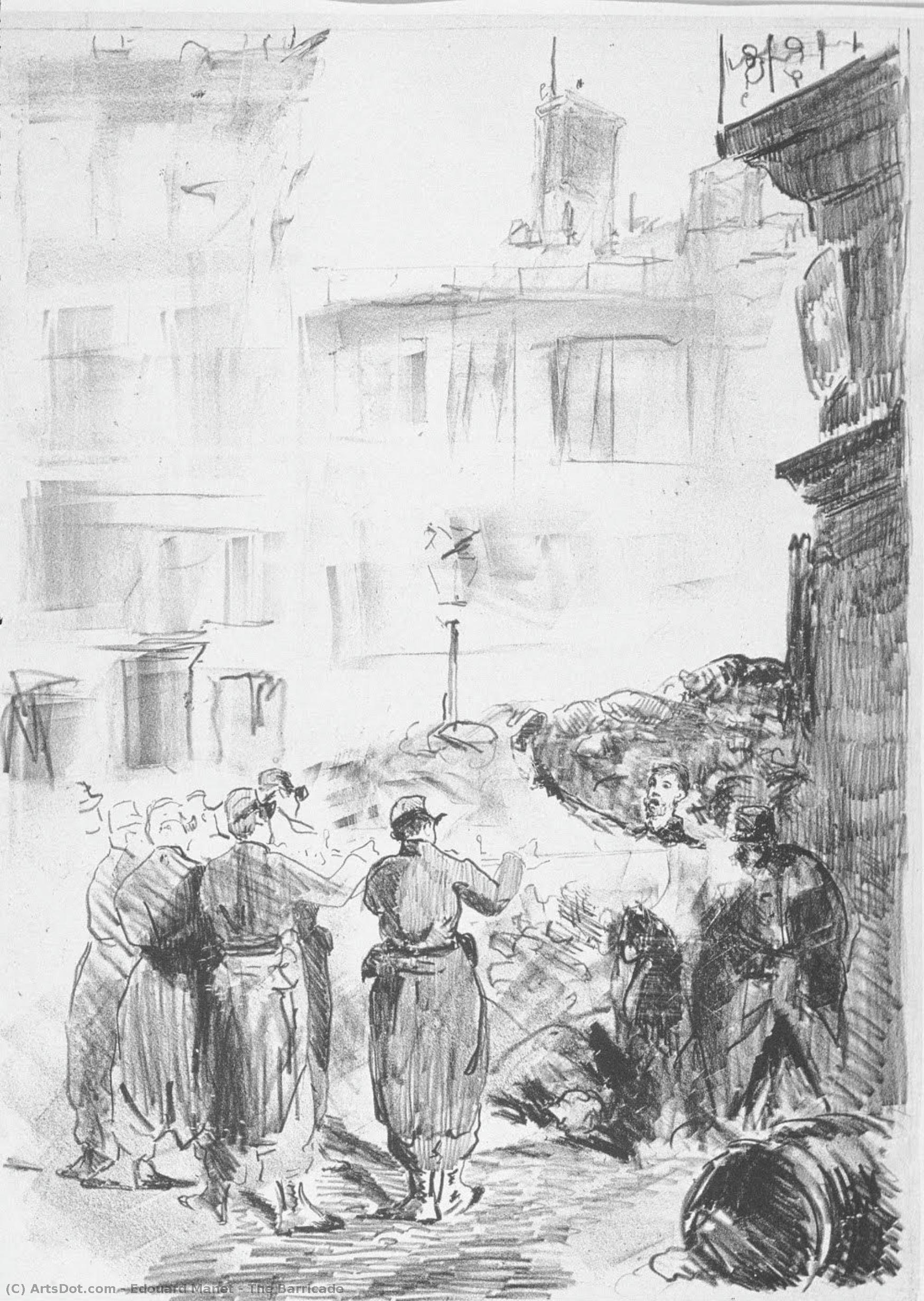
This artwork explores themes of social conflict and historical upheaval, utilizing loose lines and tonal variations to convey immediacy and tension. It’s a significant piece from Manet's oeuvre, demonstrating his mastery of lithography and capturing the spirit of the Franco-Prussian War.
Explore Édouard Manet (1832-1883), a pivotal figure bridging Realism & Impressionism. Discover iconic works like 'Le Déjeuner sur l'herbe' and 'Olympia,' and his lasting impact on modern art.
Discover Detroit's iconic art scene at the DIA! Explore world-class collections, including Rivera murals & American masterpieces, reflecting the city’s rich history and vibrant culture.
A Snapshot of Parisian Rebellion
In the heart of 1871, amidst the smoke and shadows of a fractured Paris, Édouard Manet captured more than just a street scene; he immortalized a moment of profound societal upheaval. The Barricade serves as a visceral testament to the Paris Commune, an era defined by the defiant uprising against Napoleon III's regime. As one gazes upon this monochrome landscape, the viewer is thrust into a world of makeshift defenses and urban tension. The composition, dominated by the central barricade, pulls the eye through a crowded streetscape where figures huddle in anticipation or action. Small, grounded details—a stray dog, a solitary fire hydrant—anchor the chaos in a startlingly recognizable reality, reminding us that even amidst the grand movements of history, the mundane persists.
The Mastery of Line and Shadow
Manet’s approach in this work bridges the gap between the unflinching honesty of Realism and the fleeting energy of Impressionism. Eschewing the distraction of color, he relies entirely on a sophisticated monochrome palette to sculpt form and depth. Through the masterful use of charcoal, graphite, or ink, Manet employs loose, expressive lines and intricate hatching techniques that create a sense of movement and urgency. The deliberate texture—achieved through the scraping of chine collé paper—adds a tactile dimension to the piece, mirroring the rough, unpolished nature of the barricade itself. This play of light and shadow, where deep blacks meet stark whites, does not merely depict a scene; it evokes the very atmosphere of a city on the brink of revolution.
A Legacy of Artistic Dialogue
Beyond its immediate subject matter, The Barricade is a profound dialogue with art history itself. Manet subtly references Francisco Goya’s haunting The Third of May 1808, signaling his intent to engage with the weight of political tragedy through established artistic precedents. For the discerning collector or interior designer, this piece offers more than just aesthetic beauty; it provides a window into the soul of modernism. The artwork's ability to evoke tension and anxiety while maintaining a sophisticated, understated elegance makes it a powerful statement for any curated space. It is a work that demands contemplation, inviting the viewer to reflect on the cyclical nature of struggle and the enduring power of the artist to document the human condition.