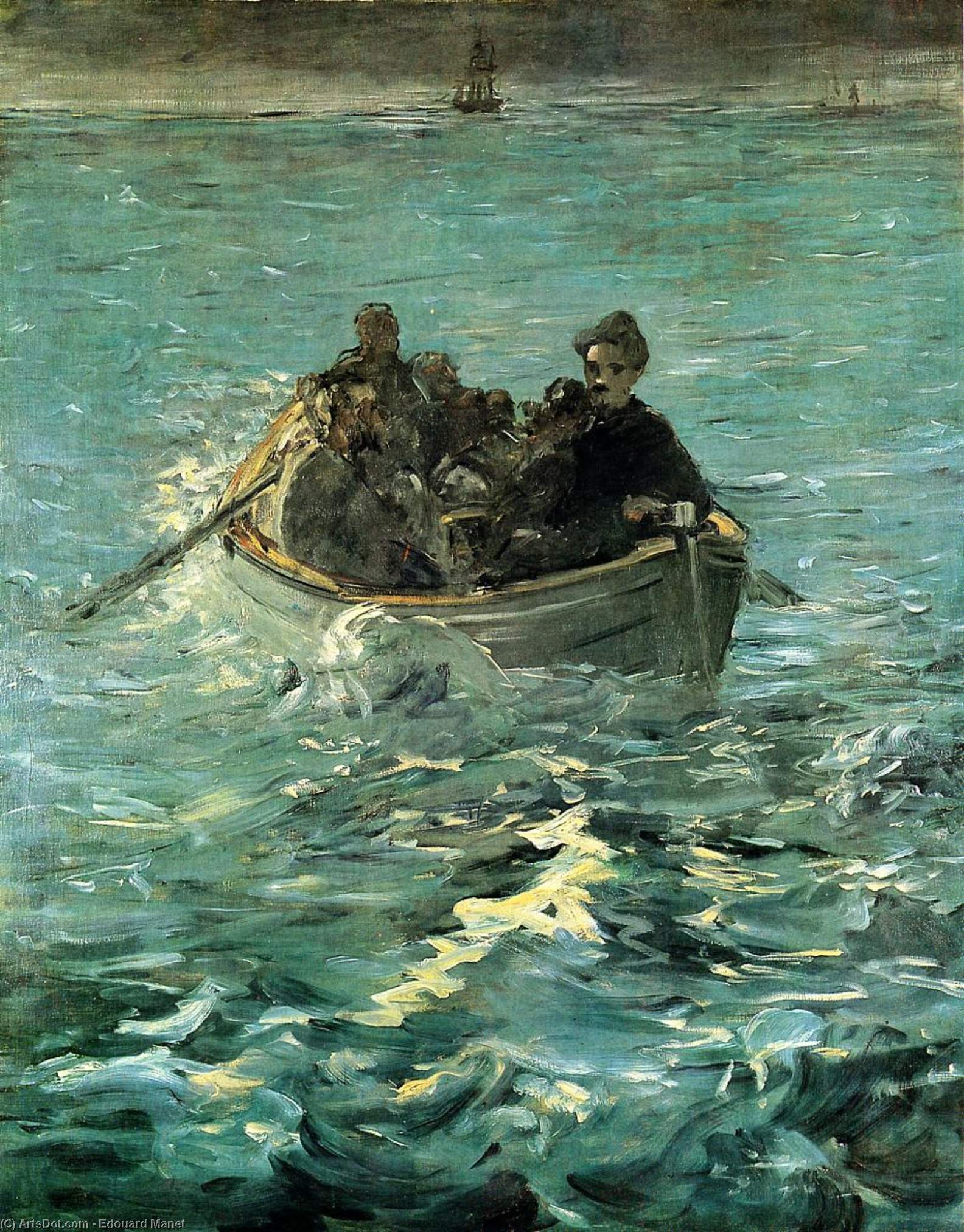
Experience Édouard Manet’s "The Escape of Rochefort," a dramatic depiction of a daring escape from New Caledonia, showcasing the artist's revolutionary style and historical insight.
Explore Édouard Manet (1832-1883), a pivotal figure bridging Realism & Impressionism. Discover iconic works like 'Le Déjeuner sur l'herbe' and 'Olympia,' and his lasting impact on modern art.
Explore the Kunsthaus Zürich's diverse collection spanning centuries! From Monet to Giacometti & modern masterpieces, experience Swiss and international art in a stunning architectural setting.
The Dramatic Escape: Manet’s “The Escape of Rochefort”
Édouard Manet's "The Escape of Rochefort," painted in 1880 and now residing within the esteemed Kunsthaus Zürich, is far more than a mere historical depiction; it’s a potent distillation of political commentary, a daring exploration of genre conventions, and a testament to Manet’s unique artistic vision. The painting captures a pivotal moment – the audacious flight of Victor Henri Rochefort, a prominent French politician exiled to New Caledonia following his involvement in the tumultuous Paris Commune. Yet, it's not simply a chronicle of events; Manet transforms this historical narrative into a dynamic and emotionally charged scene brimming with adventure, camaraderie, and an underlying sense of precariousness. The composition immediately draws the eye to a small, rather humble rowboat battling against a vast, turbulent sea – a visual metaphor for the challenges faced by those challenging established authority.
The painting’s power lies not just in its subject matter but also in Manet's masterful manipulation of artistic techniques. He eschews the polished realism favored by the Académie des Beaux-Arts, opting instead for a looser, more expressive brushstroke that imbues the scene with movement and immediacy. The colors are deliberately muted – predominantly blues and greens dominate – creating an atmosphere of brooding intensity. Notice how Manet employs broken color to suggest the choppy waves and the swirling mist, conveying both the physical danger and the psychological tension of the escape. The figures themselves are rendered with a remarkable lack of detail; they’re not idealized heroes but recognizable individuals caught in a desperate situation. This deliberate simplification allows the viewer to project their own emotions onto the scene – empathy for the fugitives, perhaps, or even a sense of vicarious thrill at their daring endeavor.
A Historical Context: Beyond the Commute
To fully appreciate “The Escape of Rochefort,” it’s crucial to understand its historical context. The painting was created during a period of intense political upheaval in France following the failed uprising of 1871 and the subsequent establishment of the Paris Commune. Rochefort, a vocal supporter of the Communards, became a symbol of resistance against the newly installed Third Republic. Manet’s decision to depict this escape wasn't simply an artistic choice; it was a deliberate act of political engagement. He consciously chose to represent a figure who had been exiled and condemned, aligning himself with those challenging the status quo. Furthermore, the painting directly engages with the conventions of history painting – a genre traditionally reserved for grand narratives of kings and battles. By applying these techniques to a relatively minor political event, Manet subverts expectations and forces viewers to reconsider the purpose and scope of historical representation.
Interestingly, Manet’s approach contrasts sharply with that of his contemporary, Edgar Degas, who, as seen in “At the Races,” focused on capturing the immediacy and spectacle of sporting events. While Degas sought to document a specific moment in time, Manet uses the history painting format to explore broader themes of rebellion, exile, and the human spirit’s capacity for resilience. The juxtaposition highlights the different ways artists can engage with historical subjects – one through meticulous observation, the other through expressive interpretation.
Symbolism and Emotional Resonance
Beyond its political significance, “The Escape of Rochefort” is rich in symbolic detail. The small rowboat itself represents vulnerability and precariousness, highlighting the desperate circumstances faced by the fugitives. The dog accompanying them adds a layer of warmth and companionship to the scene – a symbol of loyalty and solidarity amidst adversity. Even the vast expanse of the sea can be interpreted symbolically: it represents both the challenges that lie ahead and the unknown possibilities that await those who dare to break free from confinement. The painting’s emotional impact is undeniably powerful, evoking feelings of suspense, hope, and perhaps even a touch of melancholy for those left behind.
The deliberate ambiguity surrounding Rochefort's face – he’s largely obscured by shadow – further enhances this sense of mystery and intrigue. It invites the viewer to contemplate his motivations and his fate, transforming the painting into more than just a depiction of an escape; it becomes a meditation on freedom, exile, and the complexities of human experience.
Manet's Legacy and Beyond
“The Escape of Rochefort” stands as a pivotal work in Manet’s oeuvre and a landmark achievement in French art history. It demonstrated his willingness to challenge artistic conventions, engage with contemporary political issues, and explore new ways of representing the world around him. His innovative use of color, brushstroke, and composition paved the way for future generations of artists, including Impressionists like Monet and Renoir, who built upon Manet’s legacy by further pushing the boundaries of artistic expression. For those seeking to delve deeper into Manet's work or explore the broader context of 19th-century French art, a visit to the Kunsthaus Zürich is highly recommended, as is exploring the museum’s comprehensive collection dedicated to Manet and his contemporaries. Furthermore, examining works by artists like Paul Cézanne – known for his contributions to Post-Impressionism – offers valuable insights into the artistic currents that shaped Manet's revolutionary approach.