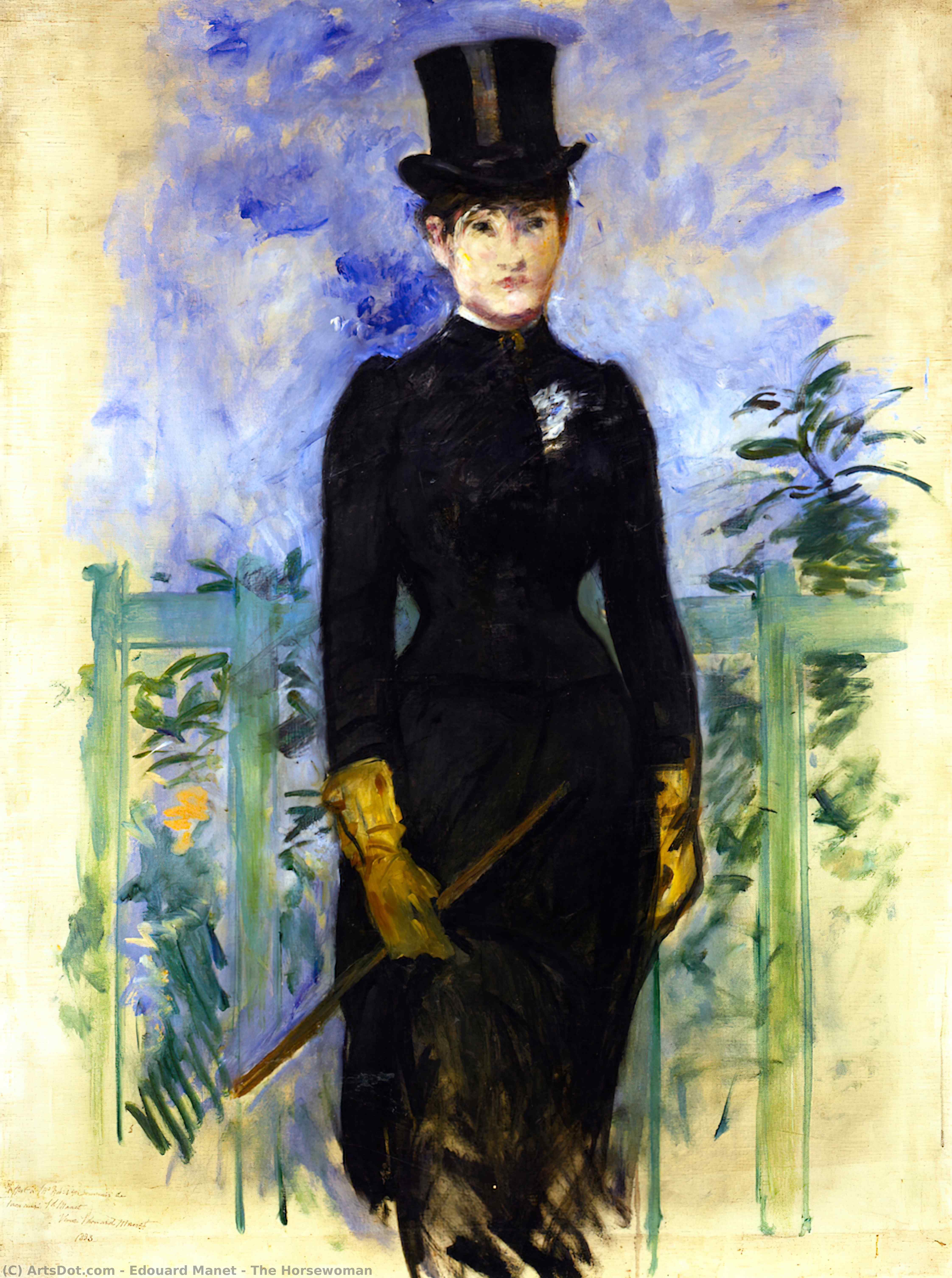
Explore Édouard Manet's 'The Horsewoman' (1882) – a captivating Impressionistic portrait blending elegance & melancholy. Own a hand-painted reproduction of this striking artwork today!
Explore Édouard Manet (1832-1883), a pivotal figure bridging Realism & Impressionism. Discover iconic works like 'Le Déjeuner sur l'herbe' and 'Olympia,' and his lasting impact on modern art.
A Study in Restrained Elegance
Édouard Manet’s “The Horsewoman,” painted in 1882, is a captivating portrait that transcends simple representation, offering instead a nuanced exploration of societal expectations and feminine independence within the burgeoning Impressionist movement. This work presents a full-length depiction of a woman poised for equestrian activity, yet notably *without* her horse – a deliberate omission that invites intriguing interpretation.
Impressionistic Technique & Composition
While firmly rooted in Impressionism’s emphasis on capturing fleeting moments and atmospheric effects through loose brushwork, this painting demonstrates Manet's unique approach to composition. Unlike some of his more radically broken compositions, “The Horsewoman” possesses a deliberate structure. The figure is centrally positioned, though slightly off-kilter, creating visual interest without disrupting the overall balance. Short, choppy brushstrokes define her tailored black jacket dress and suggest texture, while the background dissolves into blurred foliage and a pale sky, characteristic of Impressionistic rendering of light and atmosphere.
Historical Context & Manet’s Innovation
Manet was a pivotal figure in bridging Realism and Impressionism, challenging academic conventions and paving the way for modern art. Created towards the end of his life, “The Horsewoman” reflects his continued experimentation with form and subject matter. During this period, equestrian pursuits were often associated with wealth and social status, making the subject itself a statement about class and privilege. However, Manet subverts expectations by focusing on the woman *as* an individual rather than simply as a symbol of her position.
Symbolism & Emotional Resonance
The absence of the horse is arguably the most compelling aspect of this painting. It can be interpreted in multiple ways: perhaps symbolizing the woman’s self-reliance and independence, or hinting at a sense of anticipation, waiting, or even confinement. Her formal attire – the black jacket, yellow gloves, and tall top hat – speaks to societal constraints placed upon women during the 19th century. The riding crop suggests control, but also perhaps a desire for freedom. A subtle melancholy pervades the work, conveyed through her reserved expression and the muted color palette.
Color Palette & Visual Impact
The painting’s restrained color scheme – dominated by blacks, deep blues, and greys – is dramatically offset by the striking yellow of her gloves. This bold contrast immediately draws the eye to her hands and the riding crop, emphasizing agency and action. The overall effect is one of understated sophistication and quiet contemplation.
Bringing Timeless Art into Your Space
“The Horsewoman” offers a sophisticated aesthetic that complements both traditional and contemporary interiors. Its muted tones create a calming atmosphere, while its intriguing subject matter sparks conversation. A reproduction of this masterpiece will add a touch of intellectual elegance and artistic depth to any home or office, serving as a constant source of inspiration and contemplation.