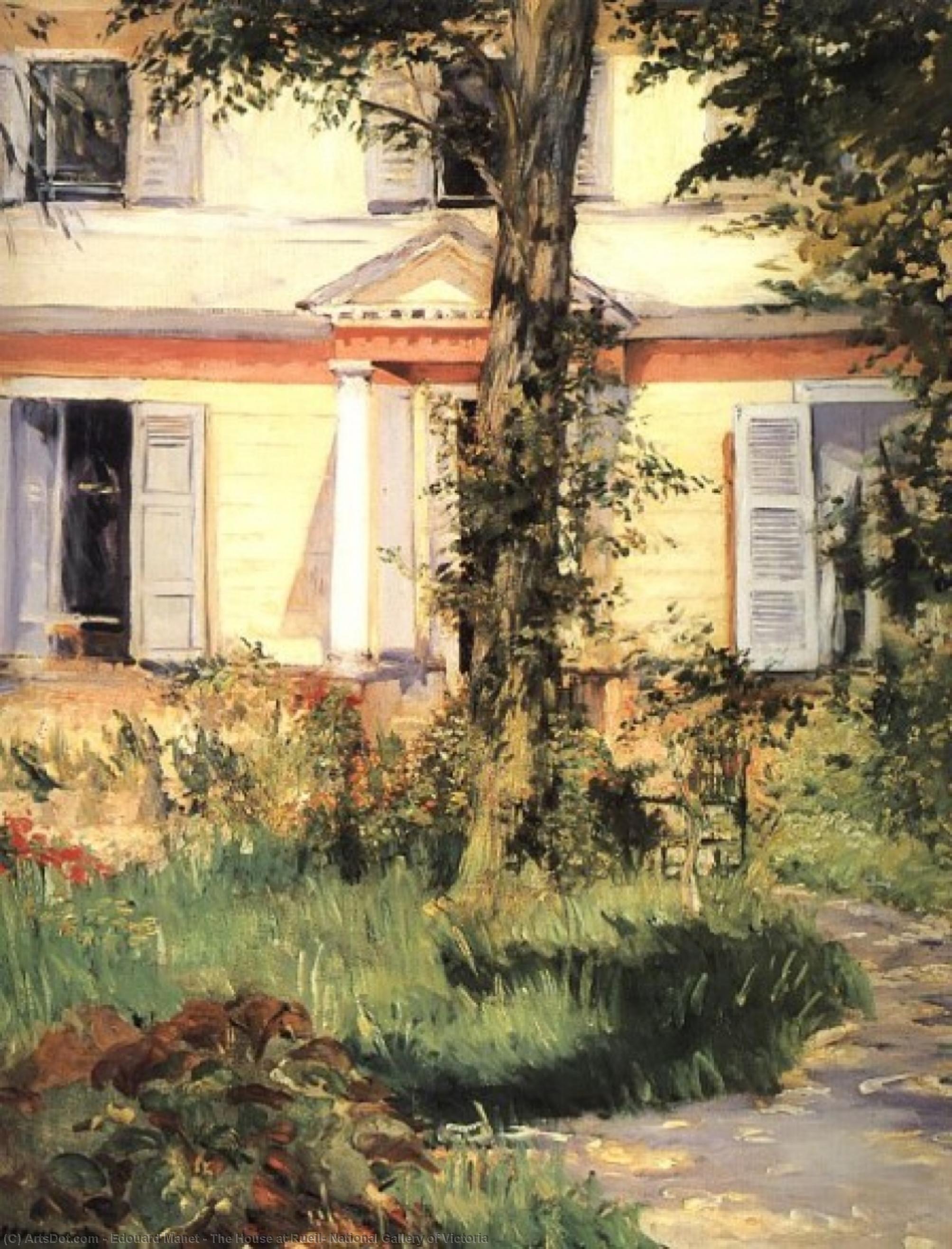
“The House at Rueil,” created in 1882 by Édouard Manet exemplifies Impressionism’s focus on capturing fleeting moments of daily life. Featuring a serene depiction of a Parisian house and garden, it showcases Manet's innovative approach to painting and his lasting impact on artistic movements. Admire this iconic artwork at the National Gallery of Victoria in Melbourne.
The House at Rueil, Édouard MANET
Édouard Manet’s “The House at Rueil” stands as a cornerstone of Impressionist painting—a deceptively simple depiction that encapsulates the spirit of modern life and profoundly influenced subsequent artists. Completed in 1882 during his brief residency in Paris, this canvas transcends mere architectural representation; it's an exploration of light, atmosphere, and fleeting emotion, reflecting Manet’s pioneering approach to capturing the immediacy of experience.
### A Snapshot of Parisian Life
The painting portrays a modest house at Rue du Château No. 18 in Rueil-Malmaison—a suburb of Paris—where Manet himself resided with his family during the summer months preceding his untimely death. Rather than striving for photographic accuracy, Manet deliberately eschewed meticulous detail, focusing instead on conveying the essence of a particular moment in time. The composition is strikingly balanced, mirroring the tranquility of the scene and subtly hinting at Manet’s own contemplative state as he wrestled with artistic innovation.
### Impressionistic Technique: Light and Color
Manet employed characteristic Impressionist techniques—primarily loose brushstrokes and vibrant color palettes—to achieve his vision. He skillfully utilized diffused sunlight to illuminate the house, casting soft shadows that contribute to the overall sense of serenity. The dominant hues are earthy tones—greens, browns, and reds—creating a harmonious blend that evokes the lush vegetation surrounding the dwelling. Notice how Manet captures the subtle variations in color within the foliage, demonstrating his meticulous observation of natural phenomena.
### Symbolism Within Simplicity
Beyond its technical brilliance, “The House at Rueil” is laden with symbolic significance. The house itself represents domesticity and stability—a counterpoint to the dynamism of Parisian society. The solitary tree positioned prominently in front of the building symbolizes resilience and permanence amidst change. Furthermore, the inclusion of a dog adds warmth and companionship to the scene, suggesting Manet’s desire to portray human connection within an urban landscape.
### Influence on Later Artists
Manet's bold experimentation with color and composition served as a catalyst for artistic evolution, inspiring artists like Eliza Goodridge—an American painter known for her portraits—who sought to emulate Manet’s stylistic innovations. His willingness to challenge academic conventions paved the way for Impressionism’s ascendancy and cemented his legacy as one of the most influential figures in modern art history.
- Size: Approximately 92.8 × 73.5 cm (36.5 × 29 inches)
- Date: 1882
- Location: National Gallery of Victoria, Melbourne, Australia
Discover the rich history of artworks at Bodleian Libraries, Oxford, United Kingdom: /art/list/?Filter=A@D3BV87-Discovering-the-Artworks-of-Bodleian-Libraries-Oxford-United-Kingdom