A Nocturne of Longing: Edvard Munch’s ‘Girls on the Pier’
Edvard Munch's “Girls on the Pier,” painted in 1904, isn’t merely a depiction of a seaside scene; it’s a profound exploration of isolation, anxiety, and the unsettling beauty of human emotion. Created during a period of intense personal struggle for the artist – marked by recurring nightmares, mental health challenges, and a deep-seated fear of mortality – the painting resonates with an almost palpable sense of unease that continues to captivate viewers over a century later. It’s a work steeped in Symbolism and Expressionism, pushing beyond realistic representation to delve into the inner landscapes of the human psyche.
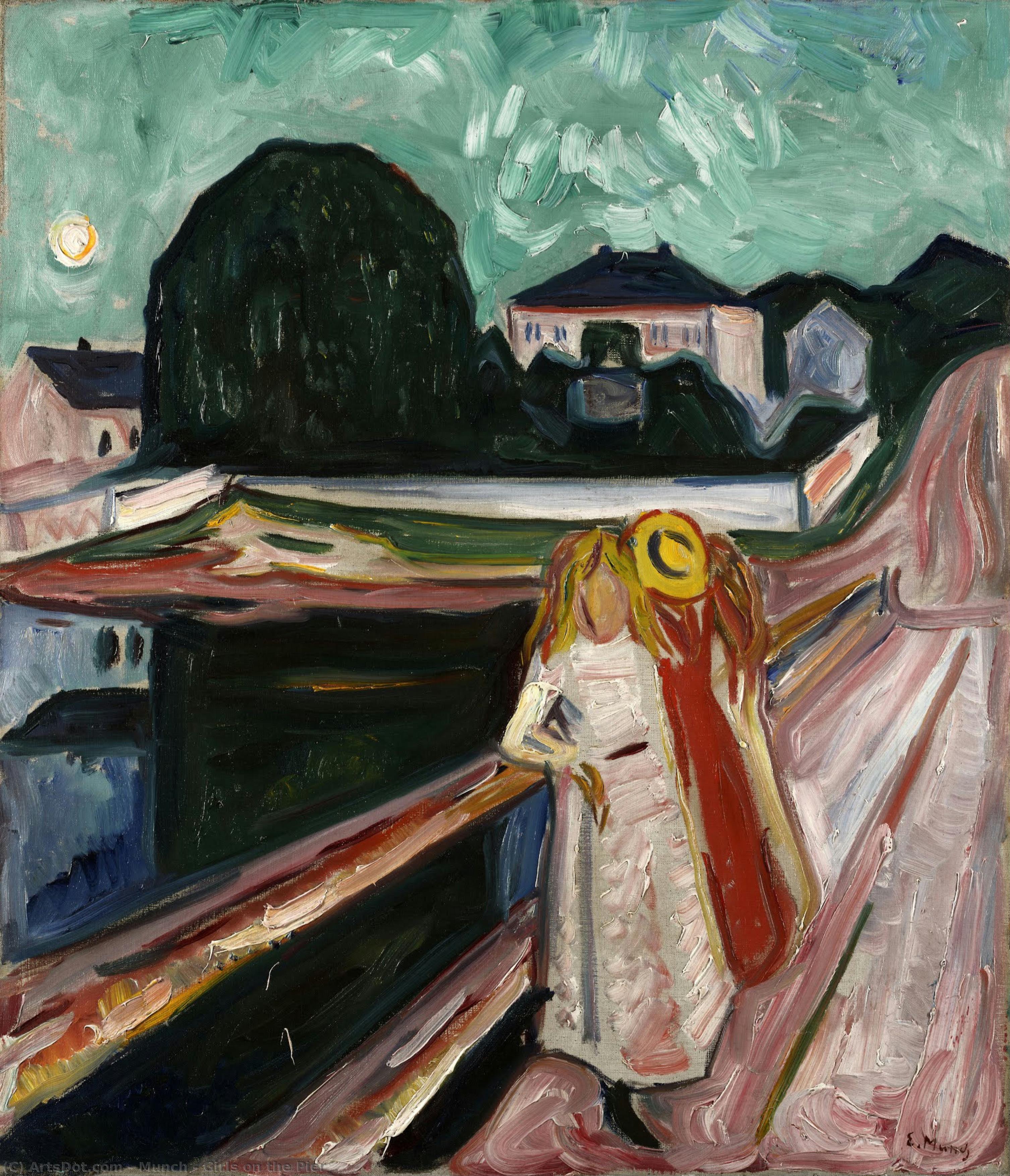
The composition itself is strikingly unconventional. Munch abandons traditional perspective, instead employing a dramatic, slanting diagonal that dominates the canvas. This pier, rendered in shades of dusky pinks and reds, doesn’t offer a comforting vista; it relentlessly draws the eye towards a distant, almost spectral hotel under a swollen, full moon. The figures – four young women – are positioned along this unsettling trajectory, seemingly lost within their own thoughts, adrift in a space that feels both expansive and claustrophobic. Their postures are subtly melancholic, suggesting a shared burden of unspoken anxieties. Notably, one girl turns her back to the group, her face an enigmatic blankness—a powerful symbol of detachment and introspection.
The Palette of Disquiet: Color and Technique
Munch’s masterful use of color is central to the painting's emotional impact. He eschews bright, cheerful hues in favor of a muted palette dominated by greens, pinks, reds, and blues—a deliberate choice that contributes to the overall atmosphere of melancholy and foreboding. The sky isn’t a serene blue but rather a bruised turquoise-green, mirroring the turbulent emotions simmering beneath the surface. Bold brushstrokes are immediately apparent; they aren't blended smoothly but retain their individual character, creating a textured surface that feels both raw and immediate. This visible technique—a hallmark of Munch’s style—underscores the painting’s intensely personal nature, conveying not just an image but also the artist’s own emotional state.
The application of paint is particularly noteworthy in the rendering of the pier itself. The diagonals are emphasized through thick, layered strokes, creating a sense of instability and movement. The distant hotel, bathed in the ethereal glow of the moon, appears almost dreamlike—a symbol perhaps of unattainable desires or lost innocence. Munch’s technique isn't about replicating reality; it’s about translating feeling onto canvas, using color and line to evoke a specific mood.
Symbolism and the Weight of Experience
“Girls on the Pier” is rich in symbolic meaning, reflecting Munch’s own personal struggles with illness, loss, and mental instability. The pier itself can be interpreted as a liminal space—a threshold between worlds, representing the uncertainty and anxiety inherent in life. The women themselves embody themes of isolation, introspection, and perhaps even repressed desires. Their averted gazes suggest a shared awareness of something unspoken, a collective burden of melancholy. The blank expression of the girl facing away from the group is particularly poignant, hinting at a profound sense of detachment and an inability to connect with others.
Furthermore, the setting—Åsgårdstrand, where Munch spent time in 1893 developing these ideas—was a popular resort known for its artistic community. However, even within this environment of creativity, Munch’s vision remained shadowed by his personal demons. The painting isn't simply a depiction of a seaside scene; it’s a window into the artist’s troubled soul.
A Legacy of Emotional Intensity
“Girls on the Pier” stands as one of Edvard Munch’s most enduring and emotionally resonant works. Its haunting beauty, combined with its underlying sense of unease, continues to resonate with viewers today. The painting's influence can be seen in subsequent generations of Expressionist artists, who embraced Munch’s exploration of subjective experience and his willingness to confront the darker aspects of human existence. Reproductions of this powerful image—particularly those capturing the dynamic brushwork and evocative color palette—offer a glimpse into the mind of a tormented genius, inviting us to contemplate our own anxieties and vulnerabilities in the face of an uncertain world.