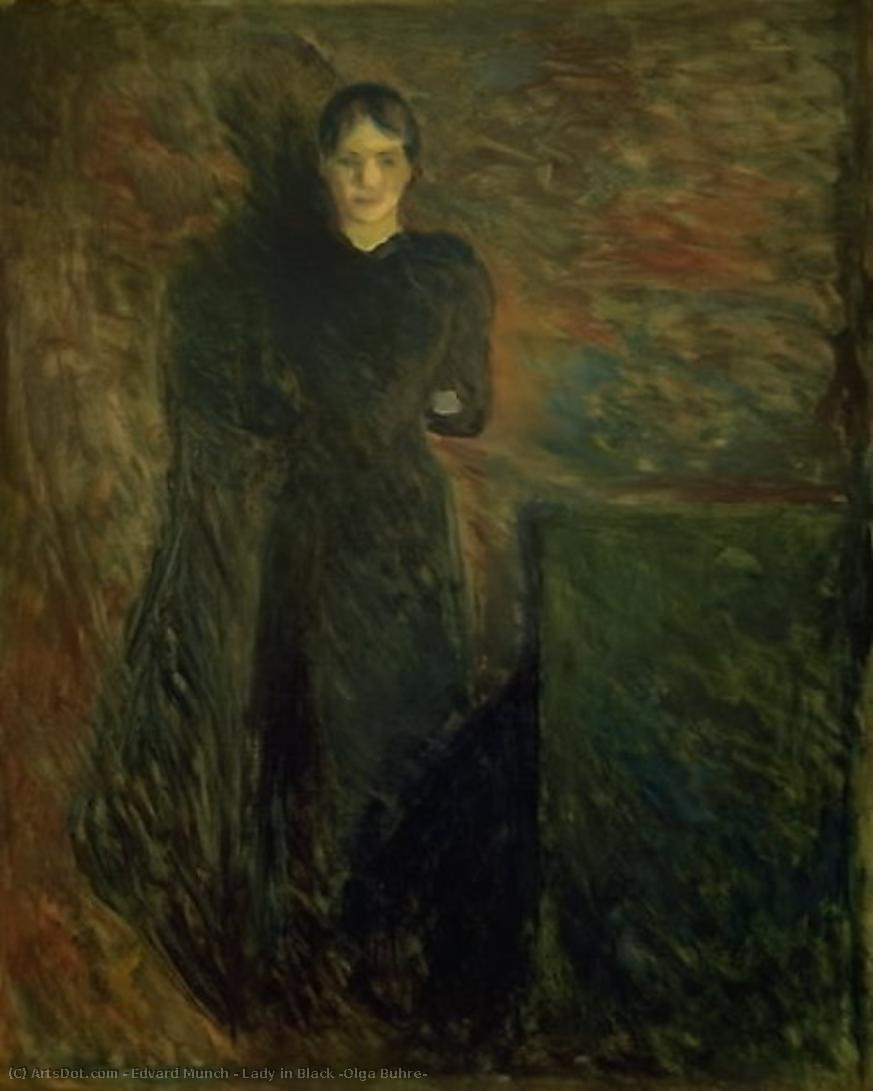
Lady in Black (Olga Buhre)

Experience Edvard Munch’s iconic "Lady in Black," a haunting 1891 portrait brimming with mystery and psychological depth. This evocative painting captures the artist's signature style, exploring themes of melancholy and despair. Discover this captivating artwork and bring its timeless beauty into your space.


Edvard Munch (1863 - 1944)

Explore Edvard Munch (1863-1944), pioneer of Expressionism! Discover 'The Scream' & art exploring anxiety, mortality, love & psychological themes.

Lady in Black: A Portrait of Existential Disquiet

  • Edvard Munch’s “Lady in Black,” painted in 1891, is more than just a portrait; it's a distilled essence of the anxieties that defined the fin de siècle. Executed during a period of profound social and intellectual upheaval, this work embodies the burgeoning Symbolist movement’s fascination with psychological states and subjective experience. Measuring 73 x 59 cm, the intimate scale of the painting draws the viewer into a remarkably personal space, mirroring the internal turmoil suggested by the subject's gaze.
  • The sitter, identified as Olga Buhre, presents a striking image of controlled defiance. Dressed entirely in black – a color historically associated with mourning, power, and mystery – she adopts a posture of assertive independence, her hands firmly planted on her hips. This deliberate positioning immediately establishes a sense of contained energy, hinting at an underlying tension or perhaps even disdain. The artist’s masterful use of dark tones amplifies this effect, creating a dramatic chiaroscuro that emphasizes the contours of her face and clothing.

Technique and Style: Echoes of Expressionism

  • Munch's technique in “Lady in Black” anticipates the tenets of Expressionism, a movement he would significantly influence. He employs loose brushstrokes and a flattened perspective to convey emotion rather than strict realism. The paint is applied with a deliberate roughness, adding to the painting’s raw intensity. Note the almost sculptural quality of the figure, achieved through careful manipulation of light and shadow.
  • The background, featuring a simple chair seemingly integrated into a dining table setting, serves not as a mere decorative element but as a subtle stage for the drama unfolding within the portrait. This deliberate ambiguity contributes to the painting’s overall sense of mystery and invites speculation about the sitter's thoughts and feelings.

Symbolism and Context: A Reflection of Munch’s World

  • Painted in 1891, “Lady in Black” reflects the anxieties prevalent during a time of rapid industrialization, social change, and burgeoning psychological theories. The color black itself carries significant symbolic weight – representing mourning, death, but also power and sophistication. It’s a deliberate choice that elevates the portrait beyond a simple likeness.
  • Munch's personal life profoundly shaped his artistic vision. His early experiences with loss—the deaths of his mother and sister from tuberculosis—fueled a lifelong preoccupation with themes of mortality, illness, and psychological distress. This biographical context is crucial to understanding the painting’s emotional depth; it’s not merely an observation of a woman but a projection of Munch's own anxieties onto her form.

Emotional Impact and Collectible Value

  • "Lady in Black" possesses a haunting beauty that continues to resonate with viewers today. The painting’s ability to evoke feelings of unease, contemplation, and perhaps even melancholy is a testament to Munch's artistic genius. It represents a pivotal moment in the development of modern art, bridging the gap between Symbolism and Expressionism.
  • As a work by one of the most influential artists of the late 19th and early 20th centuries, “Lady in Black” holds significant historical and artistic value. A hand-painted reproduction offers an exceptional opportunity to experience this iconic image firsthand, bringing Munch’s profound vision into your home or studio.