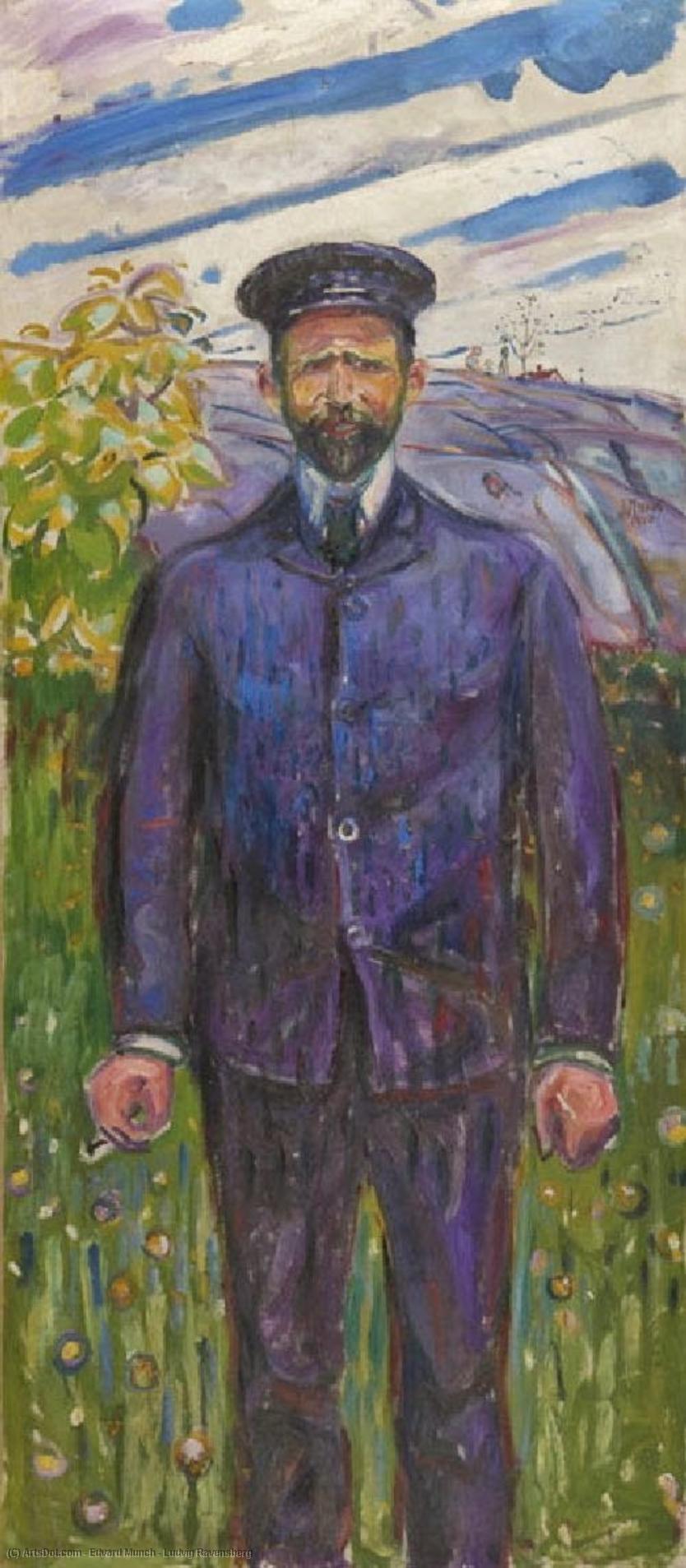
Explore Edvard Munch’s ‘Ludvig Ravensberg’! A vibrant Post-Impressionist portrait in oil, capturing atmospheric landscapes & emotional depth. Discover its unique style & symbolism.
Explore Edvard Munch (1863-1944), pioneer of Expressionism! Discover 'The Scream' & art exploring anxiety, mortality, love & psychological themes.
A Portrait of Quiet Dignity: Exploring Edvard Munch’s “Ludvig Ravensberg”
This captivating portrait by Edvard Munch presents a man formally dressed in a dark suit and hat, set against a backdrop of swirling, impressionistic landscape. While the exact date and size remain unknown, the work offers a compelling glimpse into Munch's evolving style and his preoccupation with the human condition. The painting is demonstrably influenced by Post-Impressionism – particularly the expressive color and textured brushwork reminiscent of Vincent van Gogh – yet retains a uniquely Norwegian sensibility. It’s a piece that invites contemplation, prompting questions about the sitter’s identity and inner life.
Style & Technique: A Bridge Between Impressionism and Expressionism
Munch masterfully employs an impasto technique, layering thick strokes of oil paint onto the canvas to create a rich, tactile surface. This is particularly evident in the rendering of the foliage and sky, where color seems to vibrate with energy. The composition relies heavily on loose brushwork and a focus on capturing light and atmosphere rather than precise detail. Lines are short and broken, contributing to the overall impressionistic feel, while organic shapes avoid harsh edges. The flattened perspective, typical of Impressionism, prioritizes the emotional impact over strict spatial accuracy. The color palette is dominated by deep blues, purples, and greens, providing a somber yet vibrant foundation, punctuated by warmer yellows that draw the eye to key areas. This technique foreshadows Munch’s later fully-fledged Expressionist works, where he would further distort form and amplify emotional intensity.
Historical Context & Symbolism
Painted during a period of significant artistic transition, “Ludvig Ravensberg” reflects the growing dissatisfaction with academic realism and the embrace of subjective experience. Munch’s biography profoundly shaped his art; marked by loss, illness, and a lifelong struggle with mental health, he sought to express the inner turmoil that defined his existence. The figure in formal attire suggests a sense of respectability or perhaps isolation – is this a man of business, a traveler, or someone simply observing the world from a distance? The turbulent landscape, rendered with such expressive force, could symbolize the anxieties and uncertainties of modern life, mirroring the internal struggles of the sitter. The painting’s creation likely occurred during Munch's formative years, as he moved away from naturalism toward more symbolic representations of human emotion – a pivotal moment in his artistic development.
Emotional Resonance & Contemporary Appeal
“Ludvig Ravensberg” is not merely a portrait; it’s an exploration of mood and psychological state. The painting evokes a sense of quiet melancholy, inviting viewers to project their own emotions onto the scene. Its enduring appeal lies in its ability to resonate with contemporary audiences who grapple with similar themes of isolation, anxiety, and the search for meaning. For collectors, this work represents a significant example of Munch’s transitional style – a bridge between Impressionism and his groundbreaking Expressionist masterpieces. Interior designers will appreciate its sophisticated color palette and evocative atmosphere, which can add depth and intrigue to any space. A high-quality reproduction of “Ludvig Ravensberg” offers an opportunity to bring the emotional power and artistic brilliance of Edvard Munch into your home or office.