Explore Edvard Munch (1863-1944), pioneer of Expressionism! Discover 'The Scream' & art exploring anxiety, mortality, love & psychological themes.
Explore the world's largest collection of Edvard Munch’s art at Oslo’s MUNCH Museum! Discover iconic works like *The Scream*, contemporary exhibits, and stunning architecture on the Oslofjord.
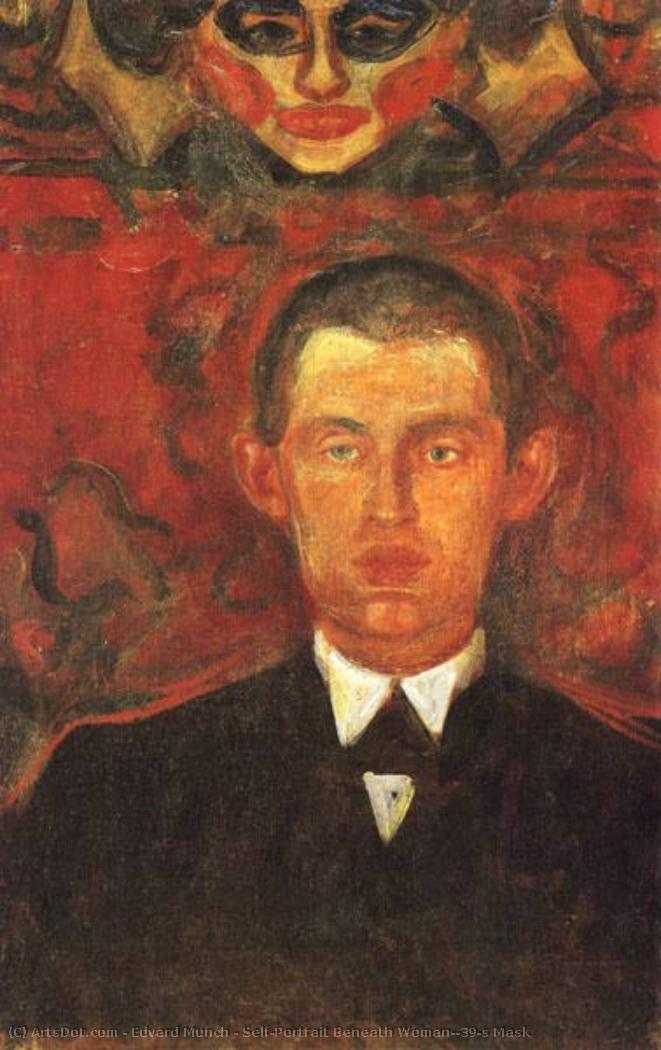
Self-Portrait Beneath Woman's Mask
Edvard Munch’s “Self-Portrait Beneath Woman’s Mask,” completed in 1892, stands as a haunting testament to the artist’s preoccupation with psychological turmoil and his pioneering exploration of Expressionist aesthetics. More than just a depiction of an individual face—though Munch meticulously captures its features—the painting embodies a profound meditation on identity, vulnerability, and the pervasive influence of emotion upon perception. Painted in tempera on unprimed wooden panel, it exemplifies Munch’s commitment to conveying inner experience rather than merely representing external reality.
- Style: Expressionism – Munch’s distinctive style rejects academic conventions, prioritizing subjective feeling and distortion to communicate psychological states. The painting abandons naturalistic representation in favor of symbolic imagery designed to evoke intense emotion.
- Color Palette: Dominated by fiery reds and stark blacks, the color scheme contributes significantly to the artwork's dramatic atmosphere. These hues aren’t employed conventionally; instead, they serve as conduits for Munch’s inner anxieties—the red symbolizing passion and danger, while black represents darkness and despair.
- Technique: Munch utilized a bold brushstroke technique characterized by thick impasto – applying paint thickly onto the surface of the canvas – creating textural surfaces that heighten visual impact and convey a sense of urgency. This method underscores the artist’s desire to capture not just what he saw but how he *felt*.
The painting's historical context is inextricably linked to Munch’s personal struggles with mental illness and his fascination with themes of mortality and psychological vulnerability. Created during a period marked by intellectual ferment—particularly influenced by Symbolism—the artwork reflects the broader artistic movement’s interest in exploring subconscious anxieties and portraying inner landscapes as vividly as external ones. The Symbolist movement championed subjective experience, rejecting realism in favor of evocative imagery that aimed to communicate emotional truths beyond rational comprehension. Munch's exploration of these themes aligns perfectly with the spirit of this era.
- Symbolism: Recurring motifs—such as the woman’s mask and the skeletal arm—are laden with symbolic significance. The mask represents concealment, repression, and the difficulty of confronting one’s inner demons. Simultaneously, the skeleton arm symbolizes death and decay, serving as a constant reminder of human fragility.
- Composition: Munch's masterful composition draws attention to the central figure’s face—a focal point that commands immediate visual engagement. The surrounding figures serve as framing elements, enhancing the sense of isolation and amplifying the emotional intensity of the portrait.
“Self-Portrait Beneath Woman’s Mask” transcends mere visual representation; it operates on a deeper level to provoke contemplation about the human condition. Munch's deliberate use of color and technique—coupled with his exploration of psychological themes—creates an artwork that resonates powerfully with viewers, conveying a palpable sense of unease and vulnerability. It remains a cornerstone of Expressionist art, cementing Munch’s legacy as one of the most influential artists of the late nineteenth century and continuing to inspire artistic interpretation today. Its enduring power lies in its ability to capture the essence of existential angst—a timeless reflection on the complexities of human consciousness and emotion.