The Haunting Beauty of Suffering: Edvard Munch's Self-Portrait During Eye Disease II
Edvard Munch, a name synonymous with the anxieties and emotional turbulence of the modern age, possessed an unparalleled ability to translate inner turmoil into visual form. His oeuvre is not merely a collection of paintings; it’s a raw, unflinching exploration of the human condition – a landscape scarred by loss, fear, and the inescapable awareness of mortality. Among his most poignant works, Self-Portrait During Eye Disease II (1930) stands as a particularly arresting testament to this vision, offering a deeply personal glimpse into the artist’s struggles with illness and a profound meditation on the nature of suffering itself.

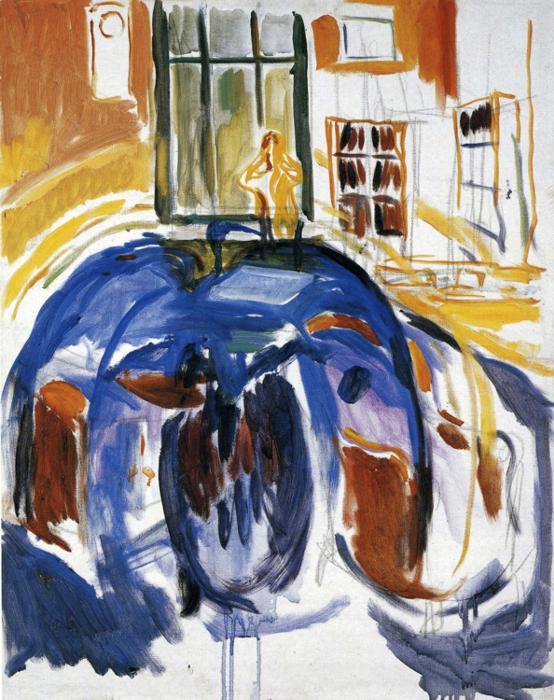
(Image: Self-Portrait During Eye Disease II by Edvard Munch)
A Fragmented Reality: Style, Technique, and the Expressionist Vision
Painted during a period of significant physical hardship for Munch – he was battling a severe eye hemorrhage that threatened his vision – this work exemplifies the core tenets of Expressionism. The painting eschews realistic representation in favor of conveying intense emotional experience. Munch employs distorted forms, elongated figures, and jarring color combinations to create an atmosphere of unease and psychological distress. Notice how the woman’s features are subtly warped, her gaze fixed on the distant window with a palpable sense of melancholy. The use of muted blues and greens, punctuated by flashes of ochre and crimson, further amplifies this feeling of disquiet. The loose, almost frantic brushstrokes contribute to the painting's dynamic energy, mirroring the turbulent state of mind it seeks to portray.
Executed in oil on canvas, a medium Munch favored for its ability to capture both texture and emotion, the work is characterized by a remarkable economy of detail. The background—a blurred cityscape punctuated by windows and a passing blue automobile—functions less as a literal depiction and more as a symbolic backdrop, intensifying the woman’s isolation and introspection. The inclusion of two chairs, one centrally positioned and another to the right, subtly suggests a moment of pause, a brief respite from the overwhelming weight of her thoughts.
The Language of Loss: Symbolism and Personal Narrative
Beyond its formal qualities, Self-Portrait During Eye Disease II is deeply rooted in Munch’s personal history. The painting directly references his own struggles with eye disease, a condition that had plagued him for years and profoundly impacted his artistic practice. The woman's gaze, often interpreted as one of profound sadness or contemplation, can be seen as an embodiment of Munch’s own anxieties about loss, mortality, and the fragility of human perception. The bird perched on the left side of the canvas offers a fleeting moment of tranquility—a fragile symbol of hope amidst the prevailing gloom.
Furthermore, the painting resonates with broader themes explored throughout Munch's work: the isolation of the individual in the face of overwhelming forces, the haunting presence of death and disease, and the struggle to find meaning in a world seemingly devoid of order. The window itself serves as a potent symbol—a barrier between the interior world of the woman’s thoughts and the external reality, suggesting a sense of detachment and alienation.
A Legacy of Emotional Intensity: Reproduction and Artistic Resonance
Self-Portrait During Eye Disease II remains one of Munch's most compelling and emotionally resonant works. Its enduring power lies in its ability to tap into universal themes of suffering, loss, and the search for meaning. ArtsDot offers meticulously crafted hand-painted reproductions that faithfully capture the painting’s original intensity and detail, allowing you to experience this masterpiece firsthand. Whether displayed as a striking centerpiece or incorporated into a thoughtfully curated interior space, a reproduction of Self-Portrait During Eye Disease II serves not only as an artistic object but also as a poignant reminder of the complexities and vulnerabilities of the human spirit.