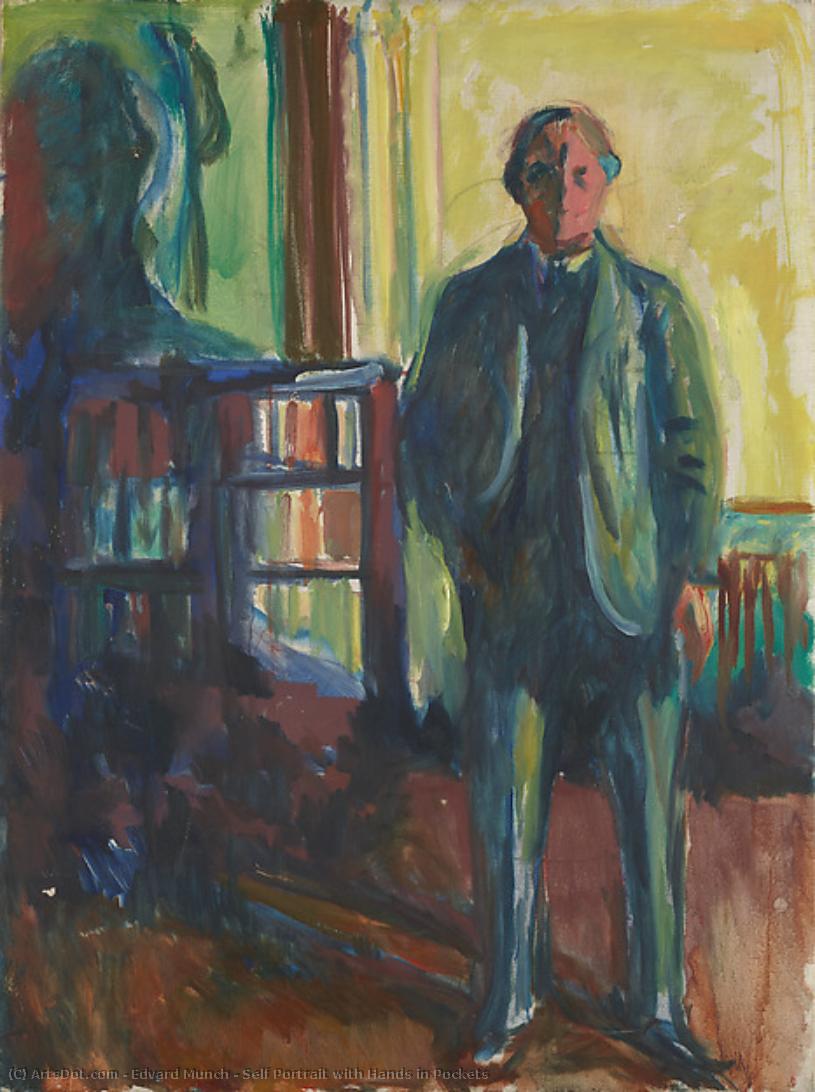
Explore Edvard Munch’s ‘Self Portrait with Hands in Pockets.’ A haunting Expressionist piece featuring bold brushstrokes & unsettling colors. Discover this 1926 oil painting's emotional depth.
Explore Edvard Munch (1863-1944), pioneer of Expressionism! Discover 'The Scream' & art exploring anxiety, mortality, love & psychological themes.
A Window into Inner Turmoil: Edvard Munch’s 1926 Self-Portrait
This striking self-portrait, created in 1926, offers a compelling glimpse into the psychological landscape of one of art history's most influential figures – *Edvard Munch*. More than just a likeness, this work embodies the core tenets of Expressionism, revealing a profound sense of introspection and emotional vulnerability. Measuring 80 x 60 cm, the painting’s intimate scale draws the viewer into a deeply personal space.
Style & Technique: Echoes of a Master
The artwork is immediately recognizable as belonging to Munch's distinctive style – a bold departure from traditional representation. The loose brushwork and flattened perspective are hallmarks of his approach, reminiscent of his earlier, iconic works like *The Scream*. Munch employs an expressive use of line, prioritizing emotional impact over realistic depiction. Swirling strokes convey movement and unrest, while simplified forms contribute to the painting’s overall intensity. Impasto, the thick application of paint, creates a rich texture that invites tactile engagement and adds dynamism to the composition. The palette is dominated by unsettling yet evocative greens, blues, and yellows, further enhancing the work's emotional resonance.
Subject & Composition: Isolation and Introspection
The painting depicts Munch himself, dressed in a dark suit, positioned slightly off-center within an interior space. His hands tucked into his pockets suggest a posture of withdrawal and contemplation. The blurred background hints at a room filled with bookshelves and draped fabric – perhaps the artist’s studio or living quarters – yet it remains indistinct, emphasizing the figure's isolation. The composition focuses intently on Munch’s face and body language, inviting viewers to decipher his inner state.
Historical Context: A Life Marked by Loss
To understand this self-portrait fully, one must consider Munch’s biography. Born in 1863, his life was profoundly shaped by tragedy – the early deaths of his mother and sister from tuberculosis, coupled with a lifelong fear of inherited mental illness. These experiences instilled in him a deep preoccupation with themes of mortality, sickness, and psychological distress, which permeate his artistic output. By 1926, Munch had already established himself as a pioneer of Expressionism, having profoundly influenced the course of modern art. This self-portrait represents a mature reflection on these enduring concerns.
Symbolism & Emotional Impact: A Portrait of Melancholy
The dark clothing and somber expression are potent symbols of sadness and contemplation. The act of concealing his hands in his pockets can be interpreted as a gesture of self-protection or resignation. The painting’s overall atmosphere is one of unease and melancholy, inviting viewers to confront their own feelings of vulnerability and isolation. It's not merely a depiction of Munch; it’s an embodiment of the human condition, grappling with existential anxieties and the weight of experience.
For Collectors & Designers: A Timeless Masterpiece
This self-portrait is more than just a historical artifact; it's a powerful work of art that continues to resonate with contemporary audiences. Its expressive style and emotional depth make it an ideal addition to any collection, while its evocative color palette and dynamic composition would lend sophistication and intrigue to any interior space. A high-quality reproduction captures the essence of Munch’s vision, offering a compelling focal point for contemplation and artistic appreciation.