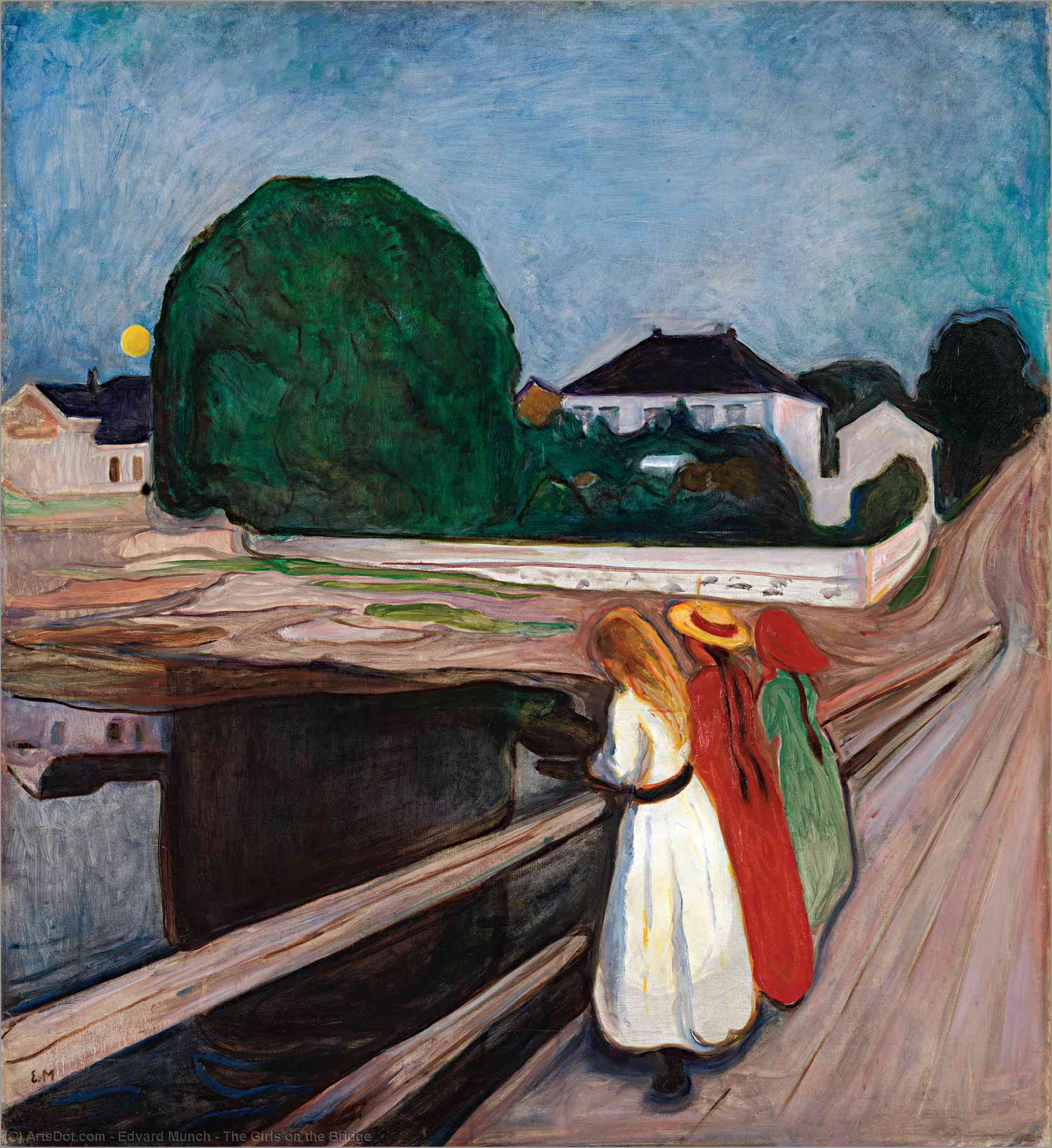
Experience Edvard Munch's 'The Girls on the Bridge'! This iconic Expressionist painting captures fleeting emotions & everyday life with vibrant colors and haunting symbolism, housed at Oslo’s Nasjonalgalleriet.
Explore Edvard Munch (1863-1944), pioneer of Expressionism! Discover 'The Scream' & art exploring anxiety, mortality, love & psychological themes.
Explore Norway’s artistic soul at the Nasjonalgalleriet (National Gallery) in Oslo! Discover iconic works by Munch, Norwegian masters & international art – now part of the new National Museum.
A Captivating Echo of Emotion: Edvard Munch’s “The Girls on the Bridge”
Edvard Munch's "The Girls on the Bridge," painted in 1901, isn’t merely a depiction of two women strolling across a structure; it’s a profound exploration of human experience – a shimmering distillation of anxiety, fleeting beauty, and the poignant awareness of time’s relentless passage. Housed within the National Gallery in Oslo, this oil-on-canvas masterpiece stands as a cornerstone of Expressionism, offering a glimpse into the artist's intensely personal world and his revolutionary approach to portraying emotion. Measuring 136 x 125 cm, the painting immediately draws the viewer in with its vibrant yet melancholic palette and the subtly distorted forms that define Munch’s signature style. It’s a work that speaks volumes without uttering a single word, inviting contemplation on themes of youth, connection, and the ephemeral nature of existence.
The Seeds of Turmoil: Context and Influences
Munch's artistic journey was deeply intertwined with personal tragedy and a pervasive sense of unease. Born in 1863 amidst the stark landscapes of Norway, he experienced significant loss early in life – the deaths of his mother and sister from tuberculosis profoundly shaped his worldview. These experiences weren’t simply biographical details; they became the very bedrock of his artistic vision, fueling an unrelenting investigation into the inner landscape of fear, grief, and longing. His father's strict religious beliefs further contributed to a sense of foreboding that permeated Munch’s life and subsequently manifested in his art. During his time in Paris, he was profoundly influenced by artists like Paul Gauguin, Vincent van Gogh, and Henri de Toulouse-Lautrec – their bold colors, expressive brushstrokes, and willingness to challenge conventional representation all resonated with Munch's own desire to convey raw emotion rather than strict realism. The Parisian influence is particularly evident in the painting’s dynamic composition and use of color, creating a visual intensity that mirrors the emotional turmoil at its core.
A Symphony of Color and Distortion: Artistic Technique
“The Girls on the Bridge” exemplifies Munch's masterful manipulation of color and form to evoke specific moods. He employs a vibrant yet unsettling palette – deep blues and greens mingle with flashes of pink and ochre, creating an atmosphere that is both alluring and slightly disquieting. The figures themselves are rendered with deliberate distortion; their backs are turned to the viewer, fostering a sense of detachment and anonymity while simultaneously inviting us to project our own emotions onto them. The bridge itself isn’t depicted as a stable structure but rather as a fluid, almost dreamlike element, contributing to the painting's overall feeling of instability and unease. Munch’s brushwork is loose and expressive, with visible strokes that convey movement and energy. The use of light is particularly noteworthy – it doesn’t illuminate the scene in a straightforward manner but instead seems to emanate from within the figures themselves, intensifying their emotional presence. The inclusion of a clock on the wall in the background serves as a potent symbol of time's relentless flow, emphasizing the fleeting nature of human experience and the inevitability of change.
Symbolism and Emotional Resonance: Unpacking the Narrative
Beyond its technical brilliance, “The Girls on the Bridge” is rich in symbolic meaning. The women’s posture – their backs turned to the viewer – suggests a sense of introspection and perhaps even isolation. Their carrying of handbags hints at an everyday existence, grounding the scene in reality while simultaneously highlighting the contrast between the mundane and the profound. The smaller figures in the background represent the broader world, offering a sense of perspective and reminding us that these women are part of a larger social context. The boat near the bottom of the image could symbolize journeys, both literal and metaphorical, representing transitions and departures. Ultimately, the painting’s power lies in its ability to evoke a complex range of emotions – melancholy, longing, perhaps even a touch of eroticism – without resorting to explicit narrative. It's a testament to Munch’s genius that he can capture such profound emotional depth through seemingly simple imagery. The work continues to resonate with viewers today, offering a timeless reflection on the human condition and the enduring power of art to illuminate our inner lives.