A Portrait of Mystery: Exploring Burne-Jones' "The Wizard"
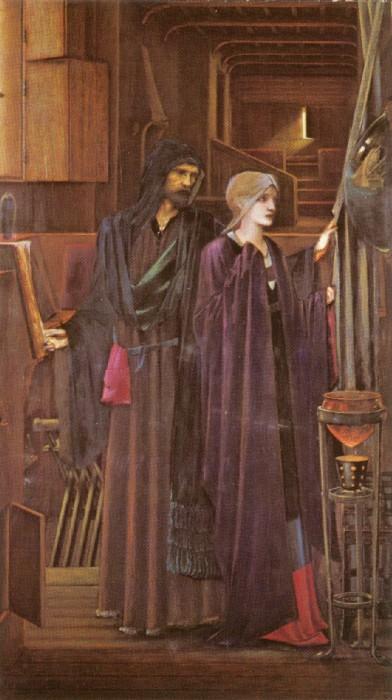
Edward Coley Burne-Jones’s “The Wizard,” painted in 1896, is more than just a portrait; it’s an immersion into the richly layered world of Pre-Raphaelite symbolism and Victorian aestheticism. This captivating work, depicting a woman amidst a group of enigmatic figures, immediately draws the viewer into a scene brimming with unspoken narratives and carefully constructed atmosphere. The painting's subdued palette – dominated by deep purples, blacks, and hints of crimson – contributes significantly to its mood of quiet contemplation and veiled mystery. Burne-Jones masterfully employs a technique reminiscent of his Pre-Raphaelite peers, characterized by meticulous detail, rich textures, and an almost obsessive attention to surface qualities. The brushwork is visible yet controlled, creating a sense of depth and volume that draws the eye across the canvas.
Subject and Composition: A Tableau of Ambiguity
The central figure, a woman in a flowing purple gown accented by a vibrant red sash, commands immediate attention. Her gaze, directed slightly off-camera, suggests a secret known only to her, inviting speculation about what she observes or contemplates. The two men flanking her – dressed in somber black – add another layer of complexity. Their postures and positioning subtly reinforce the sense of an enclosed narrative, perhaps hinting at a clandestine meeting or a shared burden of knowledge. Burne-Jones’s compositional choices are deliberate; he avoids sharp diagonals and instead favors a balanced arrangement that fosters a feeling of stillness and solemnity. The inclusion of secondary figures in the background – a solitary individual near the center-left and another towards the top-right – further expands the scene's narrative potential, suggesting a larger social context or a network of interconnected relationships.
Symbolism and Victorian Context
"The Wizard" is deeply rooted within the symbolic language prevalent in Pre-Raphaelite art. The purple hue, often associated with royalty, spirituality, and mystery, elevates the woman’s status, suggesting she might be a figure of power or wisdom. The red sash could represent passion, sacrifice, or perhaps even danger – elements frequently explored in Victorian literature and visual culture. Burne-Jones was deeply influenced by medieval legends and folklore, drawing inspiration from Arthurian romances and biblical stories. This influence is evident in the painting’s overall mood and its suggestion of a timeless, almost mythical quality. Painted in 1896, the work reflects the Victorian era's fascination with both romanticism and a yearning for a return to simpler, more virtuous values – a desire often expressed through art that sought to evoke emotion and moral contemplation.
Emotional Impact and Artistic Legacy
“The Wizard” possesses a profound emotional impact, largely due to Burne-Jones’s ability to capture subtle nuances of expression and atmosphere. The painting evokes a sense of quiet melancholy, inviting the viewer to engage in their own interpretation of the scene's meaning. Burne-Jones’s work has had an enduring influence on subsequent generations of artists, particularly those interested in narrative illustration and decorative arts. His meticulous technique and evocative symbolism continue to resonate with audiences today, solidifying his place as one of the most important figures in Pre-Raphaelite art. A hand-painted reproduction offers a remarkable opportunity to experience the full beauty and depth of this captivating masterpiece within your own space.