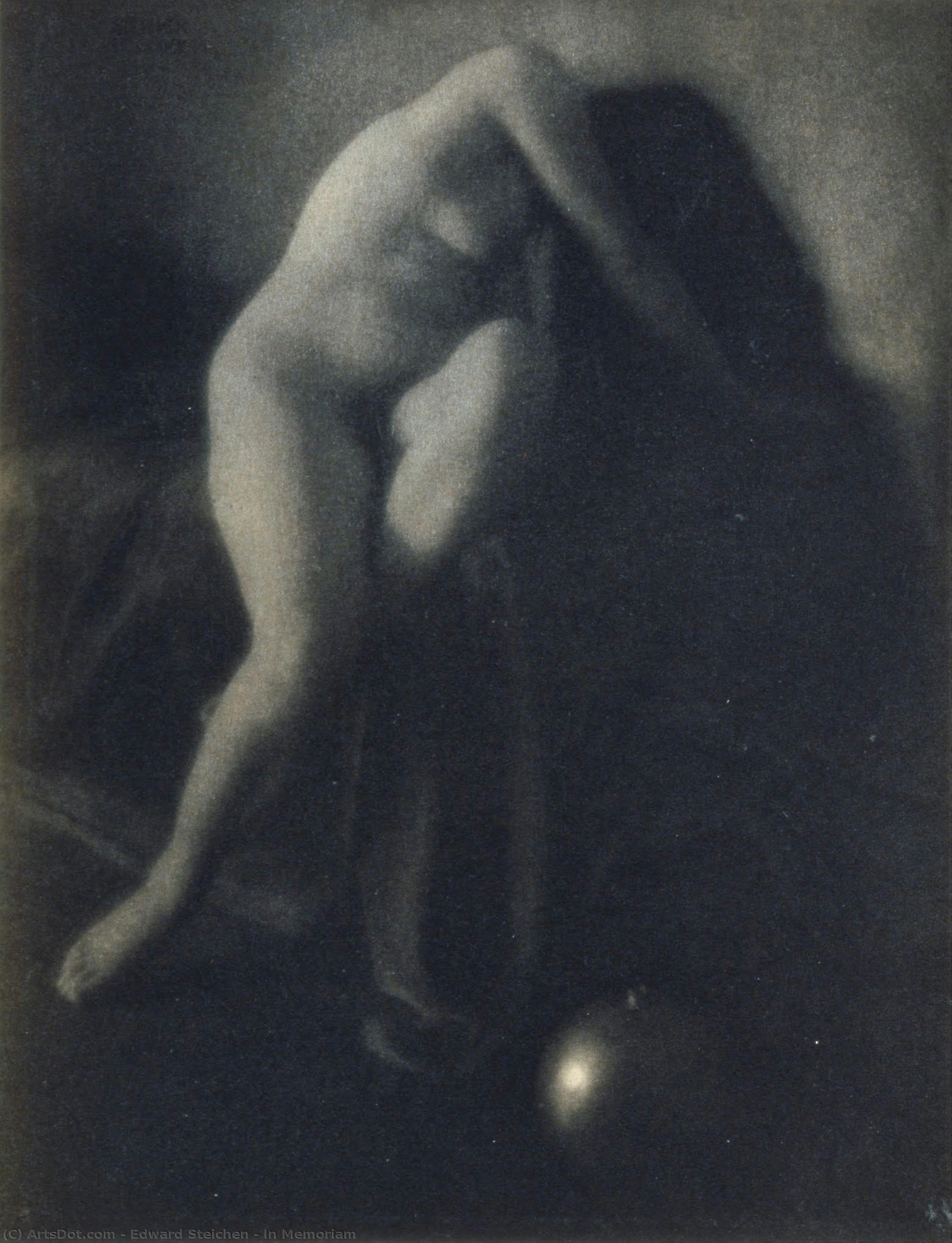
Edward Steichen’s "In Memoriam" captures the emotional depth of loss through a striking black-and-white photogravure print. Featuring a woman shielding herself from sorrow, alongside symbolic sports balls, it exemplifies Steichen's artistic vision and enduring legacy.
A Silent Echo of Grief: The Soul of In Memoriam
In the quietude of Edward Steichen’s “In Memoriam,” one does not merely observe a photograph; one enters a sanctuary of shared sorrow. Created in 1906, this profound work transcends the boundaries of early 20th-century photography to become a timeless meditation on loss and the enduring tenacity of memory. The image presents a hauntingly beautiful tableau: a woman, her form captured with a tender vulnerability, cradles another figure who remains partially concealed, as if retreating from the harsh light of reality into the safety of her embrace. There is an ethereal, almost dreamlike quality to the scene, where the boundaries between the physical world and the psychological landscape begin to blur, inviting the viewer to contemplate their own experiences of mourning and solace.
Steichen, a master of the Pictorialist movement, deliberately moved away from the clinical precision of traditional photography. Instead, he sought to infuse his work with the emotional weight typically reserved for fine art painting. Through the meticulous use of the photogravure process—a sophisticated technique involving the transfer of ink from copper plates—he achieved a breathtaking range of tonal gradations. This method allowed for a velvety texture and a soft-focus atmosphere that lends the piece its characteristic depth. The interplay of light and shadow does more than define shapes; it sculpts the very essence of grief, creating a chiaroscuro effect that highlights the woman’s resilience while casting the hidden figure in a shroud of mystery and fragility.
Symbolism and the Tapestry of Memory
Beyond its immediate emotional resonance, “In Memoriam” is rich with subtle symbolic layers that reward deep contemplation. The composition is masterfully balanced, with the woman positioned prominently on the left, acting as an anchor of strength and devotion. Her posture, both protective and yielding, serves as a powerful metaphor for the human capacity to endure hardship through love. Interestingly, the presence of two sports balls—one nestled near the center-right and another tucked into the bottom-left corner—introduces a poignant, almost surrealist element to the composition. These objects may serve as anchors to a lost innocence or as quiet reminders of the vibrant, lived moments that exist even in the shadow of death, adding a layer of complexity that keeps the viewer engaged in an endless cycle of interpretation.
For the discerning collector or interior designer, this piece offers much more than mere decoration; it provides a focal point for profound reflection. The monochromatic palette and the intricate textures of the photogravure make it an exquisite addition to a curated space, particularly one that seeks to evoke a sense of history, sophistication, and quiet elegance. Whether placed in a contemplative study or as a centerpiece in a gallery-style living room, a high-quality reproduction of this masterpiece brings with it the weight of art history and the transformative power of Steichen’s vision. It is an invitation to pause, to breathe, and to find beauty within the solemnity of the human condition.