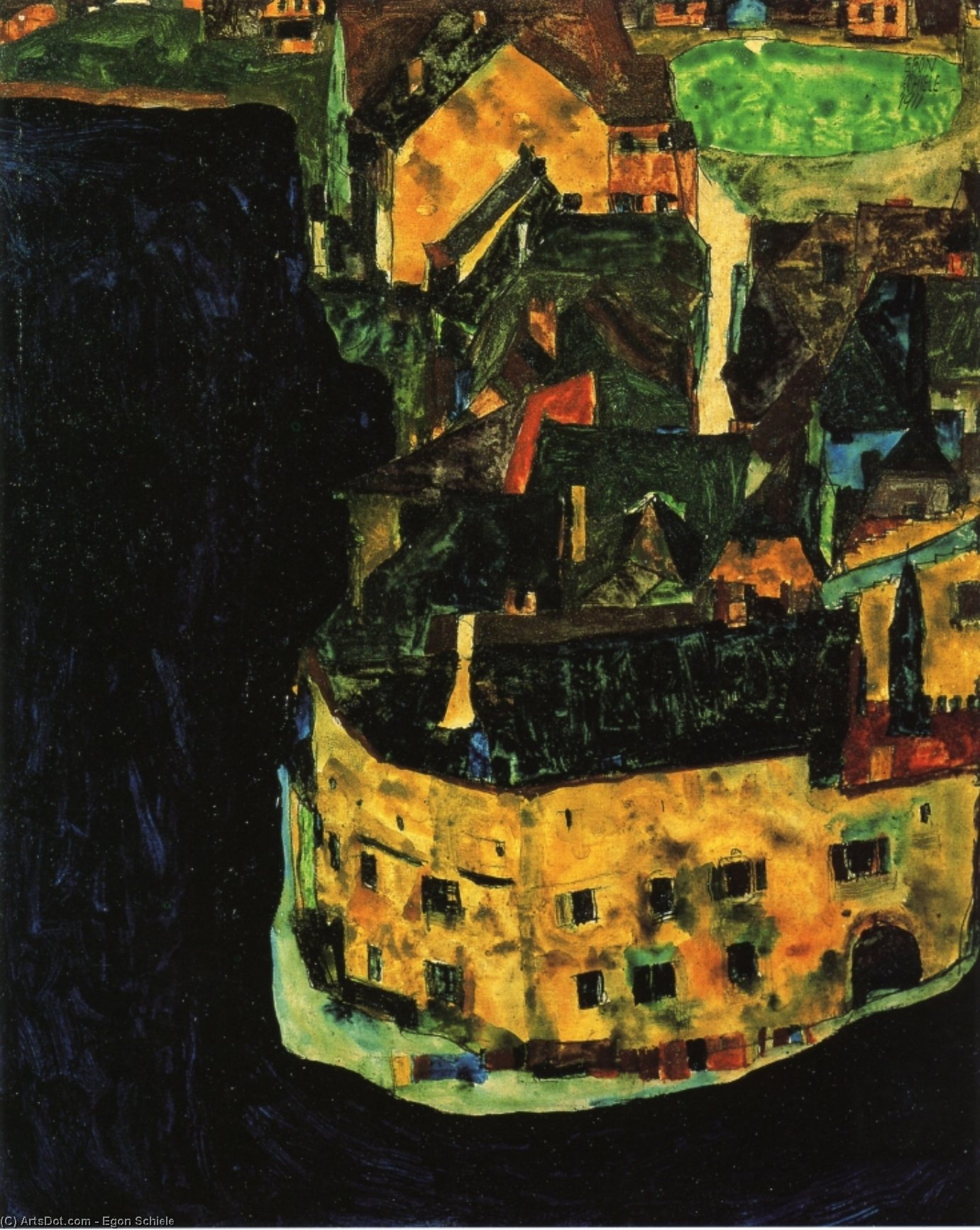
A Vision of Isolation: Egon Schiele’s “City on the Blue River”
Egon Schiele’s “City on the Blue River,” completed in 1911, stands as a haunting testament to Expressionist aesthetics and a profound exploration of human vulnerability. Painted during Schiele's formative years in Český Krumlov, Bohemia – a location that would become an enduring obsession for him – this small-scale panel embodies the artist’s signature style: stark realism infused with psychological intensity.
The painting depicts a densely populated cityscape dominated by a monumental brick building. Its numerous windows gaze outwards, reflecting a sense of detachment and highlighting the isolation inherent in urban life. Schiele meticulously renders the textures of brickwork and stone, employing a technique characterized by thick impasto—a deliberate layering of paint that creates palpable physicality—which contributes to the artwork’s dramatic visual impact.
Expressionist Roots: Atmosphere and Emotion
Schiele's artistic vision was deeply influenced by Expressionism, a movement that prioritized emotional honesty over objective representation. Like many Expressionist artists of his time, Schiele sought to convey inner turmoil and anxiety through distorted forms and unsettling color palettes. The muted earthy tones—primarily ochre and brown—that comprise the building’s façade contrast sharply with the cool, melancholic blue of the river flowing beneath it.
This deliberate juxtaposition serves not merely as compositional device but as a symbolic gesture reflecting Schiele's preoccupation with mortality and decay. The lone boat traversing the river reinforces this sense of solitude, suggesting an individual adrift in a vast, indifferent universe. It’s a scene imbued with palpable sadness—a feeling that resonates powerfully through Schiele’s masterful brushstrokes.
Symbolism Within Detail: The Boat and Its Significance
Beyond the overarching mood of melancholy, “City on the Blue River” is replete with subtle symbolic elements. The boat itself represents a journey – perhaps a futile one—and embodies the artist's own desire to escape from oppressive circumstances. Schiele’s meticulous attention to detail—particularly in capturing the reflections shimmering on the water surface—underscores his commitment to conveying psychological truth.
The painting’s placement within Český Krumlov, a town steeped in medieval history and folklore, adds another layer of significance. Schiele drew inspiration from the town's architectural grandeur and its atmosphere of quiet contemplation, channeling these influences into his artistic endeavors. “City on the Blue River” remains an unforgettable masterpiece—a poignant meditation on human experience that continues to captivate viewers today.