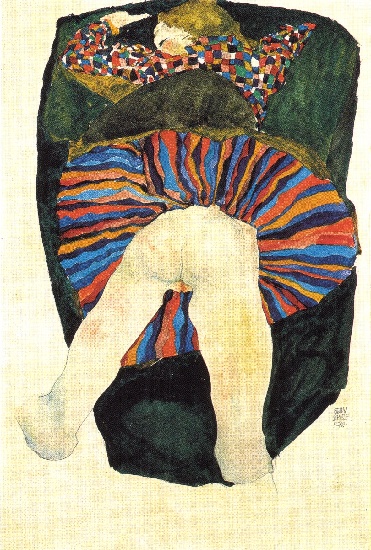
A Fragment of Intense Emotion: Exploring Egon Schiele’s Femme à Demi Nue Étendue
Egon Schiele's Femme à Demi Nue Étendue (Woman Half Naked Extended) stands as a haunting testament to the artist’s singular vision and his unflinching confrontation with themes of vulnerability, mortality, and primal desire. Painted in 1911, this deceptively simple composition—a woman seated on a chair with her legs crossed—holds within it layers of psychological complexity that continue to captivate viewers today. It is far more than just a depiction of the human form; it is an embodiment of Schiele’s distinctive Expressionist style and a poignant reflection of the anxieties simmering beneath the surface of Viennese society at the turn of the century.
The painting centers around a female nude figure positioned in repose, yet radiating a palpable tension. Her posture, while appearing relaxed, is subtly constricted, suggesting both physical vulnerability and an inner struggle. The chair serves as a grounding element, anchoring her body against a backdrop of muted reds and blues, creating a visual dialogue between stillness and movement. Schiele’s masterful use of expressive linework defines the piece, where thick, agitated brushstrokes convey an overwhelming sense of immediacy and emotion. The artist famously eschewed idealized beauty, opting instead for a brutally honest portrayal of the human body—a hallmark of Expressionism that sought to capture subjective experience rather than objective reality.
The Pulse of Viennese Modernism
To understand the raw energy of this work, one must look toward the historical context of early 20th-century Vienna. This was an era experiencing rapid social and intellectual upheaval, fueled by burgeoning psychoanalysis and profound anxieties surrounding sexuality. Schiele's work directly engages with these concerns, mirroring the broader cultural preoccupation with confronting uncomfortable truths about human nature. Influenced heavily by his mentor Gustav Klimt, Schiele moved away from Klimt's opulent ornamentation toward a more skeletal, visceral aesthetic that exposed the nervous system of the subject.
The painting’s color palette and texture offer a sensory experience that is both jarring and beautiful. The predominant use of red tones, punctuated by sharp blue accents, creates a chromatic tension that mirrors the psychological state of the sitter. For collectors and interior designers, this piece offers a profound focal point; its ability to command attention through raw, unshielded emotion makes it an extraordinary addition to any curated space. It does not merely decorate a wall; it invites a conversation about the very ache of existence.
A Timeless Vision for the Modern Collector
For those seeking to bring the transformative power of Expressionism into their homes, a high-quality reproduction of Femme à Demi Nue Étendue serves as a window into a period of unparalleled artistic revolution. The work’s ability to oscillate between the erotic and the existential ensures its relevance in contemporary design. Whether placed in a minimalist setting where its jagged lines can breathe or within a more textured, classical environment, the painting acts as a profound psychological excavation.
Owning a piece of this caliber allows one to inhabit the world of Schiele—a world forged in shadow and light, where every line is a confession. It remains an essential acquisition for anyone moved by the beauty found in fragility and the strength found in vulnerability.