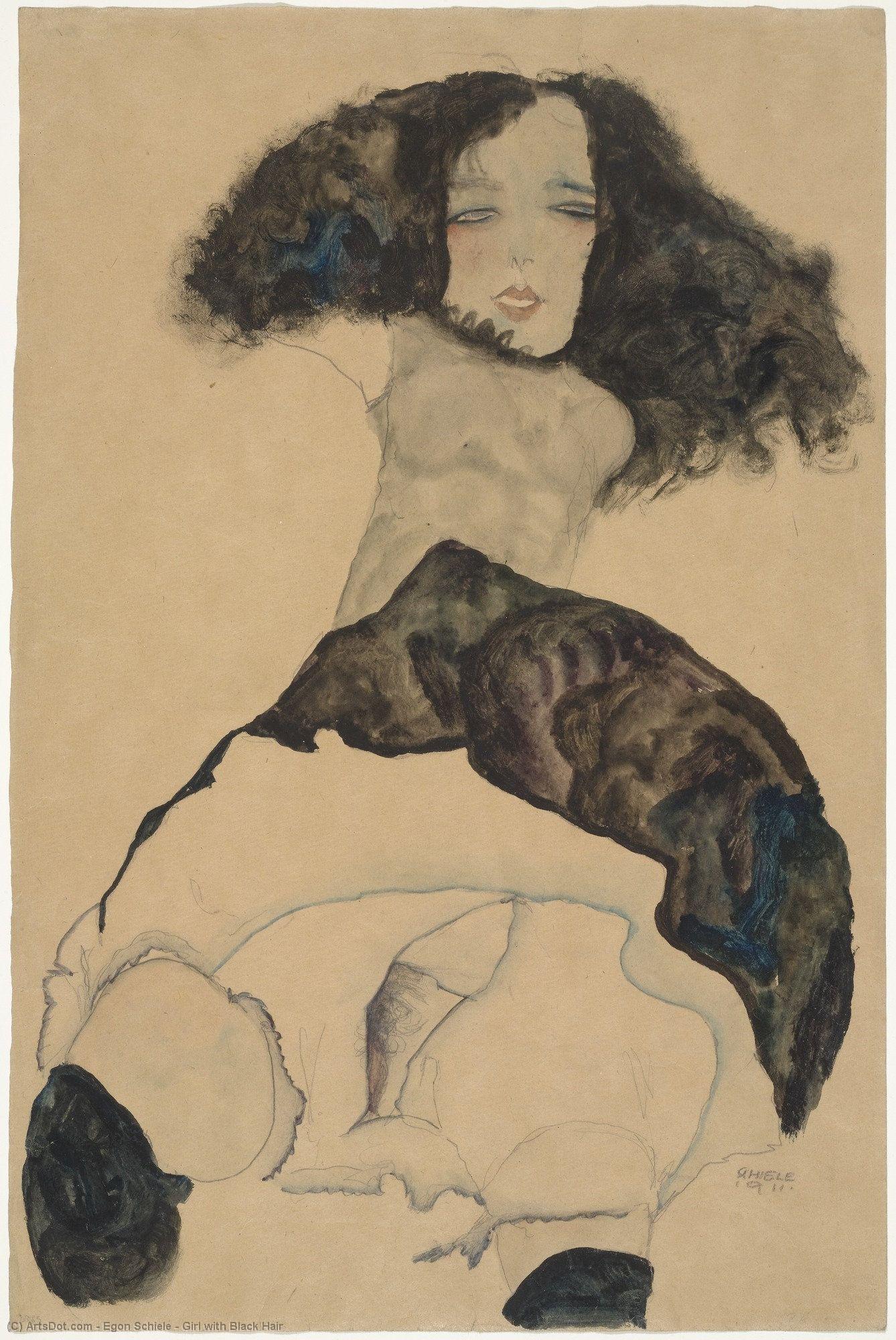
Discover 'Girl with Black Hair' by Egon Schiele – a haunting Expressionist watercolor exploring intimacy & vulnerability. Explore this pivotal work’s unique style & emotional depth.
Explore the emotionally charged Expressionist art of Egon Schiele (1890-1918): bold portraits, psychological themes & unique lines. Discover reproductions now!
A Tangled Embrace: Exploring Egon Schiele’s ‘Girl with Black Hair’
This captivating watercolor painting by Austrian Expressionist master, Egon Schiele, plunges viewers into a world of raw emotion and intimate connection. Depicting two intertwined nude figures in a reclining pose, the artwork is a powerful exploration of human vulnerability, desire, and perhaps, underlying melancholy.
Style & Technique: The Essence of Expressionism
‘Girl with Black Hair’ exemplifies Schiele's signature style – a bold departure from traditional representation. Heavily influenced by the Expressionist movement, the work prioritizes emotional intensity over realistic depiction. Distorted forms, elongated shapes, and gestural lines create a sense of unrestrained energy and spontaneity. The watercolor technique itself contributes to this effect; washes layered upon washes build texture and depth while maintaining a grainy quality that enhances the painting’s emotive power. Notice the deliberate lack of strong highlights or shadows – a choice that further amplifies the somber, introspective mood.
Composition & Form: Verticality and Interconnection
The composition is strikingly vertical, with the figures stacked upon one another, emphasizing their physical closeness and psychological entanglement. This arrangement isn’t merely anatomical; it speaks to a deeper connection – a merging of identities. Perspective is intentionally flattened, drawing attention to the interplay of forms rather than creating an illusion of spatial depth. The simplification of shapes focuses our gaze on volume and contour, highlighting the figures' bodies as vessels of emotion.
Historical Context: A Generation in Turmoil
Egon Schiele lived a tragically short life (1890-1918), bookended by societal upheaval and personal struggles. His art emerged during a period of profound change – the waning years of the Austro-Hungarian Empire, marked by anxieties about modernity, sexuality, and mortality. Schiele’s work challenged conventional norms, confronting taboo subjects with unflinching honesty. He was briefly imprisoned for “offending public morality” due to the explicit nature of his art, a testament to its radical departure from artistic tradition. His mentor, Gustav Klimt, also faced similar scrutiny, highlighting the rebellious spirit of Vienna's avant-garde scene.
Symbolism & Emotional Impact: Vulnerability and Desire
While interpretations are subjective, ‘Girl with Black Hair’ is rich in symbolic potential. The intertwined figures suggest a profound connection – love, dependence, or perhaps even a shared sense of isolation. Their postures convey vulnerability and exposure, inviting viewers to contemplate the complexities of human relationships. The lack of distinct facial features encourages projection; we see our own emotions reflected in their ambiguous expressions. The overall effect is deeply moving, evoking feelings of intimacy, longing, and a quiet sense of sadness.
Collecting & Interior Design: A Statement Piece
A reproduction of ‘Girl with Black Hair’ serves as a powerful statement piece for any art collection or interior space. Its muted color palette and expressive lines complement modern and contemporary décor schemes. The artwork's emotional depth adds an element of sophistication and intrigue, sparking conversation and inviting contemplation. Consider pairing it with minimalist furnishings to allow the painting’s intensity to take center stage, or alongside other Expressionist works to create a cohesive artistic narrative.