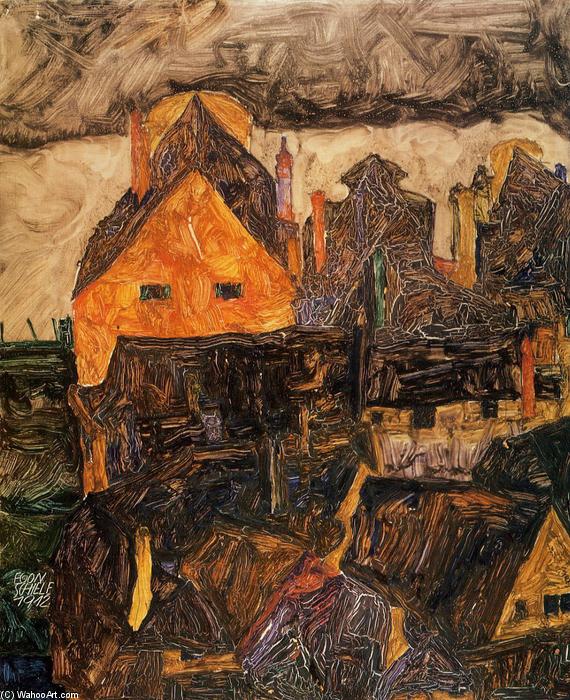
Austrian Expressionist Egon Schiele’s haunting monochrome depiction captures Krumau village nestled beneath a dramatic cloudy sky—a poignant glimpse into the artist's exploration of mortality and human vulnerability during Vienna’s turbulent era. Admire this evocative masterpiece and bring its timeless beauty home.
Explore the emotionally charged Expressionist art of Egon Schiele (1890-1918): bold portraits, psychological themes & unique lines. Discover reproductions now!
A Window into Viennese Expressionism: Egon Schiele’s Krumau on the Molde
The painting “Krumau on the Molde,” executed in 1912 by Austrian Expressionist artist Egon Schiele, transcends mere depiction; it embodies a profound exploration of human vulnerability and spiritual yearning. Captured in stark black and white photography, this artwork offers a glimpse into Schiele’s distinctive artistic vision—a vision deeply rooted in his personal experiences and informed by the anxieties prevalent within Viennese society at the time.
Subject Matter and Composition
At its core, “Krumau on the Molde” presents a simple yet powerfully evocative scene: a solitary house perched atop a hill against a turbulent sky. The architectural details—two chimneys flanking the central dwelling, two windows punctuating the façade—are rendered with meticulous precision, reflecting Schiele’s mastery of draughtsmanship. However, it is not the literal representation that commands attention but rather the atmosphere conveyed by the composition itself. The house stands alone, vulnerable against the looming clouds, symbolizing perhaps a yearning for stability amidst chaos and uncertainty. The surrounding buildings provide context, hinting at the social landscape of Schiele's era—a world grappling with rapid industrialization and shifting moral values.
Style and Technique
Schiele’s artistic style is unmistakably Expressionist, characterized by angular lines, flattened perspectives, and a deliberate rejection of idealized beauty. Unlike Impressionists who sought to capture fleeting moments of light and color, Schiele aimed to convey inner emotion—a preoccupation with mortality and psychological torment—through formal elements alone. The black and white palette amplifies this emotional intensity, stripping away any distractions from the subject matter and focusing solely on tonal variations that heighten the sense of drama and unease. Schiele’s technique involved applying paint thinly onto canvas, allowing for subtle gradations of tone and creating a textured surface that contributes to the overall visual impact.
Historical Context: Vienna at the Turn of the Century
“Krumau on the Molde” emerged during a period of significant intellectual ferment in Vienna—the “Fin de Siècle.” This era witnessed a surge of artistic experimentation driven by anxieties surrounding societal change and a fascination with psychoanalysis, spearheaded by Sigmund Freud. Schiele’s work reflects these concerns, mirroring the psychological complexities explored by Freud's theories. The painting speaks to the pervasive sense of disillusionment felt by artists and intellectuals who questioned traditional values and confronted the darker aspects of human nature. It aligns itself with broader artistic movements that sought to express inner turmoil and grapple with existential questions—a legacy that continues to resonate with contemporary audiences.
Symbolism: Silence, Vulnerability, and Spiritual Quest
Beyond its formal qualities, “Krumau on the Molde” is laden with symbolic significance. The solitary house represents resilience amidst adversity, a beacon of hope against the oppressive darkness of the sky. The chimneys symbolize aspiration—a desire to rise above earthly limitations—while the windows offer glimpses into inner contemplation and spiritual exploration. Schiele’s masterful use of tonal contrast underscores these themes, emphasizing the vulnerability of human existence and prompting viewers to confront uncomfortable truths about mortality.
Emotional Impact: A Portrait of Inner Turmoil
Ultimately, “Krumau on the Molde” succeeds in conveying a palpable sense of emotional depth. The painting evokes feelings of melancholy, apprehension, and perhaps even fear—yet it also possesses an undeniable beauty born from Schiele’s unflinching honesty. It invites contemplation about the human condition, prompting viewers to consider questions of faith, suffering, and transcendence. Reproductions of this artwork offer a powerful opportunity to experience Schiele's artistic vision firsthand, bringing his distinctive style and emotive power into any interior space.