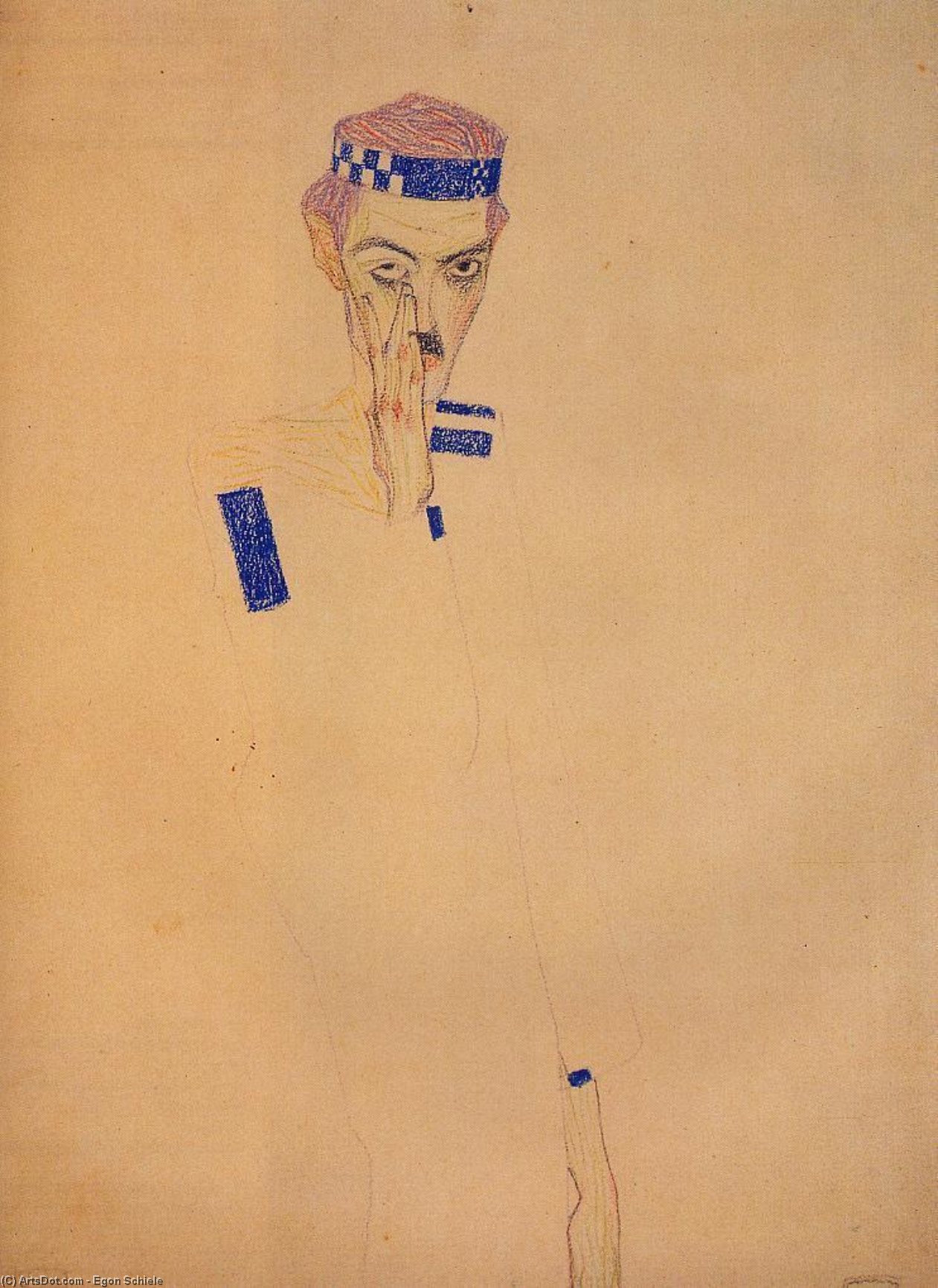
A Window into the Soul: Egon Schiele’s ‘Man with Blue Headband and Hand on Cheek’
This captivating drawing by
Egon Schiele, created in 1909, is a powerful example of early Expressionism. More than just a portrait, it's an intimate exploration of the human psyche, rendered with striking intensity and psychological depth. The work invites us to contemplate not merely *what* we see, but *how* we feel when confronted by such raw emotion.
Decoding the Expressionist Style
Schiele was a key figure in the Expressionist movement, which sought to convey subjective emotional experience rather than objective reality. Like his contemporaries – notably
Edvard Munch, whose ‘Self-portrait in blue suits’ similarly delves into inner turmoil – Schiele rejected traditional artistic conventions in favor of distortion and exaggeration. This is vividly apparent in ‘Man with Blue Headband and Hand on Cheek’. The elongated features, angular lines, and the subject's almost gaunt appearance contribute to a sense of unease and vulnerability. The deliberate departure from naturalistic representation serves not to obscure, but to amplify the emotional core of the work.
Technique and Materials: A Study in Line
Executed with pencil (likely graphite or charcoal), the drawing showcases Schiele’s mastery of line. The sharply defined contours and strategic use of hatching and cross-hatching create a dynamic interplay of light and shadow, emphasizing the subject's bone structure and intensifying his introspective gaze. The limited color palette – primarily shades of beige, brown, blue, and red – further enhances the somber mood. Notice how the artist doesn’t rely on extensive shading; instead, line weight dictates form and volume, a hallmark of his distinctive style.
Symbolism and Interpretation
The pose itself is laden with meaning. The hand raised to the cheek isn't merely a gesture; it suggests contemplation, introspection, or even concealment. Is the figure shielding himself from the world, lost in thought, or perhaps grappling with inner demons? The blue headband adds another layer of intrigue – a subtle splash of color that draws attention to the head and symbolizes intellect or spirituality. The lack of background elements focuses all our attention on the subject’s internal state, making him feel isolated yet profoundly present.
Historical Context: Vienna at the Turn of the Century
Schiele's work emerged during a period of significant social and political upheaval in Vienna. The Austro-Hungarian Empire was crumbling, and traditional values were being questioned. This atmosphere of anxiety and uncertainty deeply influenced Schiele’s art, which often explored themes of sexuality, death, and alienation. He challenged societal norms with his unflinching honesty, paving the way for future generations of artists to explore taboo subjects. The
Museum Kunstsalon Franke Schenk (Germany) offers a rich collection of Expressionist works from this era, providing further context for Schiele’s artistic vision.
Emotional Resonance and Lasting Impact
‘Man with Blue Headband and Hand on Cheek’ is not simply a visually striking artwork; it's an emotionally resonant experience. It compels us to confront our own vulnerabilities and anxieties, reminding us of the shared human condition. Schiele’s ability to capture such raw emotion in a few simple lines is a testament to his genius. This piece continues to inspire artists and captivate audiences today, solidifying Schiele's place as one of the most important figures in modern art. For those seeking to experience this emotional depth firsthand,
ArtsDot.com offers high-quality handmade oil painting reproductions that faithfully capture the essence of Schiele’s masterpiece.