A Study in Vulnerability: Egon Schiele’s ‘Nude Black-Haired Girl’
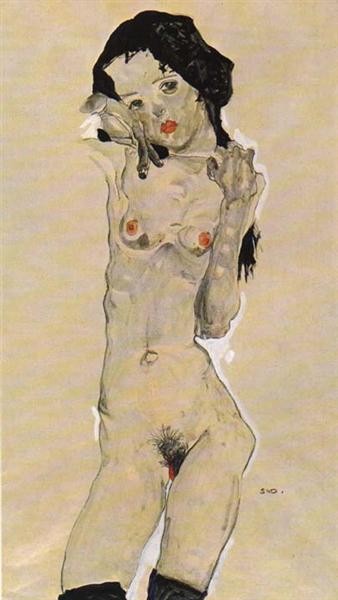
Egon Schiele's “Nude Black-Haired Girl,” a hauntingly intimate portrait rendered in the late 1910s, stands as a pivotal work within the artist’s intensely personal and emotionally charged oeuvre. More than simply a depiction of a nude figure, it’s an exploration of vulnerability, introspection, and the precarious balance between life and death – themes that would increasingly dominate Schiele's artistic vision during his tragically short career. The painting immediately commands attention with its stark simplicity and unsettling directness; a young woman, almost unnervingly still, occupies the center of the composition, her dark hair cascading across her shoulders in a deliberate, slightly defiant gesture.
Schiele’s distinctive style is powerfully evident here. He employs a technique heavily influenced by Expressionism, prioritizing subjective emotion and distorted forms over photographic realism. Loose, expressive brushstrokes create a sense of movement and immediacy, while thick black outlines delineate the figure's contours with an almost sculptural quality. These lines aren’t merely delineating form; they actively separate the subject from the muted beige background, intensifying her isolation and vulnerability. The use of watercolor or gouache on paper lends a fluidity to the paint application, suggesting both delicacy and underlying tension – a visual echo of the emotional complexity at play.
The Language of Line and Form
Schiele’s masterful manipulation of line is central to the painting's impact. The stark black outlines aren’t simply boundaries; they are active participants in the narrative, creating a sense of unease and drawing the viewer into the figure’s gaze. Notice how these lines subtly emphasize the curves of her body – the gentle slope of her shoulders, the delicate arch of her back – yet simultaneously hint at underlying fragility. The simplification of shapes, moving away from realistic representation, allows Schiele to focus on conveying a deeper psychological state. This deliberate abstraction amplifies the painting’s emotional resonance, inviting viewers to project their own feelings and interpretations onto the image.
The composition itself contributes significantly to this effect. The figure is positioned slightly off-center, creating a dynamic imbalance that mirrors the internal turmoil suggested by her expression. Her gaze is averted, not confrontational, suggesting a quiet contemplation – perhaps even a melancholy awareness of mortality. The minimal perspective—a flattened space devoid of traditional depth—further enhances the sense of intimacy and immediacy, as if we are witnesses to a private moment.
Symbolism and Context
Considering Schiele’s life and artistic trajectory, “Nude Black-Haired Girl” can be understood within the context of his preoccupation with death, illness, and the human condition. The early loss of his father, who succumbed to syphilis, profoundly impacted Schiele's work, fueling a fascination with mortality and the fragility of existence. This painting resonates with that broader theme, embodying a sense of vulnerability and quiet desperation. The train motif, a recurring element in Schiele’s art, subtly appears here—perhaps representing journeys, both physical and metaphorical, towards an uncertain destination.
Furthermore, it's important to note the historical context of 1910-1918 Vienna – a period marked by social upheaval, artistic experimentation, and a growing sense of anxiety. Schiele’s work reflects this atmosphere, capturing the emotional intensity and psychological complexities of his time. The painting’s raw honesty and unflinching portrayal of human vulnerability continue to resonate with viewers today, solidifying its place as a significant masterpiece of Expressionist art.
A Timeless Portrait of Introspection
“Nude Black-Haired Girl” is more than just a depiction of a nude figure; it’s a profound meditation on the human condition. Schiele's masterful use of line, simplified forms, and evocative brushwork creates an image that is both unsettling and deeply moving. A reproduction of this work offers a unique opportunity to experience the intensity of Schiele’s vision – a testament to his ability to capture not just the outward appearance of the body, but also the complex emotions and psychological states within.