A Portrait of Quiet Intensity: Egon Schiele’s ‘Young Boy’
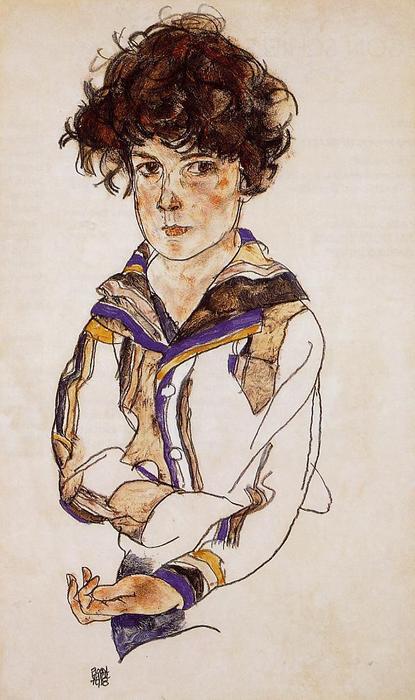
Egon Schiele’s “Young Boy,” painted in 1918, stands as a testament to the artist's masterful command of watercolor and his unflinching exploration of human emotion. Captured during a period marked by profound artistic upheaval—the waning years of Expressionism—this deceptively simple portrait transcends mere representation, delving into themes of vulnerability, contemplation, and the unspoken burdens carried by youth.
The painting depicts a young boy seated in profile, his gaze directed downwards with an expression that hints at melancholy or perhaps profound thought. Schiele’s meticulous attention to detail—the subtle folds of the shirt, the carefully positioned hand clasped together—creates a palpable sense of realism despite the stylized execution. The watercolor medium lends itself beautifully to capturing nuanced tonal variations and conveying a feeling of ethereal fragility.
Technique and Style: Expressionist Precision
- Watercolor Technique: Schiele employed a technique characterized by layering washes of color, building up texture and depth with delicate brushstrokes. This method allowed him to achieve remarkable luminosity and atmospheric perspective, capturing the subtle nuances of light and shadow that contribute significantly to the painting’s emotional impact.
- Expressionist Style: Rooted in the Expressionist movement, “Young Boy” embodies its core tenets—a rejection of idealized beauty and a preoccupation with psychological states. Schiele's angular lines and flattened planes disrupt conventional perspective, prioritizing emotional honesty over visual accuracy.
Historical Context: Trauma and Remembrance
Painted in the immediate aftermath of World War I, “Young Boy” reflects the pervasive anxieties surrounding mortality and loss that gripped Europe during this era. Schiele’s personal experiences—the premature death of his sister Elvira and the debilitating illness affecting his father—fueled a preoccupation with themes of suffering and decay, which permeate throughout his oeuvre. This painting serves as a poignant reminder of the psychological scars inflicted by conflict and the enduring quest for meaning in times of crisis.
Symbolism: Hands Clasped Together – A Gesture of Reflection
The boy’s hand clasped together before him is arguably the most striking element of the composition. This gesture symbolizes introspection, restraint, and perhaps a yearning for solace amidst uncertainty. It speaks to the universal human experience of confronting difficult emotions and grappling with existential questions—themes that resonate powerfully within Schiele's artistic vision.
Emotional Impact: Capturing Vulnerability
"Young Boy" isn’t merely a depiction of a child; it’s an embodiment of vulnerability itself. Schiele succeeds in conveying a profound sense of melancholy and quiet contemplation, inviting the viewer to contemplate the complexities of human emotion and the enduring power of artistic expression. This watercolor reproduction offers a captivating glimpse into the artist's genius and invites admirers to immerse themselves in the evocative atmosphere of Expressionist art.