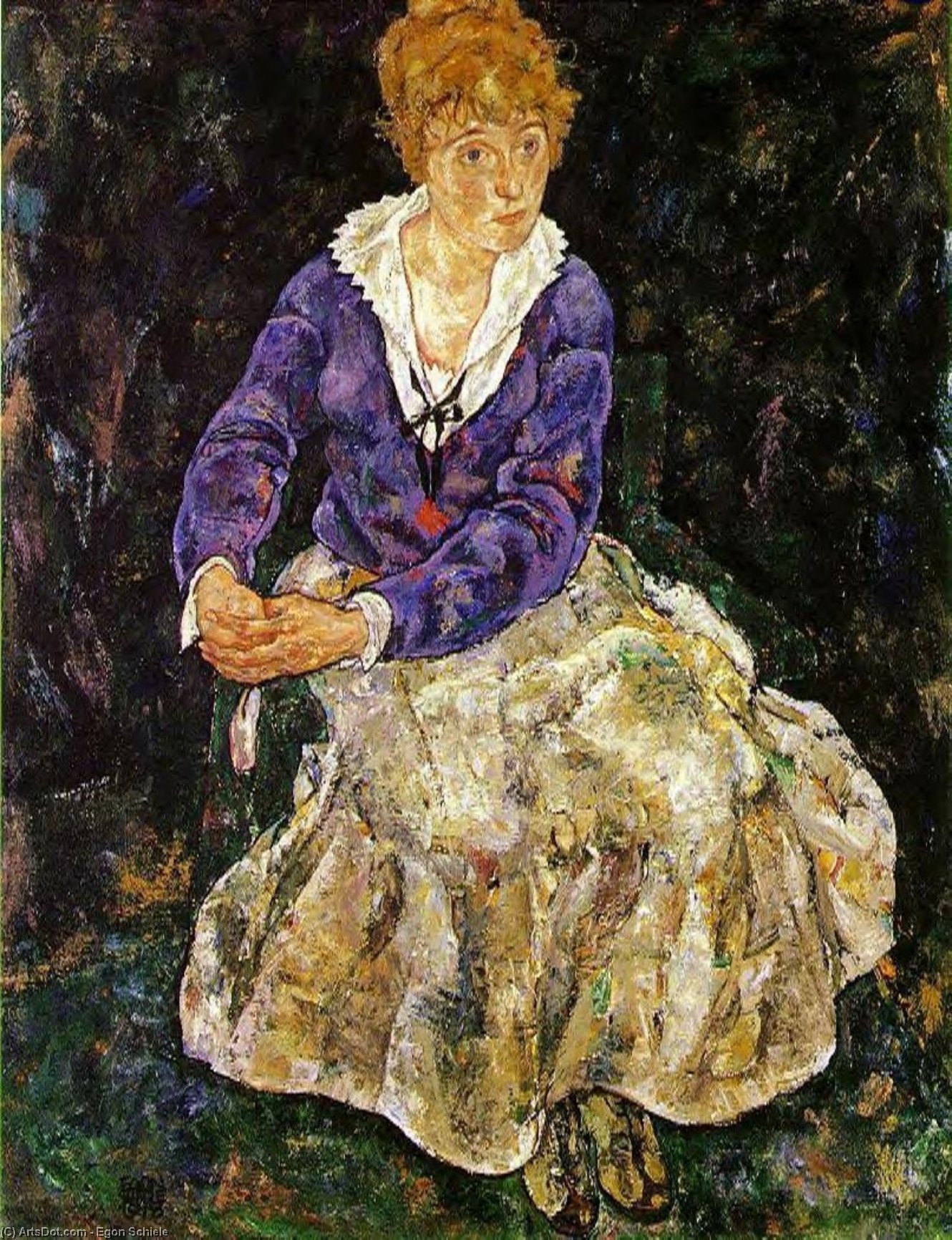
Schiele's distinctive style—characterized by twisted body shapes and expressive lines—established him as a pioneer of Expressionism, capturing the anxieties and passions of his time. Explore Schiele’s other notable paintings on ArtsDot.
Explore the emotionally charged Expressionist art of Egon Schiele (1890-1918): bold portraits, psychological themes & unique lines. Discover reproductions now!
Discover Austrian art at the Belvedere Palace! Marvel at Klimt's "The Kiss," Habsburg treasures & stunning Baroque architecture in Vienna’s iconic museum.
A Portrait Steeped in Emotion: Egon Schiele’s ‘The Artist's Wife Seated’
Egon Schiele’s “Portrait of the Artist’s Wife, Seated,” completed in 1918 during his formative years as an Expressionist painter, transcends mere representation; it embodies a profound exploration of psychological depth and artistic innovation. Executed on canvas measuring 140 x 110 cm and currently residing at the Österreichische Galerie Belvedere in Vienna, Austria, this painting stands as a cornerstone of Austrian modern art and continues to fascinate viewers with its unsettling beauty and masterful technique.
Composition and Observation
The artwork’s visual narrative centers around a woman seated calmly in a chair—a seemingly simple pose that belies the complexity inherent within Schiele's artistic vision. Her hands clasped delicately in her lap convey a palpable stillness, juxtaposed against the subtle tension radiating from her posture. The artist skillfully employs geometric forms and muted color palettes to create an atmosphere of contemplative introspection. Notably, a partially obscured figure on the left side introduces an element of ambiguity, prompting viewers to consider unspoken narratives and emotional undercurrents. Furthermore, the inclusion of a clock positioned prominently in the upper right corner serves as a poignant reminder of time’s relentless passage—a motif recurrent throughout Schiele's oeuvre and indicative of his preoccupation with mortality.
Expressionism: Beyond Impressionistic Illusion
Schiele’s artistic approach firmly establishes him within the Expressionist movement, rejecting the idealized aesthetics of Impressionism in favor of subjective experience and emotional intensity. This stylistic rebellion sought to capture not merely what was seen but what was felt—a daring endeavor that prioritized psychological truth over optical accuracy. The artist's distinctive style is characterized by distorted anatomical forms and expressive lines—techniques deliberately employed to convey inner turmoil and anxiety. Schiele’s work reflects the broader anxieties of the era, mirroring the pervasive disillusionment following World War I and grappling with themes of sexuality and vulnerability.
Symbolic Resonance: Leopold Museum’s Legacy
Inspired by Symbolist painting traditions – as exemplified by collections housed at The Leopold Museum in Vienna – Schiele's oeuvre delves into esoteric imagery and psychological symbolism. These influences underscore his desire to communicate beyond the surface level, inviting viewers to contemplate deeper meanings related to human existence and emotional states. Like many Expressionist artists of his time, Schiele utilized visual metaphors to convey complex ideas about identity, repression, and the confrontation with death—themes that continue to resonate powerfully today.
A Masterpiece Revisited: Reproductions Available
“Portrait of the Artist’s Wife Seated” exemplifies Schiele's unparalleled ability to distill emotion into visual form. Its haunting gaze and unsettling stillness encapsulate the anxieties of a generation grappling with profound societal shifts. For those seeking to immerse themselves in the artistic legacy of Egon Schiele or desiring to adorn their homes with a stunning reproduction of this iconic artwork, exploring “Portrait of the Artist’s Wife Seated” on ArtsDot offers an invaluable opportunity—a chance to experience firsthand the enduring power of Expressionist art.