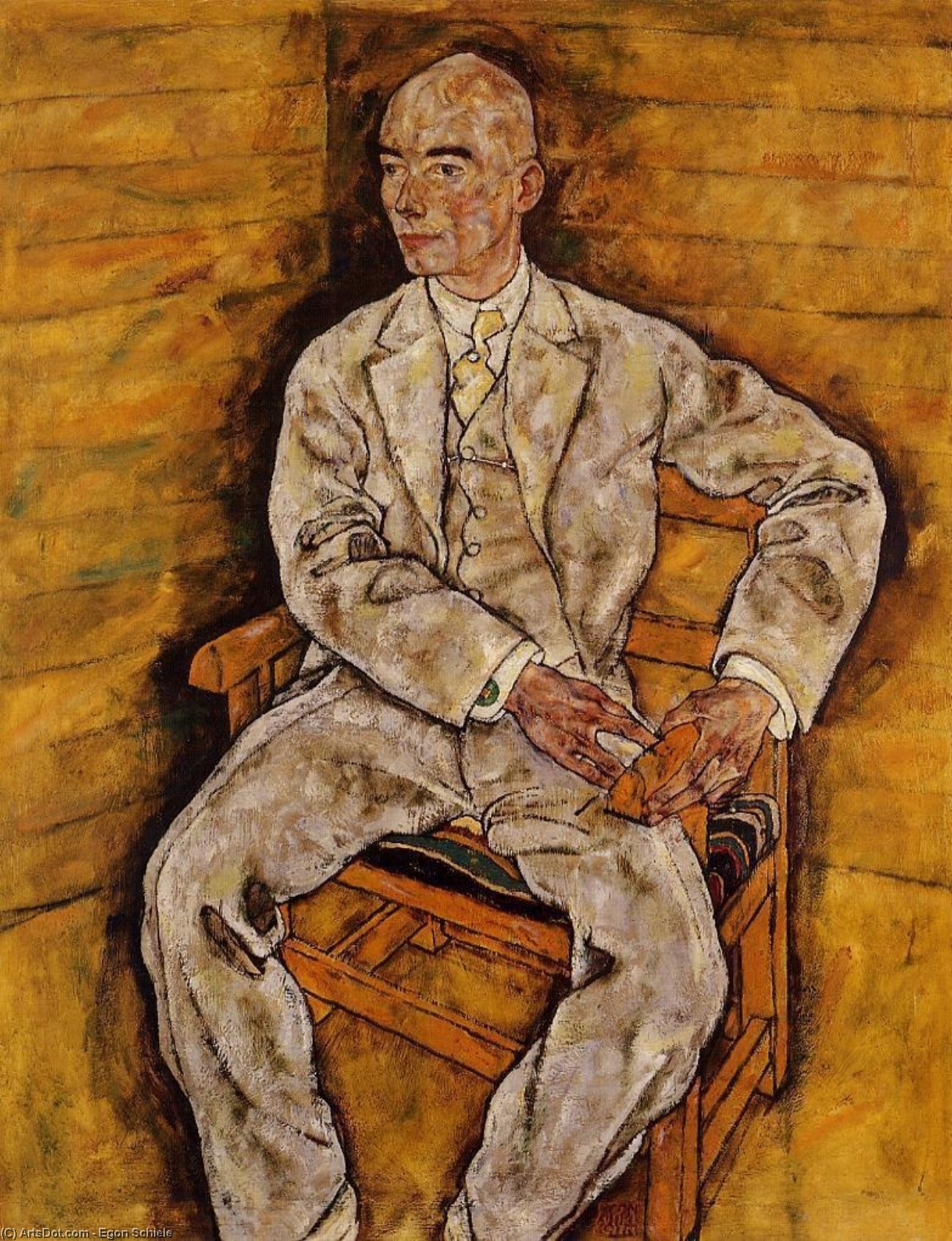
Portrait of Victor Ritter von Bauer: A Study in Controlled Intensity
Egon Schiele’s “Portrait of Victor Ritter von Bauer,” painted in 1918, is not merely a likeness; it's a carefully constructed distillation of the anxieties and quiet contemplation simmering beneath the surface of early 20th-century Vienna. Created during a turbulent period marked by political unrest and shifting social norms, this oil on canvas offers a profound glimpse into the psyche of its subject – a man poised between formality and an unspoken melancholy. The painting resides within the Belvedere Museum in Vienna, a testament to Schiele’s enduring legacy as one of Expressionism's most compelling figures.
Schiele’s signature style is immediately apparent: elongated forms, subtly distorted yet undeniably elegant, dominate the composition. Victor Ritter von Bauer sits rigidly in a chair, his hands clasped together – an almost supplicating gesture that speaks volumes about his internal state. The formal attire—a dark suit and tie—suggests a man accustomed to social obligations, perhaps preparing for an important event or awaiting news. However, it’s the subject's face that truly captivates. His expression is not one of outward joy or sorrow, but rather a profound stillness, a contemplative gaze directed just beyond the viewer’s reach. This deliberate ambiguity invites speculation about his thoughts and emotions – what burdens weigh upon him? What secrets does he hold?
The Language of Expressionism
“Portrait of Victor Ritter von Bauer” is a quintessential example of Schiele's Expressionist approach. Bold, decisive brushstrokes create a sense of immediacy and raw emotion, eschewing the meticulous realism favored by earlier portraitists. The color palette is restrained yet potent – deep browns, muted blues, and hints of ochre—contributing to the painting’s somber mood. Notice how Schiele utilizes light and shadow not to simply illuminate the subject, but to sculpt his features, emphasizing the lines of his face and conveying a sense of vulnerability. The background, a simple wall, serves as a grounding element, preventing the composition from becoming overly claustrophobic while simultaneously reinforcing the man’s isolation.
Schiele's use of line is particularly noteworthy. He employs thick, broken lines to define the subject’s form, creating a dynamic and restless energy that contrasts with the stillness of his expression. This technique reflects the artist’s own turbulent emotional state and his desire to capture the subjective experience rather than objective reality. The subtle distortion of the figure—the slightly elongated head, the subtly compressed shoulders—further emphasizes this expressive intent.
Contextualizing a Moment in Time
To fully appreciate “Portrait of Victor Ritter von Bauer,” it’s essential to understand the historical context in which it was created. Vienna at the time was a city grappling with profound social and political changes, marked by the rise of nationalism, anxieties about modernity, and the lingering effects of World War I. Schiele's work reflects these tensions, capturing a sense of unease and uncertainty that permeated Viennese society. The Leopold Museum in Vienna, another significant institution housing Austrian modern art, highlights the broader context of Expressionism’s influence on the era.
Interestingly, the portrait was commissioned during a period when Schiele's career was facing challenges. Despite his artistic talent and growing recognition, he struggled with financial difficulties and personal demons. The commission for this portrait offered him a brief respite from these struggles, but it also underscores the precariousness of his position as an artist in a rapidly changing world. Further research reveals that Victor Ritter von Bauer was a Jewish industrialist, adding another layer of complexity to the portrait’s interpretation – considering the rising antisemitism prevalent at the time.
Symbolic Resonance and Emotional Impact
Beyond its technical merits, “Portrait of Victor Ritter von Bauer” resonates with profound symbolic meaning. The clasped hands suggest a desire for connection or perhaps an attempt to control one's emotions. The subject’s serious expression invites introspection, prompting the viewer to contemplate his inner world. Schiele masterfully conveys a sense of quiet intensity—a feeling that lingers long after viewing the painting. It is a portrait not just of a man, but of a moment in time, a reflection on mortality, and an exploration of the complexities of human experience.
Reproductions of this powerful work offer a unique opportunity to bring Schiele’s evocative vision into your home or office. ArtsDot offers meticulously crafted hand-painted reproductions that faithfully capture the nuances of color, texture, and emotion, allowing you to appreciate the genius of Egon Schiele in stunning detail.