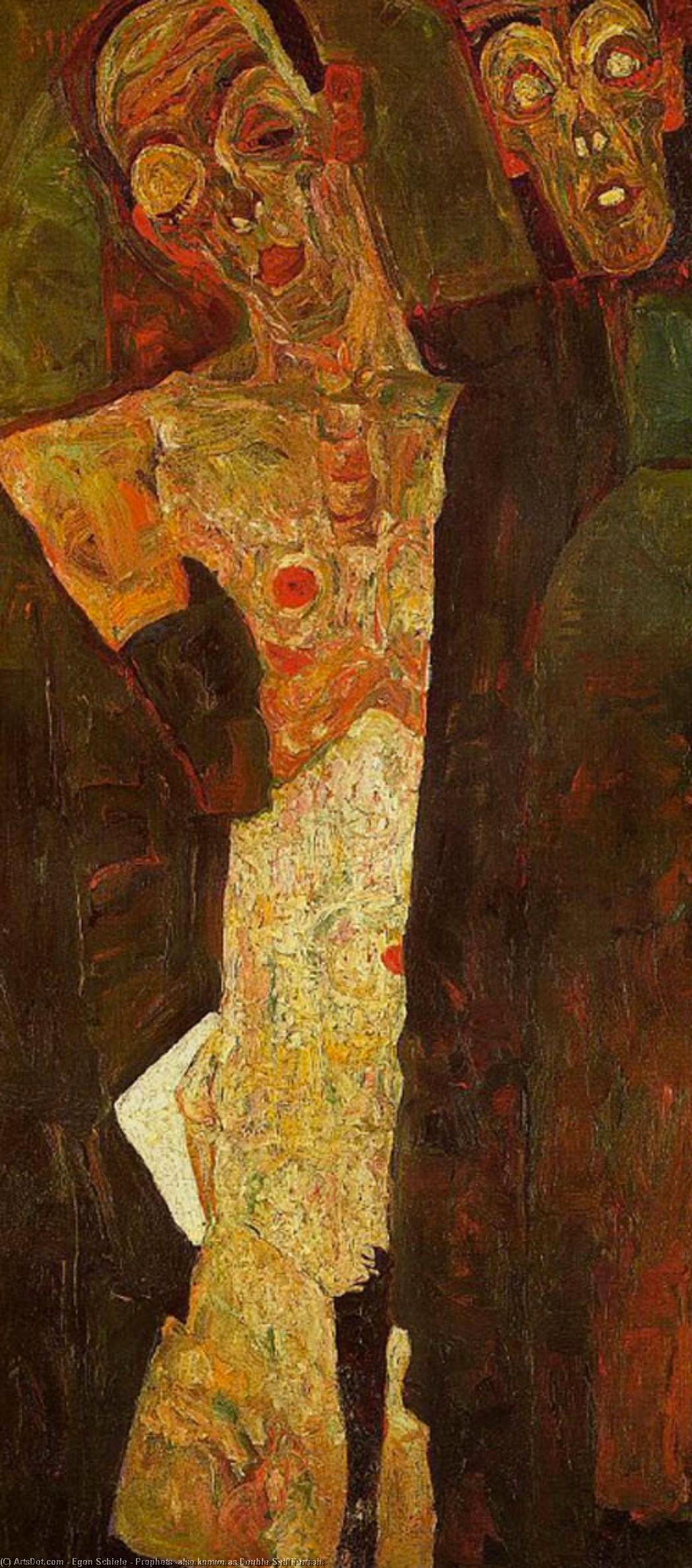
Explore Egon Schiele’s "Prophets" – a haunting Expressionist self-portrait of raw emotion & psychological turmoil. Thick impasto, angular lines, and earthy tones capture intense anxiety. #art #expressionism #schiele
Explore the emotionally charged Expressionist art of Egon Schiele (1890-1918): bold portraits, psychological themes & unique lines. Discover reproductions now!
Prophets (Double Self Portrait) – A Descent Into Psychological Torment
The artwork “Prophets” by Egon Schiele stands as a chilling testament to the artist’s preoccupation with mortality and psychological vulnerability, rendered in an intensely expressive style that defines his signature oeuvre. Painted in 1911 during a period of profound artistic experimentation and personal crisis, this double self-portrait transcends mere representation; it plunges into the depths of human consciousness, capturing a state of agonizing introspection and confronting viewers with unsettling imagery.
Style and Technique: Expressionist Intensity
Schiele’s approach to painting aligns squarely with the tenets of Expressionism—a movement that prioritized emotional honesty over objective observation. Unlike Impressionists who sought to capture fleeting moments of light and color, Schiele aimed to convey inner turmoil through distorted forms and jarring compositional choices. Thick impasto brushstrokes dominate the canvas, creating a palpable textural surface that embodies the artist’s agitated state of mind. The deliberate fragmentation of the figures—particularly the torso and heads—reflects the disintegration of psychological stability, mirroring Schiele's own anxieties about existence. Angular lines dissect the composition, generating a sense of unease and instability, while overlapping shapes contribute to a chaotic visual field that amplifies the emotional impact.
Historical Context: Vienna’s Artistic Avant-Garde
Schiele’s work emerged from Vienna’s vibrant artistic milieu at the turn of the century—a city grappling with intellectual ferment and social upheaval. The Expressionist movement flourished in Austria, fueled by disillusionment following World War I and a desire to grapple with existential questions. Schiele's exploration of themes like death, sexuality, and psychological distress resonated deeply within this cultural landscape, reflecting anxieties prevalent among artists and intellectuals of the era. He was influenced by artists such as Edvard Munch and Oskar Kokoschka, who similarly sought to depict inner emotional states through distorted forms and symbolic imagery.
Symbolism: Confronting Mortality and Isolation
The painting’s symbolism is laden with references to Christian iconography—specifically the crucifixion—suggesting a confrontation with mortality and spiritual suffering. The pose of the figures embodies vulnerability and anguish, mirroring Schiele's own struggles with illness and loss. The muted earthy palette – ochre, burnt sienna, and dark browns – punctuated by flashes of yellow and red – serves to heighten the emotional intensity, emphasizing the psychological torment depicted. The minimal lighting casts dramatic shadows that further accentuate the distorted forms, creating a claustrophobic atmosphere that underscores the figures’ isolation.
Emotional Impact: A Window Into Schiele's Psyche
“Prophets” is not merely an aesthetically striking artwork; it offers a profound glimpse into Schiele’s psyche—a portrait of a man wrestling with demons both internal and external. The artist’s gaze, piercing and unsettling, conveys a palpable sense of desperation and fear. The painting compels viewers to confront uncomfortable truths about human vulnerability and the inevitability of death. Its enduring power lies in its ability to evoke empathy for Schiele's tormented soul and to provoke contemplation on the complexities of human experience—a testament to Schiele’s masterful command of artistic expression.