The Unveiling of Form: An Encounter with Schiele's Nude Study
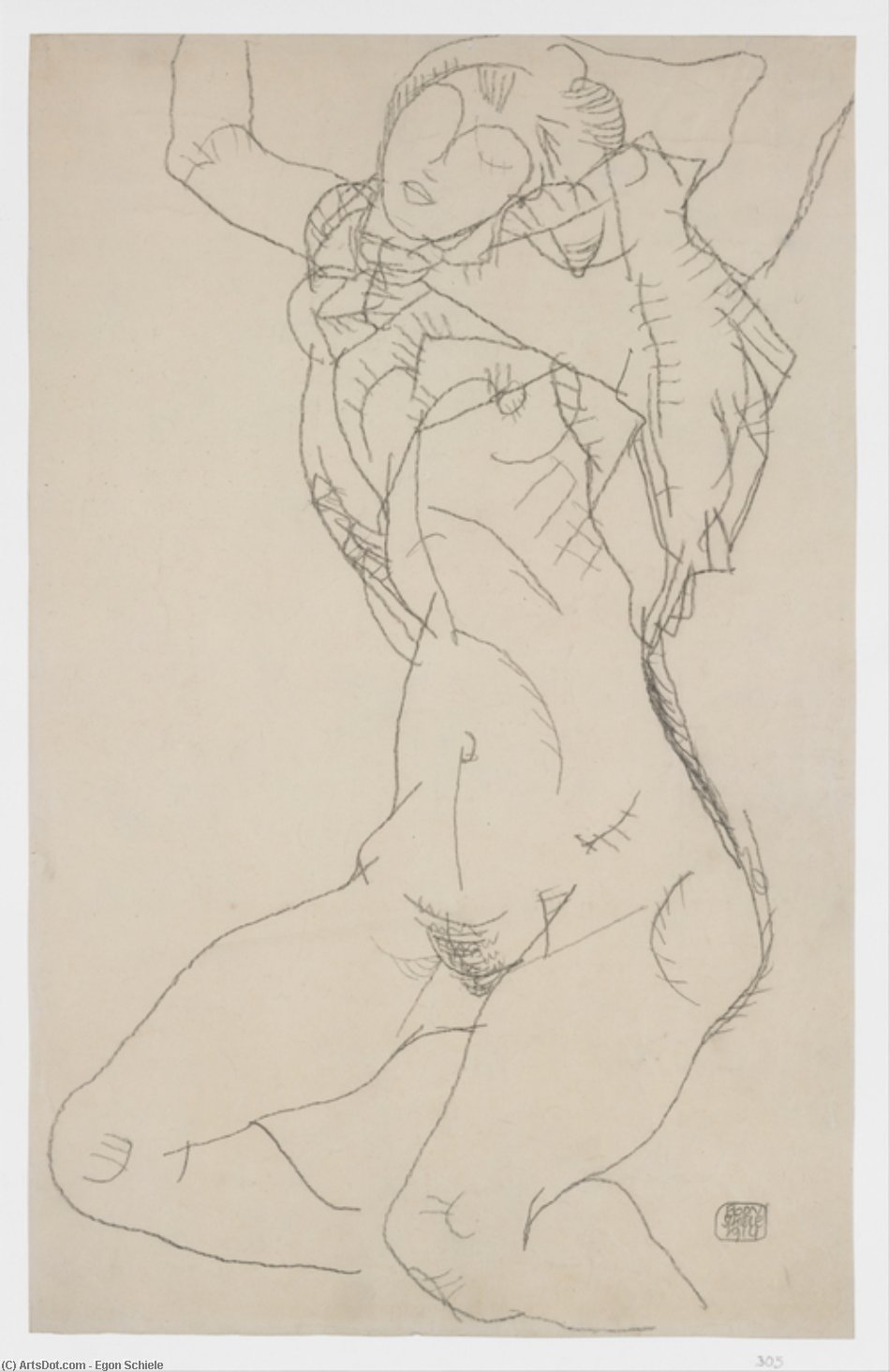
To stand before a depiction such as this Reclining Semi-Nude with Arms Raised is not merely to observe the human figure; it is to confront an emotional landscape rendered in graphite and shadow. Egon Schiele, the master of Viennese Expressionism, never offered pretty portraits. Instead, he presented raw, unflinching examinations of existence—the body as a site of vulnerability, tension, and profound psychological drama. This drawing captures that signature intensity, presenting a figure caught in an act of exquisite, almost painful self-awareness. The composition itself is dynamic, suggesting not a moment held still, but rather a breath being drawn out slowly, deliberately.
Technique and the Expressionist Gaze
Schiele’s technique, even in drawing, possesses a visceral energy. His lines are never passive; they writhe with an internal life, echoing the turbulent spirit of his time. Here, the artist utilizes line work to build volume and emotion simultaneously. The rendering of the musculature and the graceful arch of the back, emphasized by the raised arms, speaks to a mastery that transcends mere anatomical study. It is a drawing imbued with gesture. Notice how the varying angles of the limbs create a sense of restless energy, as if the subject is perpetually shifting between repose and sudden awakening. For those who appreciate the power of line art in interior design or collecting, this piece offers unparalleled graphic impact.
Symbolism of Vulnerability and Ascent
The act of raising the arms above the head is inherently symbolic. It can suggest surrender, a moment of ecstatic release, or perhaps even an attempt to ward off unseen pressures. In Schiele’s hands, this gesture becomes charged with meaning—it speaks to the tension between physical grace and inner turmoil. The semi-nude state strips away artifice, forcing the viewer into an intimate dialogue with the human condition itself. It is a meditation on exposure; the beauty found not in perfection, but in the eloquent articulation of being alive.
A Touchstone of Early 20th Century Angst
To understand this work is to understand Vienna at the turn of the century—a period brimming with decadent artistic flourish yet shadowed by deep societal anxieties. Schiele’s art was a direct response to that tension. His focus on the exposed, often angular body served as a mirror reflecting the psychological fragmentation brewing beneath the surface of polite society. Owning a reproduction of this drawing is acquiring a piece of that intellectual and emotional history; it allows one to integrate the raw poetry of early modern angst into a contemporary space.
Bringing the Intensity Home
Whether displayed in a gallery setting or as a focal point within a sophisticated interior, this artwork commands attention. Its expressive quality ensures that it will never feel static. It invites contemplation, prompting viewers to consider their own moments of tension and release. For collectors seeking art with narrative depth, or for designers aiming to infuse a room with intellectual gravitas, Schiele’s unflinching vision remains eternally compelling.