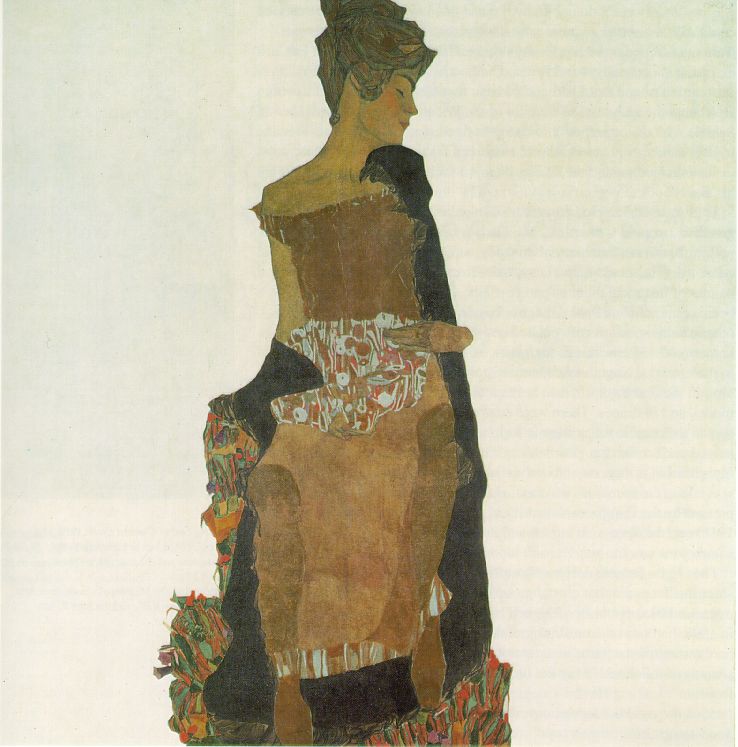
A Glimpse into the Soul: Egon Schiele’s Portrait of Gerti Schiele
Egon Schiele's portrayal of his sister, Gerti Schiele, is more than just a likeness; it’s a hauntingly beautiful exploration of youth, vulnerability, and the burgeoning anxieties of a rapidly changing era. Painted around 1909, during a pivotal moment in both Schiele’s artistic development and the broader cultural landscape of Vienna, this work embodies the transition from Art Nouveau's decorative elegance to the raw emotional intensity that would define Expressionism. The painting captures Gerti with her back partially turned, an elegant black dress clinging to her form, hinting at a nascent maturity while simultaneously preserving a sense of youthful mystery. The subtle suggestion of a corset beneath the fabric speaks to societal constraints and expectations placed upon women during this period, adding layers of symbolic weight to the composition.
Vienna’s Artistic Climate and Schiele's Early Style
To understand “Gerti Schiele” is to understand the artistic ferment of early 20th-century Vienna. The city was a crucible of ideas, grappling with the decline of the Austro-Hungarian Empire and the rise of modern psychology. Gustav Klimt, a dominant figure in the Viennese art scene, served as an early mentor to Schiele, influencing his use of decorative elements and flowing lines. However, Schiele quickly diverged from Klimt’s opulent style, stripping away ornamentation to reveal the underlying emotional core of his subjects. This painting demonstrates that transitional phase beautifully – the elegant curves and refined color palette echo Art Nouveau sensibilities, but a nascent psychological depth begins to emerge in Gerti's posture and the overall mood of introspection. Schiele wasn’t merely interested in *how* something looked; he was obsessed with conveying *what it felt like* to exist within its form.
Technique and Emotional Resonance
Schiele’s technique in this portrait is masterful, even at this early stage in his career. The delicate rendering of Gerti's hair, styled in an updo and adorned with a pearl necklace, contrasts sharply with the more angular lines defining her back and shoulders. This interplay between softness and sharpness creates a visual tension that mirrors the emotional complexity of the subject. The limited color palette—dominated by blacks, grays, and subtle flesh tones—further enhances the painting’s somber mood. Schiele's use of line is particularly striking; it isn’t simply used to define form but to convey emotion, with each stroke imbued with a sense of nervous energy and psychological insight. The way Gerti glances over her shoulder adds an element of unease, as if she is both inviting and withdrawing from the viewer’s gaze. This ambiguity invites us to project our own emotions onto the figure, forging a deeply personal connection with the artwork.
Gerti Schiele: Muse and Sister
Gerti Schiele was not just a subject for her brother's art; she was a constant presence in his life, a source of both inspiration and complex emotional entanglement. Recent discoveries have revealed previously unknown details about Gerti’s own life, including the tragic circumstances surrounding her institutionalization and death. Knowing this adds another layer of poignancy to works like this portrait. It's impossible not to see a premonition of sadness in her pose, a subtle foreshadowing of the hardships she would endure. Schiele’s portraits of Gerti are particularly compelling because they reveal an intimacy that transcends mere artistic representation; they offer a glimpse into the complex dynamics of siblinghood and the enduring power of familial bonds.