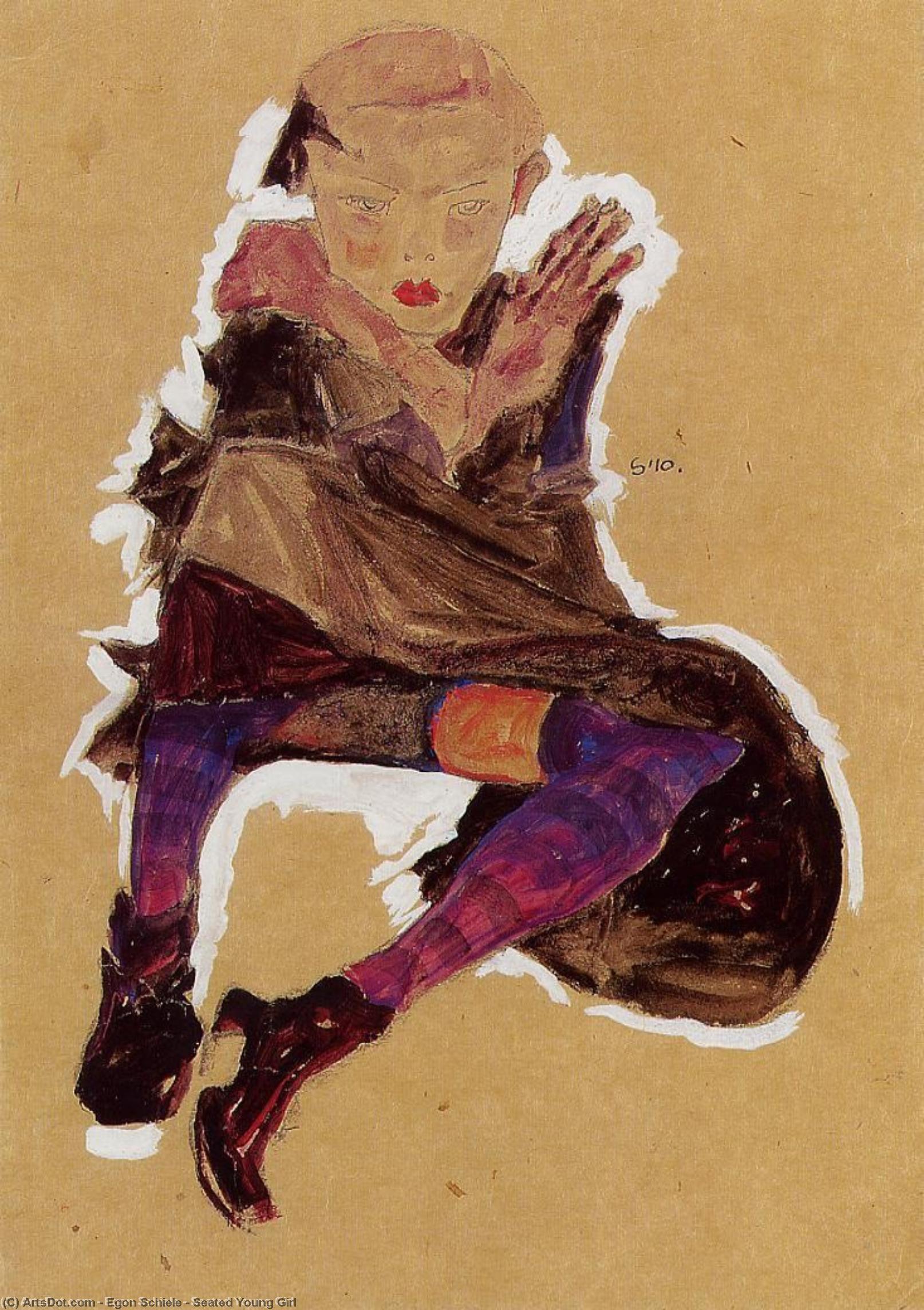
A Portrait of Yearning: Egon Schiele’s ‘Seated Young Girl’ (1910)
“All art is essentially the expression of the self.” – Egon Schiele. This sentiment resonates deeply within ‘Seated Young Girl’, a captivating work by Austrian Expressionist master, Egon Schiele, created in 1910. The painting offers a poignant glimpse into the artist’s exploration of psychological states and his distinctive stylistic approach.
Subject & Composition
The artwork centers on a solitary young woman depicted in a seated pose. Her body language is immediately striking – hands clasped tightly together, suggesting a gesture of supplication or quiet desperation. The composition isn’t conventionally balanced; it's deliberately off-center, drawing the viewer’s eye directly to her face and expressive hands. This dynamic arrangement contributes to the overall sense of unease and emotional intensity.
Style & Technique
‘Seated Young Girl’ is a prime example of Schiele’s early Expressionist style, exhibiting influences from Fauvism as well. The artist eschews realistic representation in favor of conveying inner emotion through distorted forms and bold lines.
Loose, expressive brushwork dominates the canvas, with visible layers of paint creating a rich texture – an impasto effect that invites tactile engagement. Schiele’s deliberate rejection of academic precision is evident in his simplified shapes and flattened perspective, prioritizing emotional impact over photographic accuracy. The background, rendered as textured brown paper, further emphasizes the raw and immediate quality of the piece.
Historical Context & Artistic Influences
Created during a period of significant artistic upheaval, ‘Seated Young Girl’ reflects the anxieties and psychological explorations prevalent in early 20th-century Vienna. Schiele was deeply influenced by Gustav Klimt, who served as a mentor, but he quickly developed his own unique voice – one characterized by a more raw and unsettling honesty. The painting emerged during a time when artists were breaking away from traditional artistic conventions to explore subjective experience and the darker aspects of human existence. The Leopold Museum in Vienna holds the world’s largest collection of Schiele's work, offering further insight into his artistic development.
Symbolism & Emotional Impact
While subtle, symbolic elements contribute to the painting’s emotional weight. The clasped hands are particularly evocative, suggesting vulnerability, longing, or a silent plea. The overall mood is melancholic and introspective, conveying a sense of quiet desperation. Schiele's masterful use of line and color amplifies this feeling, creating an atmosphere of psychological tension.
The painting isn’t simply a portrait; it’s a window into the sitter’s inner world.
Collecting & Interior Design Considerations
‘Seated Young Girl’, like many of Schiele's works, possesses a timeless quality that makes it suitable for a variety of interior design schemes. Its muted color palette and expressive lines complement modern and contemporary spaces, adding depth and sophistication.
- Its introspective nature lends itself well to private studies or bedrooms.
- The painting’s bold aesthetic can serve as a focal point in a living room or dining area.
- Consider pairing it with minimalist furniture and neutral tones to allow the artwork to truly shine.
A high-quality reproduction of ‘Seated Young Girl’ offers an opportunity to bring Schiele's powerful vision into your home, inviting contemplation and sparking conversation.