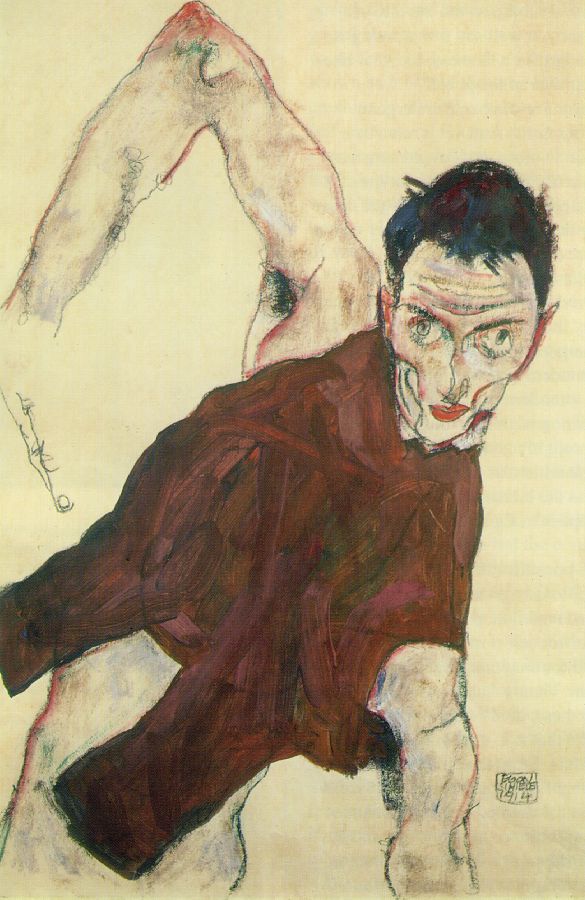
A Portrait of Anguish and Intensity: Egon Schiele’s Self-Portrait
Egon Schiele's "Self-Portrait with Raised Right Elbow" (1914) is not merely a depiction of an individual; it’s a raw, visceral expression of the artist’s internal landscape. Painted during a period of intense personal and artistic transformation, this work embodies the core tenets of Expressionism – a rejection of objective representation in favor of conveying subjective emotion and psychological states. The painting immediately confronts the viewer with a figure dominated by a palpable sense of unease and perhaps even despair. The subject, rendered in Schiele’s signature elongated, almost skeletal form, stares directly ahead, his face a mask of severe concentration and suppressed anguish. His posture – the raised right elbow, jutting outwards as if bracing against an unseen force – is particularly arresting, suggesting both defiance and vulnerability.
The color palette contributes significantly to the painting’s unsettling effect. Dominated by somber browns, deep reds, and muted blues, the colors are applied with thick, impasto brushstrokes that create a textured surface, almost as if the paint itself is struggling to contain the emotions being depicted. Schiele's use of color isn’t decorative; it’s deliberately jarring, reflecting the turmoil within the subject. The red shirt, a bold and somewhat unsettling choice against the predominantly dark tones, draws attention to the figure’s chest – an area often associated with vulnerability and mortality in Schiele’s oeuvre.
The Shadow of Loss and Mortality
To understand “Self-Portrait with Raised Right Elbow,” it's crucial to consider the context of Egon Schiele’s life. Born in 1890, he experienced a childhood marked by profound loss and instability. His father, a railway station master, succumbed to syphilis when Schiele was just fourteen, an event that deeply scarred the young artist and became a recurring theme in his work. The premature death of his sister Elvira further fueled his preoccupation with mortality and the fragility of human existence. These personal tragedies undoubtedly informed his artistic vision, leading him to explore themes of sickness, death, and psychological distress with unflinching honesty.
Schiele’s early life was characterized by a lack of stability – he moved frequently between Tulln, Krems, and Klosterneuburg, often under the guardianship of an uncle. This instability, coupled with his father's illness, fostered a sense of isolation and perhaps contributed to the melancholic atmosphere that permeates many of his paintings. The image of trains, which fascinated Schiele as a boy, subtly reappears in some of his works, serving as a potent symbol of movement, transition, and ultimately, loss.
Expressionist Techniques and Symbolism
Schiele’s technique is undeniably Expressionistic. He employed distorted forms, exaggerated proportions, and intense colors to convey emotional intensity rather than realistic representation. The elongated limbs, the sharp angles, and the overall sense of unease are hallmarks of this style. The raised elbow itself is a key symbolic element – it can be interpreted as a gesture of resistance against an overwhelming force, or perhaps as a desperate attempt to ward off impending doom. The downward gaze of the subject suggests introspection and a confrontation with his own mortality.
Furthermore, the painting’s composition—the stark contrast between light and shadow, the claustrophobic space—heightens the sense of tension and psychological distress. Schiele's masterful use of line – particularly in defining the figure’s contours – adds to the work’s raw energy and emotional impact. The small writing in the bottom right corner, though obscured in many reproductions, likely contained further details about the painting or the artist’s intentions, adding another layer of intrigue for art historians.
A Window into a Troubled Soul
“Self-Portrait with Raised Right Elbow” is more than just a portrait; it's a poignant and deeply unsettling glimpse into the mind of a tormented genius. It’s a testament to Schiele’s ability to translate his personal struggles—his grief, his anxieties, and his fascination with death—into powerful and enduring works of art. Reproductions of this painting offer a unique opportunity to engage with one of the most significant figures in Expressionism, allowing us to contemplate the complexities of human emotion and the enduring power of artistic expression.