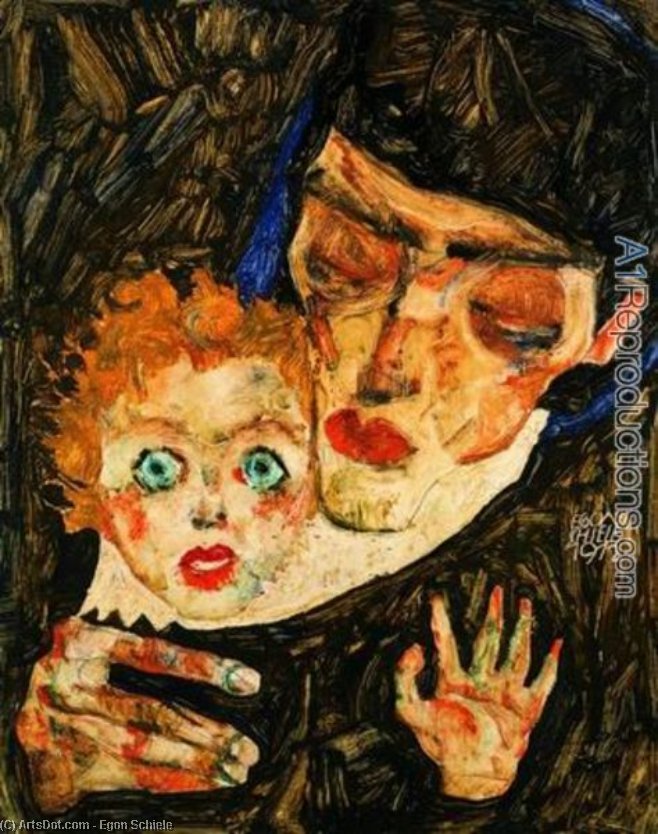
Experience Egon Schiele's poignant 'Madre e Bambino.' This tender portrait captures a mother’s love, rendered with the artist’s signature expressive lines and haunting beauty. A masterpiece of emotional intensity.
Explore the emotionally charged Expressionist art of Egon Schiele (1890-1918): bold portraits, psychological themes & unique lines. Discover reproductions now!
The Tender Embrace: Egon Schiele’s “Madre e Bambino”
Egon Schiele's "Madre e Bambino," often translated as "Mother and Child," is not merely a portrait; it’s a raw, intensely felt distillation of maternal love and the unsettling awareness of mortality. Painted in 1916 during a period of profound personal and societal upheaval – the throes of World War I casting a long shadow over Europe – this oil-on-board work offers a glimpse into Schiele's uniquely expressive vision. The painting depicts a woman, her face partially obscured by the gentle curve of her child’s body, cradling him close. Her eyes are closed, lost in a moment of quiet intimacy, while the child, adorned with a simple white shirt and sporting striking red hair, leans into her embrace. It's a scene brimming with tenderness, yet simultaneously imbued with an undercurrent of melancholy—a characteristic hallmark of Schiele’s oeuvre. The composition is remarkably intimate, almost claustrophobic, drawing the viewer directly into this private moment of connection.
A Portrait of Anxiety and Vulnerability
Schiele's artistic style during this period was deeply influenced by his personal experiences – the early death of his sister, the looming threat of war, and a lifelong struggle with illness. This emotional landscape is powerfully reflected in "Madre e Bambino." The figures are rendered with an almost skeletal quality, their forms elongated and distorted, echoing the anxieties of the time. Schiele’s signature technique—bold, expressive lines that seem to vibrate with energy—is particularly evident here. He eschews smooth surfaces and idealized beauty, instead favoring a directness and honesty that can be both unsettling and profoundly moving. The use of color is restrained, dominated by earthy tones – browns, ochres, and muted greens – which contribute to the painting’s somber mood. The red hair of the child stands out dramatically against this palette, adding a touch of vibrant life amidst the prevailing sense of quietude.
Symbolism and the Weight of Existence
Beyond its immediate depiction of motherhood, “Madre e Bambino” is rich in symbolic meaning. The closed eyes of the mother suggest a surrender to the present moment, a complete absorption in her child’s needs. However, they also hint at a deeper awareness—a recognition of the fragility of life and the inevitability of loss. The child's red hair has been interpreted as representing vitality and passion, juxtaposed against the muted tones of the mother’s attire, perhaps symbolizing the transmission of these qualities across generations. The pose itself – the woman shielding her child with her body – speaks to a primal instinct for protection and nurture, but also subtly alludes to the vulnerability inherent in motherhood. Schiele frequently explored themes of death and decay in his work, and this painting is no exception; it’s a poignant meditation on the cyclical nature of life and the acceptance of mortality.
Historical Context and Artistic Legacy
Egon Schiele's tragically short life—he died at just 28 years old during the Spanish Flu pandemic—contributed significantly to the intensity and urgency of his art. He was a key figure in the Expressionist movement, alongside artists like Gustav Klimt and Oskar Kokoschka, though he developed a distinctly personal style characterized by its raw emotion and unflinching honesty. “Madre e Bambino” exemplifies this approach, offering a powerful and deeply affecting portrayal of human connection within a world grappling with uncertainty and despair. Reproductions of this work offer a remarkable opportunity to experience Schiele’s unique vision firsthand, allowing viewers to contemplate the complex interplay of love, loss, and the enduring mystery of existence. ArtsDot offers meticulously crafted hand-painted reproductions that faithfully capture the nuances of Schiele's brushstrokes and the emotional depth of this iconic image, ensuring its legacy continues to resonate with audiences today. Consider a reproduction for your home or office – a testament to the power of art to evoke profound emotion and contemplation.