The Haunting Presence of Egon Schiele’s ‘Standing Figure with Halo’
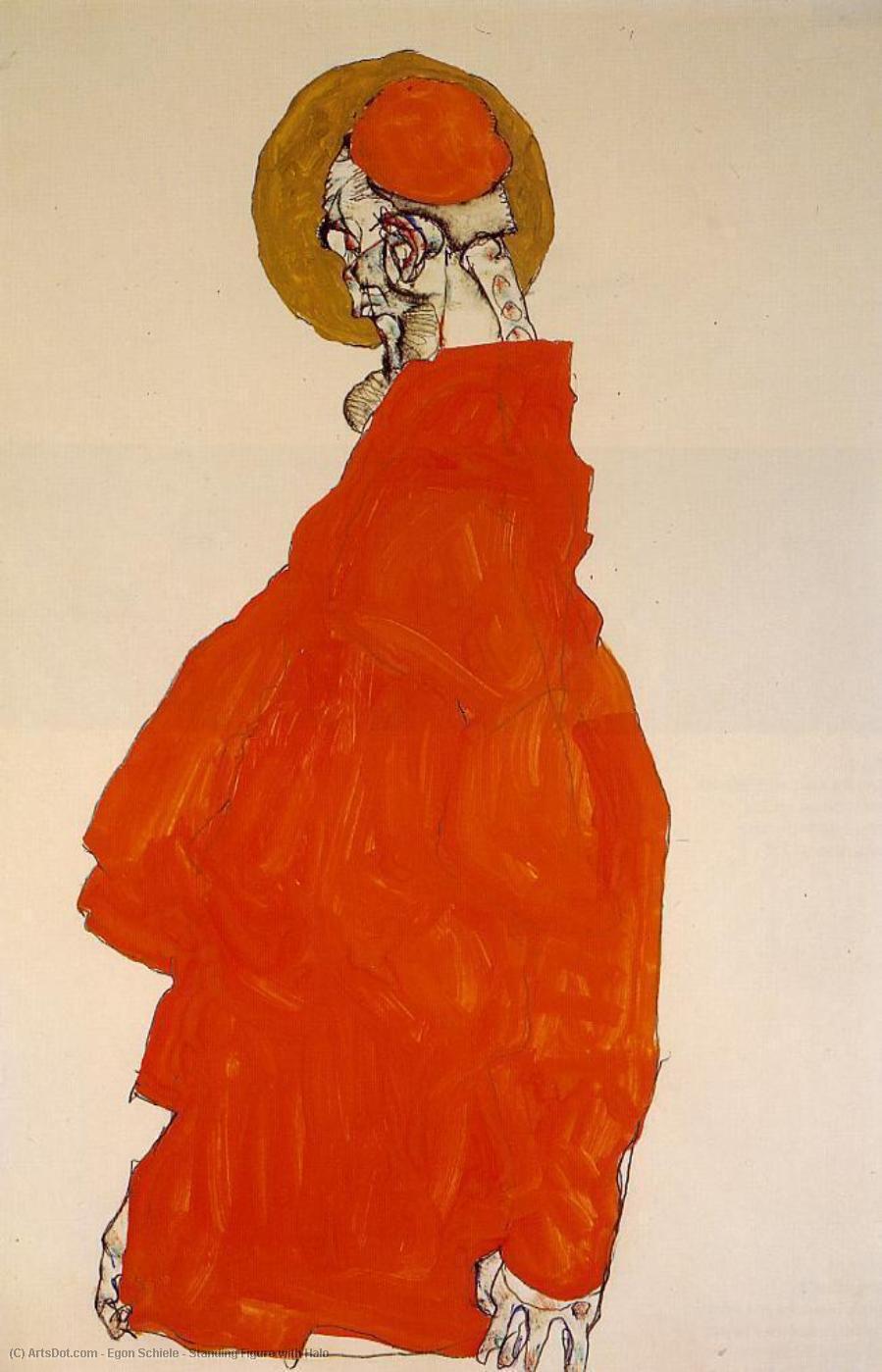
Egon Schiele's “Standing Figure with Halo,” painted in 1913, is not merely a portrait; it’s a visceral exploration of the human condition, steeped in the anxieties and burgeoning surrealism of early Expressionism. This arresting image, rendered in a distinctive watercolor style—a technique unusual for Schiele who primarily worked in oil—immediately commands attention with its stark simplicity and unsettling intensity. The central figure, a man clad in a deep red robe, is positioned before an undefined wall, creating a sense of isolation and contemplation. Above his head rests a halo, not one of divine grace, but rather a subtle, almost melancholic glow, hinting at both spiritual yearning and the inescapable shadow of mortality – a theme profoundly shaped by Schiele’s own life.
Schiele's artistic journey was inextricably linked to personal tragedy. The untimely death of his father, a railway station master consumed by syphilis, cast a long and dark pall over his childhood and subsequently influenced his entire oeuvre. This trauma, coupled with the loss of his sister Elvira, fueled an obsession with themes of illness, decay, and the fragility of existence – all powerfully conveyed through his distorted figures and emotionally charged brushstrokes. The red robe itself is significant; it’s a color often associated with passion, sacrifice, and even death, further amplifying the painting's somber mood.
Expressionist Techniques and Schiele’s Unique Style
While Schiele is renowned for his charcoal drawings characterized by their raw energy and unflinching depictions of the human form, “Standing Figure with Halo” showcases a different facet of his artistic skill. The watercolor medium lends itself to a delicate yet forceful application of color, creating a luminous quality that contrasts sharply with the figure’s somber demeanor. Notice the loose, gestural brushstrokes—a hallmark of Schiele's style—that imbue the painting with a sense of immediacy and emotional turbulence. The simplified background emphasizes the central subject, drawing the viewer’s eye to the man’s face – a study in quiet anguish.
Schiele’s distinctive approach involved layering colors and applying them in thin washes, allowing the paper's texture to peek through. This technique contributes to the painting’s ethereal quality, as if the figure is partially dissolving into light. The halo itself isn’t a solid circle; rather, it appears as a diffused glow, suggesting an internal struggle between earthly existence and something beyond.
Symbolism and the Weight of Mortality
The halo, in this context, transcends its traditional religious symbolism. It doesn't represent divine favor but rather a lingering echo of spirituality—or perhaps, a desperate attempt to grasp at it amidst the face of inevitable death. The undefined wall behind the figure could symbolize the boundaries between life and the afterlife, or simply the isolation inherent in confronting one’s own mortality. Schiele frequently explored themes of eroticism intertwined with death, and this painting is no exception. The subtle suggestion of vulnerability within the man's posture hints at a profound awareness of his own transient existence.
Considering Schiele’s biography—his father’s illness, his sister’s early demise—the “Standing Figure with Halo” becomes a deeply personal meditation on loss and the enduring power of grief. It is a poignant reminder of the artist's struggle to reconcile beauty and darkness, life and death, within the confines of human experience.
Bringing Schiele’s Vision Home: High-Quality Reproductions
ArtsDot offers meticulously crafted hand-painted reproductions of “Standing Figure with Halo,” allowing you to bring this emotionally resonant masterpiece into your home or office. Our skilled artists replicate Schiele's unique style and color palette with exceptional accuracy, ensuring that the painting’s power and intensity are faithfully preserved. Whether you appreciate Schiele’s pioneering role in Expressionism or simply admire his masterful use of line and color, a ArtsDot reproduction offers an authentic and captivating representation of this iconic work.