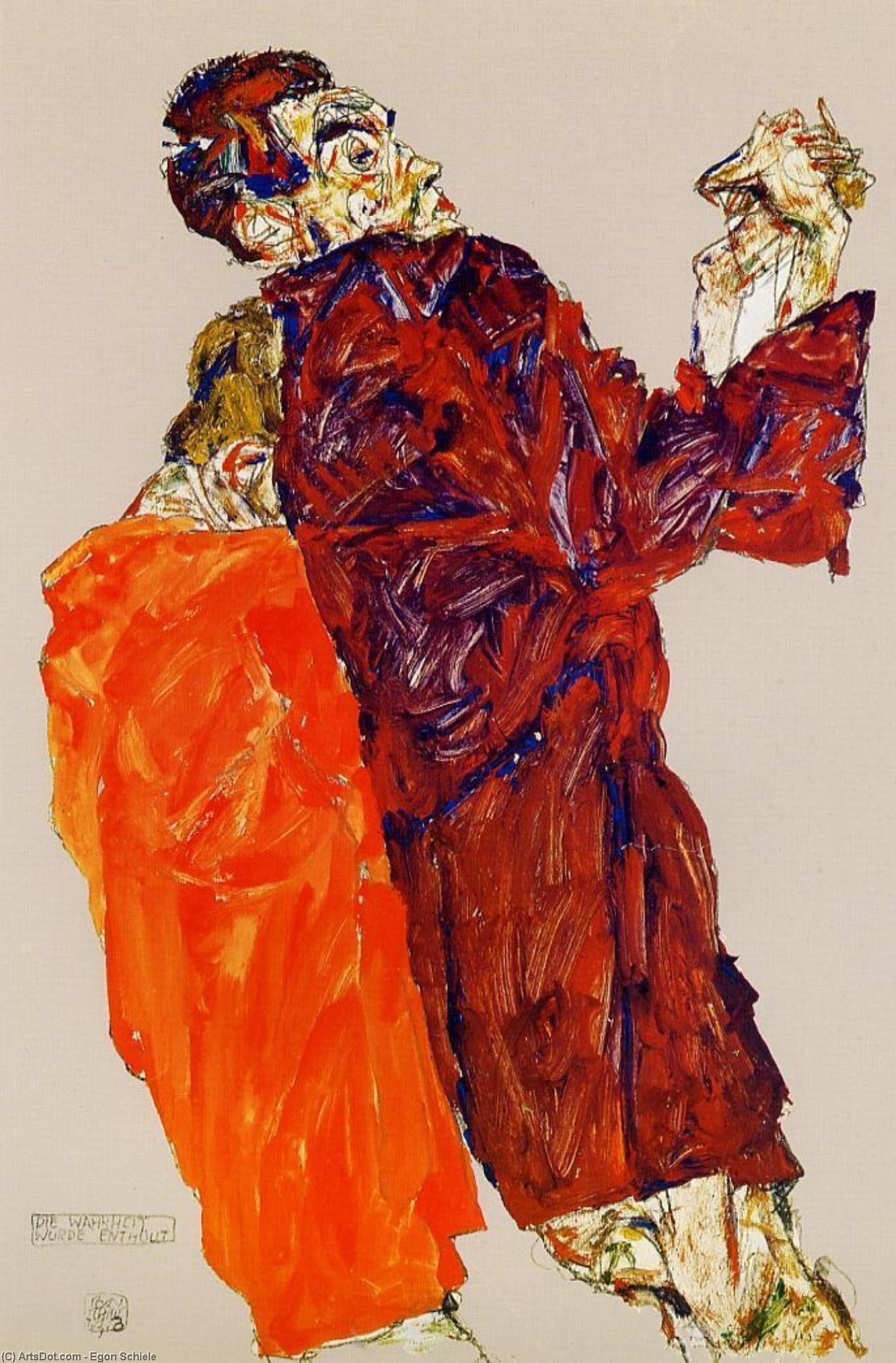
The Truth Was Revealed – An Exploration of Egon Schiele’s Psychological Landscape
Egon Schiele (1890-1918), a titan of Expressionism, relentlessly pursued an artistic vision rooted in profound psychological exploration and imbued with a palpable sense of unease. Born in Tulln an der Donau, Austria, his formative years were marked by tragedy – the untimely death of his father due to syphilis – shaping him into an artist preoccupied with mortality and the unsettling realities of human existence. Raised initially under the watchful eye of his mother and later entrusted to the care of his uncle Leopold Czihaczek, Schiele’s childhood lacked conventional stability, fostering instead a rebellious spirit that would define his artistic trajectory. Even as a young boy, he demonstrated an unwavering fascination with trains—a motif that subtly recurs throughout his oeuvre—and possessed a remarkable aptitude for drawing, though this was initially viewed unfavorably by his father who prioritized practical pursuits. The devastating loss of his sister Elvira further solidified Schiele’s preoccupation with suffering and vulnerability, informing the core themes of his art.
- Style: Schiele's distinctive style is characterized by angular lines, distorted figures, and a deliberate rejection of idealized beauty—a conscious departure from prevailing artistic conventions of his time. He embraced Expressionism’s impulse to convey inner emotion rather than objective representation, prioritizing psychological intensity over visual realism.
- Technique: Primarily working in oil paint on canvas, Schiele employed a technique marked by meticulous layering and hatching – a method that creates textured surfaces and emphasizes the artist's hand—resulting in strikingly evocative images. He favored muted color palettes, often dominated by earthy tones, reflecting his preoccupation with darkness and decay.
- Historical Context: Schiele emerged during Vienna’s Belle Époque, a period of artistic ferment fueled by intellectual currents questioning societal norms and confronting anxieties about modernity. Influenced by artists like Edvard Munch and Oskar Kokoschka, he navigated the turbulent landscape of Austro-Hungarian society amidst growing social unrest and burgeoning psychoanalytic thought.
Symbolism Within Darkness – Recurring Motifs in Schiele’s Work
Schiele's paintings are replete with symbolic imagery designed to communicate complex psychological states. The recurring motif of the human figure—often depicted in fragmented poses and contorted expressions—represents vulnerability, isolation, and the inescapable confrontation with death. Anatomical detail is rendered with unflinching honesty, highlighting the physicality of suffering and emphasizing Schiele’s fascination with the grotesque – a deliberate provocation intended to unsettle viewers and force them to confront uncomfortable truths about human nature. The bird imagery, prominently featured in “The Truth Was Revealed,” symbolizes freedom yet simultaneously hints at impending doom—a poignant juxtaposition reflecting Schiele's exploration of existential anxieties.
Emotional Resonance – Capturing the Inner Turmoil
Ultimately, Schiele’s art transcends mere visual depiction; it strives to evoke profound emotional responses in the viewer. His canvases pulsate with palpable tension and convey a sense of psychological torment—a testament to his ability to translate inner experience into compelling artistic form. “The Truth Was Revealed,” like many of Schiele's works, captures a moment of intense intimacy juxtaposed against an unsettling backdrop, prompting contemplation on themes of desire, vulnerability, and the inescapable awareness of mortality. Reproductions offer a powerful opportunity to engage with this seminal artist’s legacy—a chance to experience firsthand the visceral impact of his psychologically charged vision.