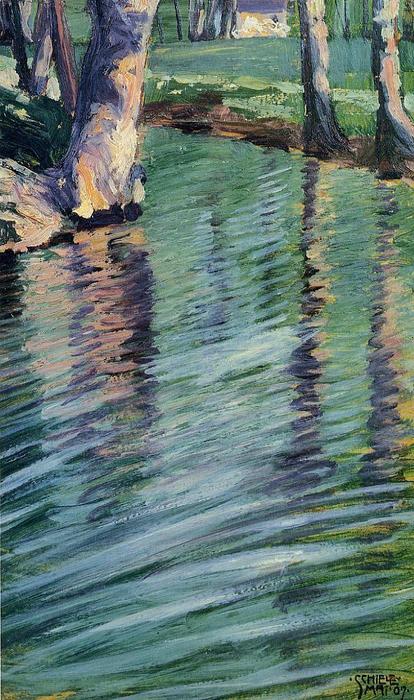
Trees Mirrored in Pond – A Reflection of Schiele’s Inner Landscape
Egon Schiele’s “Trees Mirrored in Pond,” painted in 1907, isn't merely a picturesque landscape; it’s a profound distillation of Expressionist sensibilities and a window into the artist’s tormented psyche. Created during a pivotal period of his artistic development—immediately following the devastating loss of his sister—the painting embodies Schiele’s preoccupation with mortality and vulnerability, themes that would permeate much of his oeuvre.
- Subject Matter: The composition centers around a tranquil pond reflecting several mature trees. These aren't idealized representations; they possess an unsettling stillness, hinting at the inevitability of decay and mirroring Schiele’s own anxieties about life’s fragility.
- Style & Technique: Painted in Impressionism style, “Trees Mirrored in Pond” utilizes loose brushstrokes and muted colors—primarily greens, browns, and blues—to convey a sense of atmosphere rather than precise detail. This technique aligns perfectly with Schiele's desire to capture emotional intensity through visual cues.
- Historical Context: Produced at the dawn of Schiele’s artistic career, the painting reflects the broader anxieties of the Viennese avant-garde in the early 20th century. Expressionism sought to express inner emotions and psychological states—a reaction against the prevailing optimism of Impressionism—and “Trees Mirrored in Pond” exemplifies this rebellious spirit.
The inclusion of two figures adds another layer of complexity. Positioned near the pond’s center and slightly off-kilter to the right, they represent humanity grappling with its relationship to nature and confronting existential questions. Their posture exudes a quiet contemplation—a deliberate contrast to the turbulent emotions simmering beneath Schiele's surface.
Schiele’s masterful use of line—characterized by angular contours and unsettling distortions—further underscores the painting’s emotional impact. These lines aren’t merely descriptive; they convey tension, unease, and a palpable sense of isolation. The reflection itself serves as a visual metaphor for introspection – mirroring not just the trees but also Schiele's own internal struggles.
"Trees Mirrored in Pond" transcends its formal beauty to become an emblem of Schiele’s artistic vision—a testament to his ability to transform personal grief into enduring art. Its quiet contemplation and unsettling distortions continue to resonate with viewers today, reminding us that even amidst serene landscapes, the human spirit wrestles with profound questions about existence.