A Portrait of Quiet Intensity: Unpacking Egon Schiele's "Untitled (284)"
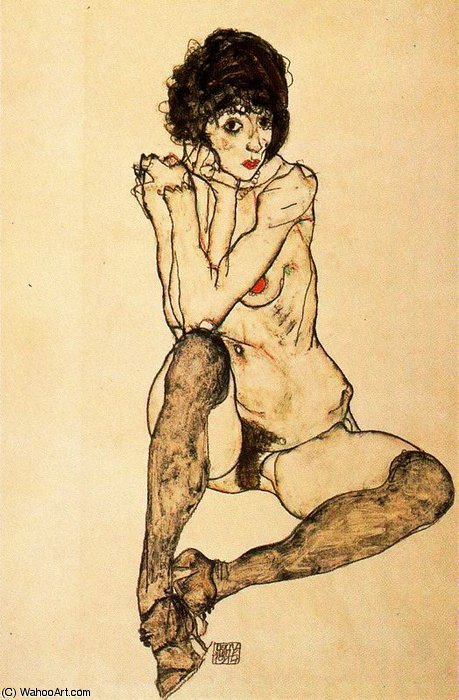
Egon Schiele’s “Untitled (284)” is not a painting that shouts for attention; rather, it whispers with an arresting intimacy. Captured in a moment of profound introspection, the image depicts a woman seated before us, her hands delicately pressed to her face, a subtle yet palpable sadness etched upon her features. The composition, deliberately devoid of extraneous detail beyond two indistinct figures glimpsed in the background – perhaps reminders of a life lived alongside hers – immediately draws the viewer into this intensely personal space. It’s a portrait not of outward beauty, but of an interior landscape grappling with something deeply felt.
The painting's power resides largely in Schiele’s masterful manipulation of line and form. His signature style—characterized by elongated figures, sharp angles, and a nervous energy—is evident here, lending the scene a sense of unease and vulnerability. The woman’s body is rendered with a raw honesty, her curves subtly suggested rather than explicitly defined. This deliberate ambiguity invites speculation about her story, allowing each viewer to project their own emotions and experiences onto the image.
The Shadow of Loss: Contextualizing Schiele's Expressionism
To fully appreciate “Untitled (284),” it’s crucial to understand the context in which it was created. Egon Schiele’s life, tragically cut short at just 28 years old during World War I, was marked by profound loss and personal hardship. His father's death from syphilis when he was only fourteen cast a long shadow over his childhood, instilling within him an early awareness of mortality and the fragility of human existence. The premature deaths of his sister Elvira and later, his beloved wife Edith, further fueled this preoccupation with grief and decay – themes that permeate much of his oeuvre.
Schiele’s work is firmly rooted in Expressionism, a movement characterized by its focus on subjective experience and emotional intensity. He rejected the idealized beauty favored by earlier artistic traditions, instead choosing to depict the darker aspects of human nature—fear, anxiety, loneliness, and death. “Untitled (284)” exemplifies this approach, offering a starkly honest portrayal of vulnerability rather than a romanticized ideal.
Symbolism and the Language of Gesture
The woman’s gesture – pressing her hands to her face – is laden with symbolic weight. It's an instinctive response to overwhelming emotion, a desire to shield oneself from pain or simply to shut out the world. The stockings she wears, a detail often overlooked, subtly hint at a sense of restraint and perhaps even a longing for something beyond her immediate circumstances. The overall composition feels almost claustrophobic, mirroring the internal struggle being portrayed.
Furthermore, Schiele’s use of line is particularly significant. The sharp, angular lines that define the woman's form contrast with the softer curves of her face, creating a dynamic tension that reflects the conflicting emotions at play. The background figures, rendered in a hazy, indistinct manner, serve to further isolate the subject and emphasize her internal world.
A Timeless Exploration of Human Emotion
“Untitled (284)” is more than just a portrait; it’s a meditation on the human condition. It's a poignant reminder of our shared capacity for grief, vulnerability, and introspection. Schiele’s ability to capture such profound emotion with such understated elegance ensures that this painting continues to resonate deeply with viewers today. ArtsDot offers meticulously crafted hand-painted reproductions of this iconic work, allowing you to experience its emotional power firsthand and bring a piece of Schiele's hauntingly beautiful vision into your own space.