A Portrait of Inner Turmoil: Unpacking Egon Schiele's "Untitled (4819)"
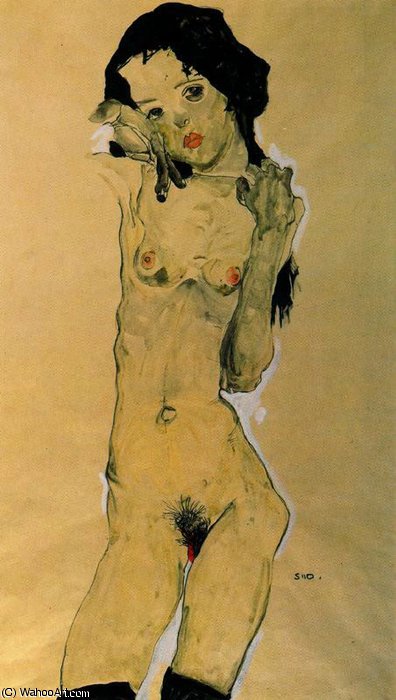
Egon Schiele’s “Untitled (4819),” a haunting depiction of a woman shielding her face with her hand, is more than just a portrait; it’s a visceral exploration of vulnerability, mortality, and the psychological landscape of early 20th-century Austria. Painted in 1917, during a period of immense personal and societal upheaval – Schiele's life was tragically cut short at the young age of 28 – this work embodies the artist’s signature style: raw emotion rendered with unsettling intensity and a profound understanding of human fragility. The painting immediately commands attention through its stark contrast—the pale, almost luminous skin of the figure against the aggressively yellow wall behind her. This deliberate juxtaposition creates an atmosphere of unease, suggesting both isolation and a desperate attempt to ward off an unseen threat.
Schiele’s technique is characterized by his distinctive use of line – thick, agitated strokes that seem to vibrate with energy. The figure's body is depicted in a simplified, almost skeletal manner, emphasizing the underlying structure beneath the surface. The loose application of paint and the lack of meticulous detail contribute to the painting’s sense of immediacy and emotional rawness. Notice how the lines around her face are particularly forceful, conveying a feeling of suppressed anguish. The pose itself—the hand pressed firmly against the cheek—is laden with symbolism. It speaks to a desire for concealment, a need to protect oneself from an overwhelming experience, perhaps even from the artist’s own self-awareness.
Expressionism and the Shadow of Loss
Schiele was a pivotal figure in the Expressionist movement, a style that sought to convey subjective emotions rather than objective reality. His work is deeply influenced by his personal tragedies – the early deaths of his father (due to syphilis) and sister Elvira – as well as the broader anxieties of a world on the brink of war. These experiences fueled an obsession with themes of mortality, illness, and psychological distress, all powerfully expressed through distorted forms and jarring color palettes. The painting’s somber mood reflects this preoccupation, echoing the pervasive sense of dread that permeated Europe at the time.
Consider the historical context: 1917 was a year marked by political instability, economic hardship, and the looming threat of World War I. Schiele's art served as a visual manifestation of these anxieties, capturing the emotional turmoil experienced by many individuals during this turbulent period. The yellow wall, often interpreted as representing illness or decay, further reinforces this sense of impending doom. It’s not merely a backdrop; it actively participates in the painting’s narrative, contributing to its overall atmosphere of unease.
Symbolism and the Unspoken Narrative
Beyond the immediate depiction of a woman shielding her face, “Untitled (4819)” is rich with symbolic meaning. The ponytail, a common motif in Schiele’s work, can be interpreted as representing both youthful vulnerability and a defiant rejection of societal norms. The nude form itself—a recurring theme in Schiele's oeuvre—is not presented in a purely sensual way but rather as an embodiment of raw emotion and exposed vulnerability. The act of covering the face suggests a desire to shut out the world, to retreat from painful experiences.
Furthermore, the painting’s ambiguity invites multiple interpretations. Is the woman protecting herself from a physical threat or from her own inner demons? Is she experiencing grief, fear, or perhaps even shame? Schiele deliberately leaves these questions unanswered, allowing viewers to project their own emotions and experiences onto the image. This open-endedness is characteristic of Expressionist art, which sought to engage the viewer in a dialogue rather than offering simple, definitive answers.
A Timeless Exploration of Human Emotion
“Untitled (4819)” remains a powerfully evocative work of art, demonstrating Schiele’s extraordinary ability to capture the complexities of human emotion. Its unsettling beauty and profound psychological depth continue to resonate with audiences today. Reproductions of this painting offer a unique opportunity to experience firsthand the intensity and vulnerability that define Schiele's artistic vision. Whether displayed in a private collection or a public space, “Untitled (4819)” serves as a poignant reminder of the fragility of life and the enduring power of art to explore the darkest corners of the human psyche.