Explore the emotionally charged Expressionist art of Egon Schiele (1890-1918): bold portraits, psychological themes & unique lines. Discover reproductions now!
Woman with Black Stockings: A Study in Vulnerability and Artistic Intensity
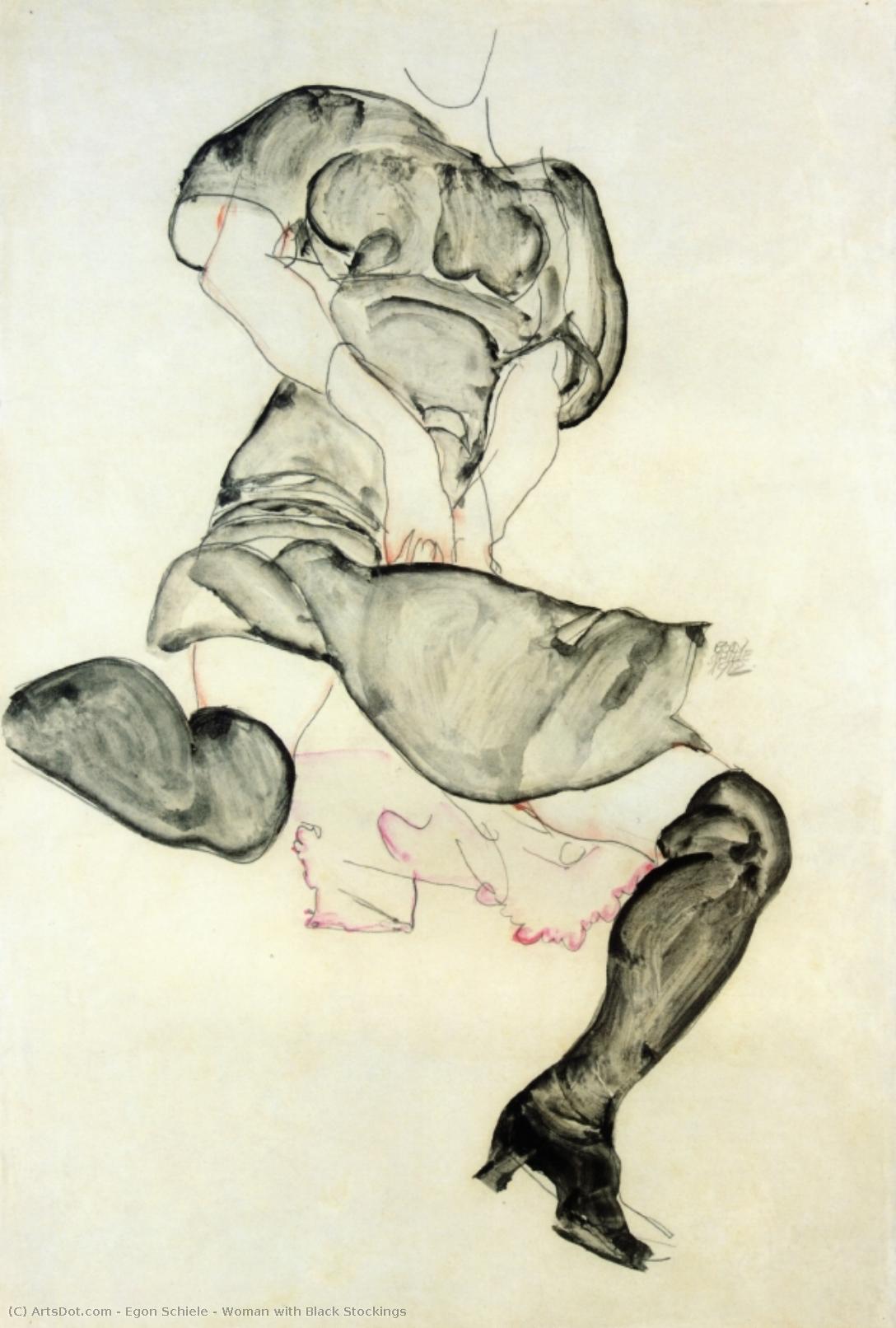
The photograph depicts Egon Schiele’s “Woman with Black Stockings,” a watercolor on paper created in 1912, capturing a moment of profound psychological exploration within the burgeoning Expressionist movement. The artwork immediately draws the eye with its stark contrast – predominantly black and white – which amplifies the emotional weight conveyed by Schiele's masterful brushstrokes. The central figure, positioned in a dynamic pose, embodies both physical vulnerability and artistic determination. Her leg extended upwards suggests movement, perhaps an attempt to escape or overcome something unseen, mirroring anxieties prevalent during the period.
Style and Technique: Expressionist Minimalism
Schiele’s approach aligns perfectly with the tenets of Expressionism, prioritizing emotional honesty over realistic representation. He eschews conventional shading techniques, favoring instead a deliberate simplification of form—a characteristic known as “minimalism.” This stylistic choice isn't merely aesthetic; it serves to heighten the viewer’s sensitivity to subtle nuances in color and texture (though limited here due to the monochrome palette). The watercolor medium itself lends an ethereal quality to the image, capturing the delicate interplay between light and shadow with remarkable precision. Notice how Schiele utilizes hatching—short parallel lines—to build up form and create a sense of depth without resorting to traditional perspective.
Historical Context: Vienna’s Artistic Crucible
Vienna in 1912 was a hotbed of artistic innovation, fueled by intellectual currents questioning societal norms and confronting existential concerns. Schiele's work reflects this atmosphere of unease and introspection—a direct response to the anxieties surrounding World War I looming on the horizon. Expressionist artists sought to depict inner turmoil and psychological states with uncompromising candor, rejecting bourgeois ideals in favor of raw emotion. The painting speaks to a broader preoccupation with themes of sexuality, mortality, and the human condition – concerns that would become central to Schiele’s oeuvre throughout his tragically short life.
Symbolism: Gesture and Repetition
The pose of the woman is laden with symbolic significance. The upward thrust of her leg can be interpreted as an assertion of defiance against oppression or a yearning for transcendence. Furthermore, Schiele employs repetitive hatching patterns—particularly around the torso—to emphasize the figure’s physicality and to create a visual rhythm that underscores the emotional intensity of the scene. These repetitions aren't merely decorative; they contribute to a feeling of claustrophobia and heighten the viewer’s awareness of the woman’s internal state. The black stockings themselves serve as a subtle visual motif, representing concealment and perhaps hinting at hidden desires or anxieties.
Emotional Impact: A Portrait of Inner Struggle
Ultimately, “Woman with Black Stockings” transcends mere depiction; it communicates profound psychological depth. Schiele's masterful use of watercolor captures the fragility of human emotion—the palpable tension between vulnerability and resilience. The painting compels viewers to confront uncomfortable truths about desire, fear, and the inescapable awareness of mortality. It remains a powerfully evocative testament to Schiele’s artistic vision and his ability to translate inner turmoil into enduring visual form. Its haunting beauty lies precisely in its refusal to offer easy answers or comforting illusions—a characteristic that cements its place as a cornerstone of Expressionist art.