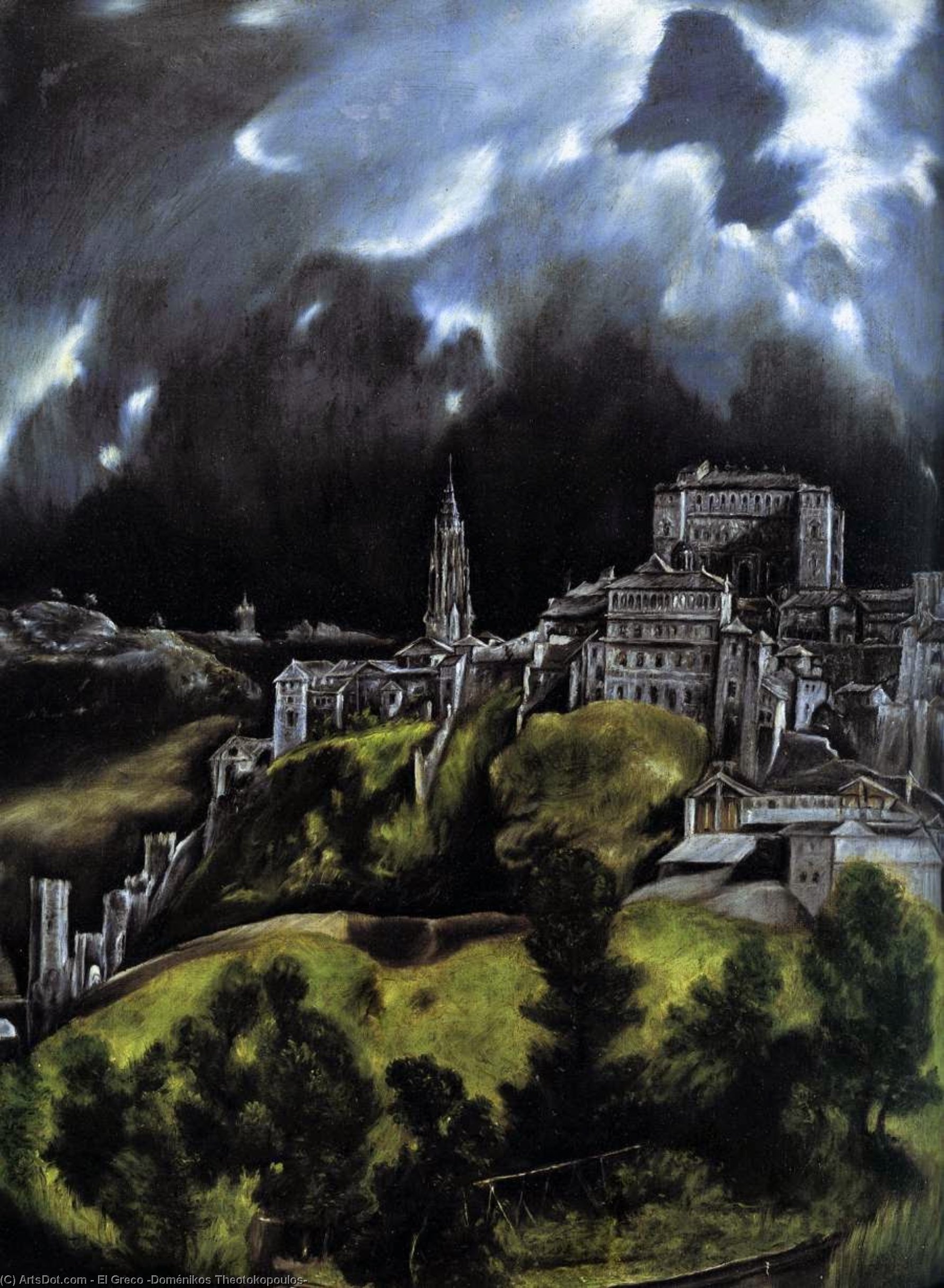
A Window into Toledo’s Soul: Examining El Greco's Dramatic Landscape
Doménikos Theotokópoulos, universally known as El Greco – “the Greek” – remains one of the most enigmatic figures in European art history. Born in Crete around 1541, his artistic journey was marked by a restless spirit and an unwavering devotion to faith, propelling him from Venice’s opulent ateliers to Rome's papal courts before ultimately establishing himself in Toledo, Spain—a city steeped in religious tradition that profoundly shaped his oeuvre. Unlike many artists of his time who adhered rigidly to established conventions, El Greco forged a path entirely his own, synthesizing influences from Byzantine iconography and Mannerist aesthetics into a style that anticipates the expressive fervor of Expressionism and the fractured perspectives of Cubism centuries ahead of their respective movements.
- Early Training & Byzantine Roots: El Greco’s formative years in Crete instilled within him a meticulous attention to detail and an understanding of sacred imagery deeply rooted in the traditions of Byzantium. This foundational knowledge would inform his later explorations, ensuring that every brushstroke carried the weight of spiritual contemplation.
- Venetian Influence & Artistic Experimentation: His relocation to Venice witnessed a crucial period of artistic experimentation as he absorbed the dynamism and color palettes characteristic of Venetian painting. However, El Greco refused to simply mimic these trends; instead, he wrestled with them, pushing boundaries and seeking new ways to convey emotion through form.
- Toledo & The Birth of Mannerism: Toledo became El Greco’s spiritual home and artistic crucible. Surrounded by the austere beauty of the cathedral and the fervent piety of its inhabitants, he honed his distinctive style—a hallmark of Mannerism—characterized by elongated figures, dramatic compositions, and an expressive manipulation of color and line.
The Painting’s Composition & Technique: A Symphony of Verticality
“A View of Toledo” (1597), arguably El Greco's magnum opus, exemplifies the artist’s masterful command of visual language. The canvas is dominated by a towering castle perched atop a hill—a symbol of power and resilience—against which a turbulent sky unfolds in shades of gray and white. This vertical orientation immediately establishes a sense of grandeur and emphasizes the immensity of the landscape. Diagonal lines created by the hillside draw the viewer’s eye upwards, mirroring the upward thrust of the castle spire and reinforcing the painting's dramatic impact. El Greco employed visible brushstrokes—a technique known as impasto—to imbue the canvas with texture, capturing the dynamism of the storm clouds and conveying a palpable feeling of movement. Careful blending in the sky creates an ethereal atmosphere, contrasting sharply with the textured foreground foliage.
- Atmospheric Perspective: El Greco skillfully utilized atmospheric perspective to depict depth, subtly lightening distant elements like the castle and diminishing their detail—a technique borrowed from Renaissance masters but executed with unparalleled sensitivity.
- Dynamic Line & Color Palette: The artist’s use of swirling lines—particularly in the sky—captures the energy of the storm, while his restrained color palette—primarily grayscale tones punctuated by hints of green and brown—contributes to the painting's solemn mood.
Symbolism & Emotional Resonance: Facing Divine Majesty
Beyond its formal brilliance, “A View of Toledo” resonates with profound symbolic meaning. The castle represents not merely architectural grandeur but also spiritual authority—a visual embodiment of faith confronting the overwhelming force of nature. The stormy sky evokes feelings of tension and apprehension, mirroring the anxieties inherent in contemplating God’s boundless power. Yet, amidst this darkness, there is a glimmer of light—perhaps symbolizing hope or divine grace—suggesting that even in moments of uncertainty, beauty and transcendence endure. El Greco's masterpiece invites contemplation on themes of faith, resilience, and the sublime—a testament to his enduring legacy as one of art history’s most visionary artists.
Exploring Toledo Through Reproduction
A high-quality reproduction of “A View of Toledo” allows you to bring El Greco's evocative vision into your home or workspace. ArtsDot offers meticulously crafted prints on premium canvas and archival paper, ensuring that the painting’s vibrant colors and textural nuances are faithfully preserved for generations to come. Discover the beauty and power of Mannerist art—and experience Toledo’s spiritual heart—through this iconic masterpiece.