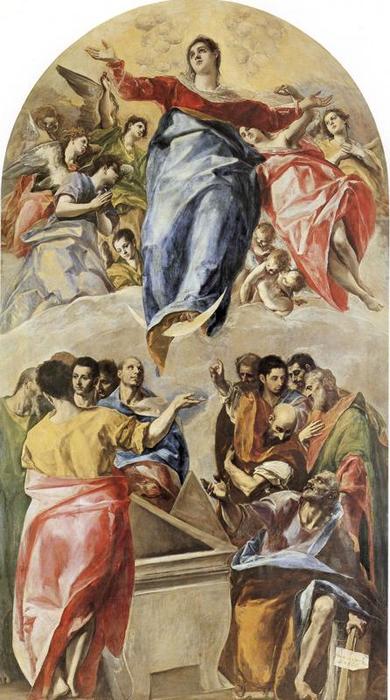
El Greco’s Assumption of the Virgin is a cornerstone of Mannerism, characterized by elongated figures and intense emotion. Painted in 1577 for Santo Domingo el Antiguo, it showcases God's grace through Mary’s celestial journey—a testament to his unique artistic vision and enduring influence.
Introduction to El Greco and his Artistic Style
El Greco (Doménikos Theotokopoulos) was a Greek painter, sculptor, and architect who lived during the Spanish Renaissance. He is best known for his dramatic and expressionistic style, characterized by elongated figures and vivid colors. El Greco's unique approach to art set him apart from his contemporaries and established him as a precursor of both Expressionism and Cubism.
The Assumption of the Virgin: A Masterpiece of Mannerism
The Assumption of the Virgin is one of El Greco's most famous works, painted in 1577 for the central panel of the High Altarpiece of the church of Santo Domingo el Antiguo in Toledo, Spain. This painting marks the beginning of El Greco's career in Spain and is the only work by him bearing a date of execution. The Assumption of the Virgin is an oil on canvas painting that measures 401 x 229 cm. It depicts the Virgin Mary ascending to heaven, surrounded by a crowd of apostles and angels. The composition is divided into two parts: the lower part shows the apostles gathered around the empty tomb of the Virgin, while the upper part shows her being received by God the Father and the Holy Spirit. El Greco's use of light in this painting is particularly noteworthy. He employs a technique called chiaroscuro, which involves the contrast between light and dark to create a sense of depth and volume. The use of light also serves to emphasize the spiritual nature of the scene, with the divine light illuminating the Virgin Mary and her surroundings.
Additional Details about the Painting
The Assumption of the Virgin is an excellent example of El Greco's Mannerist style, which is characterized by elongated figures, dramatic gestures, and vivid colors. The painting also reflects El Greco's deep religious faith, as well as his knowledge of theology and biblical symbolism. The painting was commissioned by the Brotherhood of Santo Domingo el Antiguo, a Catholic religious order based in Toledo, Spain. It was intended to be the central panel of the High Altarpiece of their church, which was being renovated at the time. The commission was secured thanks to El Greco's friendship from Rome with Luis, the son of Diego de Castilla, who was a member of the Brotherhood and one of the most influential figures in Toledo at the time. The Assumption of the Virgin is now housed in the Art Institute of Chicago, where it forms part of their permanent collection. The painting has been widely praised for its artistic merit and has been the subject of numerous scholarly studies and exhibitions.
Conclusion
The Assumption of the Virgin by El Greco is a masterpiece of Mannerism, characterized by elongated figures, vivid colors, and dramatic gestures. The painting reflects El Greco's deep religious faith and his knowledge of theology and biblical symbolism. It is an excellent example of El Greco's unique approach to art, which set him apart from his contemporaries and established him as a precursor of both Expressionism and Cubism. If you are interested in learning more about El Greco and his art, please visit our website
El Greco (Doménikos Theotokopoulos) or browse our collection of handmade oil paintings reproductions, including
The Assumption of the Virgin.
Note: All informations used in this article are from https://ArtsDot.com and Wikipedia.org.